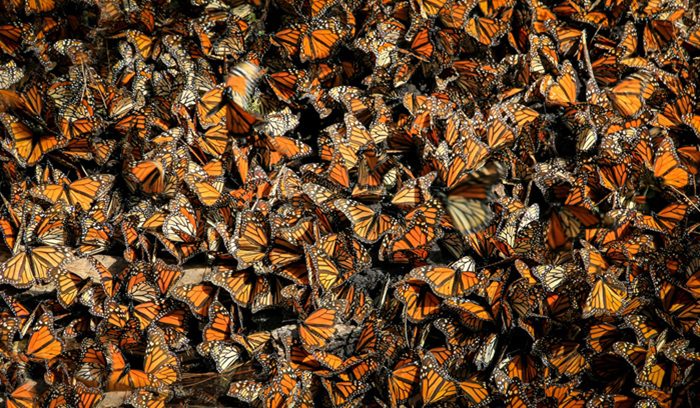
After years of alarming decline, the monarch butterfly population returned to its Mexican wintering grounds in dramatically larger numbers, with the area occupied by overwintering colonies jumping 176% in a single season — one of the most encouraging conservation reversals in recent memory.
At a glance
- Monarch butterfly population: The area occupied by overwintering monarchs in Mexico’s forests grew from roughly 0.22 hectares in the 2023–2024 C.E. season to approximately 4.01 hectares — a 176% increase over the prior year’s count.
- Overwintering sites: Monarchs cluster in the oyamel fir forests of the Monarch Butterfly Biosphere Reserve in Michoacán and Mexico State, a UNESCO World Heritage Site established specifically to protect their winter habitat.
- Counting method: Scientists measure colony area in hectares rather than individual butterflies because the insects cluster so densely that direct counts are impossible — a single hectare can contain millions of butterflies.
Why this rebound matters
The eastern monarch population had been in serious trouble for more than two decades. At its lowest modern recorded point in the 2013–2014 C.E. season, the population occupied just 0.67 hectares — a collapse from the 21 hectares documented in 1996 C.E. That long downward slide prompted the International Union for Conservation of Nature to list the migratory monarch as endangered in 2022 C.E.
A single strong season does not erase decades of loss. Scientists are careful to note that monarch populations fluctuate significantly from year to year based on weather, milkweed availability along the migration corridor, and conditions at the overwintering sites themselves. Still, a 176% jump in occupied area is not a statistical blip — it reflects millions more butterflies completing one of the most extraordinary migrations on Earth.
What drove the increase
No single factor explains the surge. Researchers point to a combination of favorable weather conditions in the northern breeding grounds, better milkweed availability across the U.S. and Canadian prairies, and reduced logging pressure in the Mexican reserve. Conservation groups on both sides of the border have spent years working to restore milkweed habitat along the migration corridor, and those efforts appear to be compounding.
The World Wildlife Fund’s Mexico program, which conducts the annual overwintering count alongside Mexico’s SEMARNAT and the Monarch Butterfly Biosphere Reserve, emphasized that the result reflects collaboration across three countries — the U.S., Canada, and Mexico — under a North American monarch conservation framework.
Indigenous and rural communities in Michoacán who live within and around the reserve have played a central role in protection efforts that mainstream conservation narratives often undercount. Community forest monitoring programs, locally enforced anti-logging patrols, and ecotourism models that give nearby residents a direct economic stake in keeping the forests intact have all contributed to the habitat stability that makes Mexican winters survivable for the butterflies.
The work that remains
Even with this rebound, the eastern monarch population remains far below historical levels. The 4.01 hectares recorded in 2024 C.E. is meaningful progress — but scientists estimate that a truly recovered population would occupy something closer to six hectares consistently, year after year. Climate change continues to threaten both the oyamel fir forests monarchs depend on in Mexico and the milkweed corridors they rely on during their months-long journey north.
Habitat restoration organizations like the Xerces Society note that milkweed has disappeared from roughly a third of its historic U.S. range due to herbicide use and land conversion — a problem that cannot be solved in a single season. Western monarch populations, which overwinter along the California coast rather than in Mexico, have also shown some recovery but remain far more precarious.
What the 2024 C.E. count does demonstrate is that monarch populations can respond when conditions improve — and that the conditions can be influenced by human action. The question is whether the policy protections, habitat investment, and cross-border cooperation that produced this season’s numbers can be sustained long enough to matter.
That is not guaranteed. But it is, for now, genuinely possible.
Read more
For more on this story, see: Good News for Humankind — Monarch butterfly population sees dramatic increase in Mexico wintering grounds
For more from Good News for Humankind, see:
- Ghana establishes major marine protected area at Cape Three Points
- Alzheimer’s risk cut in half by drug in landmark prevention trial
- The Good News for Humankind archive on wildlife conservation
About this article
- 🤖 This article is AI-generated, based on a framework created by Peter Schulte.
- 🌍 It aims to be inspirational but clear-eyed, accurate, and evidence-based, and grounded in care for the Earth, peace and belonging for all, and human evolution.
- 💬 Leave your notes and suggestions in the comments below — I will do my best to review and implement where appropriate.
- ✉️ One verified piece of good news, one insight from Antihero Project, every weekday morning. Subscribe free.