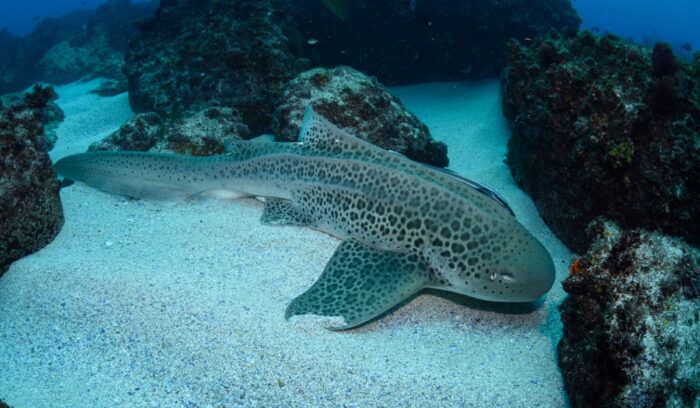
For the first time in history, an international coalition of aquariums is attempting to rewild an endangered shark species in the open ocean. The group, called ReShark, recently released the first captive-bred zebra shark eggs into the waters of Raja Ampat, Indonesia — a milestone that marine conservationists say could change how the world protects sharks and rays for generations to come.
At a glance
- Zebra shark rewilding: ReShark is a coalition of 44 aquariums across 15 countries working together to breed and release 500 zebra sharks into their native Indonesian waters — the first effort of this scale ever attempted for a shark species.
- Captive breeding program: Unlike most sharks, zebra sharks lay eggs rather than give birth to live young, making them far more practical to breed in aquarium settings and transport safely for ocean release.
- Raja Ampat release site: The first eggs were placed in waters roughly 90 miles from the nearest town, among limestone pinnacles and turquoise seas in one of the richest tropical marine ecosystems on Earth.
Why zebra sharks need help
Zebra sharks were once a common sight on the seafloor of Indonesia’s coastal reefs. Decades of overhunting pushed them to the edge of local extinction. Even in Raja Ampat — a region that has earned international recognition for its marine protections — the species has failed to recover on its own.
That gap between legal protection and actual population recovery is exactly what ReShark was designed to close. Marine protected areas can limit new harm, but they cannot replace animals that are already gone.
Ocean rewilding is notoriously harder than rewilding on land. There are no fences. Territories are impossible to enforce. Tracking individual animals across open water is expensive and often inconclusive. The ReShark team is working against those odds by starting small, monitoring closely, and scaling carefully.
A coalition that has never existed before
The 44 aquariums in the ReShark network span 15 countries, and each contributes to the breeding effort by housing adult zebra sharks, collecting eggs, and preparing juveniles for release. Coordinating that many institutions across that many borders — with different regulations, different species management practices, and different funding structures — is itself a significant achievement.
“Conservation groups, local communities, local government, and the large public aquaria together in a coalition that has never really happened before — the potential is really amazing,” said Dr. Mark Erdmann, Vice President of Asia Pacific Marine Programs for Conservation International.
Indonesian marine scientist Nesha Ichida, who helps manage the project for ReShark, described the first egg release as a turning point. “This is such a hopeful, momentous moment,” she told National Geographic.
Local communities and local government are formally part of the coalition — not just as bystanders, but as partners. That structure matters. Rewilding efforts that exclude local people tend to fail. Ones that bring them in as stakeholders tend to last.
What success could mean beyond Raja Ampat
The immediate goal is 500 zebra sharks returned to their native waters. But the team is already thinking past that number. If the model works — captive breeding, coordinated international release, local partnerships, long-term monitoring — it could be applied to other endangered shark and ray species around the world.
“We’re going to recover zebra sharks in Raja Ampat, but this is just the start,” Erdmann said. “The potential to do this with other endangered shark and ray species all around the world is immense.”
Sharks have existed on Earth for more than 400 million years. They regulate prey populations, maintain reef health, and anchor entire marine food webs. Losing them does not just mean losing a species — it means destabilizing ecosystems that billions of people depend on for food and livelihoods.
The IUCN Red List currently classifies the zebra shark as endangered, with populations declining across much of its historical range due to fishing pressure and habitat loss. ReShark’s approach — combining ocean conservation science with the practical resources of public aquariums — offers a new path forward that neither governments nor conservation groups could realistically pursue alone.
Limits and open questions
The program is still in its earliest phase, and releasing eggs is very different from confirming that adult sharks survive, reproduce, and integrate into existing reef ecosystems. Long-term survival rates and the ecological impact of the reintroduction remain to be seen — and will take years of monitoring to understand fully.
Read more
For more on this story, see: Good News Network
For more from Good News for Humankind, see:
- Renewables now make up nearly half of global power capacity
- Ghana establishes new marine protected area at Cape Three Points
- The Good News for Humankind archive on marine conservation
About this article
- 🤖 This article is AI-generated, based on a framework created by Peter Schulte.
- 🌍 It aims to be inspirational but clear-eyed, accurate, and evidence-based, and grounded in care for the Earth, peace and belonging for all, and human evolution.
- 💬 Leave your notes and suggestions in the comments below — I will do my best to review and implement where appropriate.
- ✉️ One verified piece of good news, one insight from Antihero Project, every weekday morning. Subscribe free.