
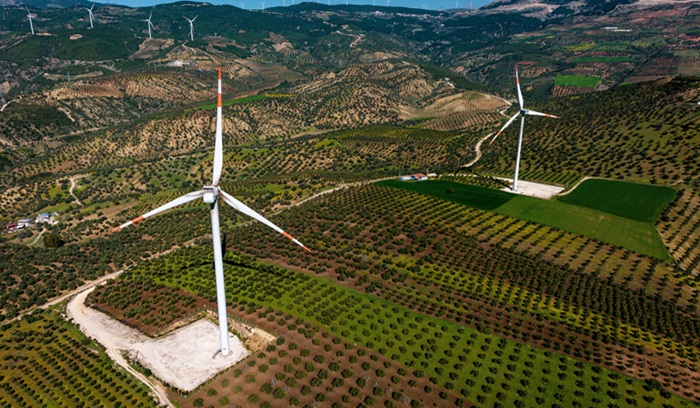
For one month in 2025 C.E., Brazil’s electricity grid did something it had never done before. Wind and solar combined to supply more than one-third of all power consumed across the country — roughly 34% of total electricity, or nearly 19 terawatt-hours, in August alone. The milestone arrived not as a gradual drift but as a measurable threshold crossed, confirmed by government data analyzed by the energy think tank Ember.
At a glance
- Brazil renewable energy: Wind and solar reached 34% of electricity supply in August 2025 C.E., up from 24% in all of 2024 C.E.
- Hydro resilience: Hydropower output dropped to its lowest level in four years that same month — yet Brazil avoided blackouts as wind and solar filled the gap.
- Emissions impact: Carbon emissions from Brazil’s power sector have fallen roughly 31% since 2014 C.E., even as electricity demand rose 22%.
How Brazil got here
The speed of this shift is striking. In 2019 C.E., solar accounted for just over 1% of Brazil’s electricity generation. By 2024 C.E., that figure had climbed to nearly 10%. Wind grew from about 9% to 15% over the same five-year span.
Brazil’s grid has long leaned heavily on hydropower, which still supplies more than half the country’s electricity. But hydro carries a growing vulnerability: drought. Climate change is making dry seasons more frequent and more severe, and August’s unusually low hydro output put the grid under real pressure. Fossil fuels covered just 14% of electricity that month. Wind and solar absorbed the difference.
That’s the practical meaning of the milestone — not just a percentage, but a demonstration that a diversified grid can hold under stress. The International Energy Agency has long argued that diverse energy mixes produce more resilient grids. Brazil, in a single month, ran that experiment at national scale and passed.
Jobs, investment, and a G20 signal
The economic story runs alongside the energy one. Solar and wind projects are generating thousands of jobs, particularly in rural regions where formal employment has historically been scarce. The International Renewable Energy Agency now ranks Brazil among the world’s top employers in renewable energy.
The World Bank has highlighted Brazil as a leading example of how clean energy expansion can support economic development while cutting emissions — framing the two not as a trade-off but as the same story told twice.
Politically, the milestone carries weight beyond Brazil’s borders. According to reporting from the Associated Press, Brazil is currently the only G20 nation on track to meet the renewable energy targets agreed at COP28. That’s a distinction that places a large, fast-growing economy in unusual company — and one that other governments are watching closely.
What the transition still requires
The shift isn’t frictionless. Managing grid stability as variable sources like wind and solar grow larger is a genuine engineering challenge that Brazil has not fully solved. Questions about fair pricing — whether lower-income communities benefit from cheaper clean power or bear disproportionate costs during the transition — remain active and unresolved debates.
What is resolved, or at least demonstrated, is that the pace of change is real. A country once almost entirely dependent on a single weather-sensitive power source now has a genuinely diversified grid, rebuilt over years rather than decades. For a world still searching for large-scale proof that clean energy transitions can actually happen in major economies, Brazil in August 2025 C.E. is now a reference point.
For more on how Brazil’s milestone fits into a larger global picture, see this look at how renewables now make up nearly half of global power capacity. Brazil’s grid also illustrates the value of biodiversity-linked resilience strategies — a theme that connects to clean energy policy debates worldwide. And the economic justice dimensions of Brazil’s transition echo challenges seen in places like Ghana’s marine protected area work, where communities most affected by environmental change are also negotiating the terms of its solutions.
Read more
For more on this story, see: AP News
For more from Good News for Humankind, see:
- Renewables now make up nearly half of global power capacity
- Ghana creates a new marine protected area at Cape Three Points
- The Good News for Humankind archive on clean energy
About this article
- 🤖 This article is AI-generated, based on a framework created by Peter Schulte.
- 🌍 It aims to be inspirational but clear-eyed, accurate, and evidence-based, and grounded in care for the Earth, peace and belonging for all, and human evolution.
- 💬 Leave your notes and suggestions in the comments below — I will do my best to review and implement where appropriate.
- ✉️ One verified piece of good news, one insight from Antihero Project, every weekday morning. Subscribe free.
More Good News
-

Germany finishes 60-year project turning coal mines into a 23-lake district
Germany’s Lusatian Lakeland is now complete — a chain of 23 human-made lakes covering 14,000 hectares where open-cast coal mines once scarred the land between Berlin and Dresden. The final piece, Lake Sedlitz, opened to swimmers and boaters this April, and in June, five of the lakes will be linked by navigable canals into a continuous 5,000-hectare waterway. Engineers spent decades channeling river water into the old craters, securing embankments, and flushing out acid — work that would have taken nature a century. The region now welcomes around 800,000 overnight stays a year, with former miners finding work in hospitality…
-

Brazilian researchers find vitamin D boosts breast cancer chemo by 79%
Vitamin D may give breast cancer chemotherapy a meaningful boost, according to a new Brazilian trial in which 43% of women taking a daily supplement saw their tumors disappear completely, compared to 24% on a placebo. Researchers at São Paulo State University gave 80 patients a modest 2,000 IU dose alongside their standard pre-surgery chemo — a level safe enough for everyday use and cheap enough for almost anyone. Most women in the study were vitamin D-deficient to begin with, a pattern common in cancer patients worldwide. If larger trials confirm the finding, it points to something rare and hopeful…
-
Chinese solar exports double in last month to hit record high
China’s solar exports hit a record 68.03 gigawatts in March 2026, nearly doubling February’s volume as countries raced to replace disrupted Middle Eastern oil and gas. Fifty nations logged all-time-high imports of Chinese solar equipment that month, with African countries jumping 176% from February alone. Behind those numbers are governments that had been moving cautiously on renewables and suddenly found solar to be the fastest, cheapest answer on the table. Battery and electric vehicle shipments climbed alongside the panels, hinting at a clean-energy package moving together. The takeaway is hopeful even amid hard circumstances: when fossil fuels falter, the world…
