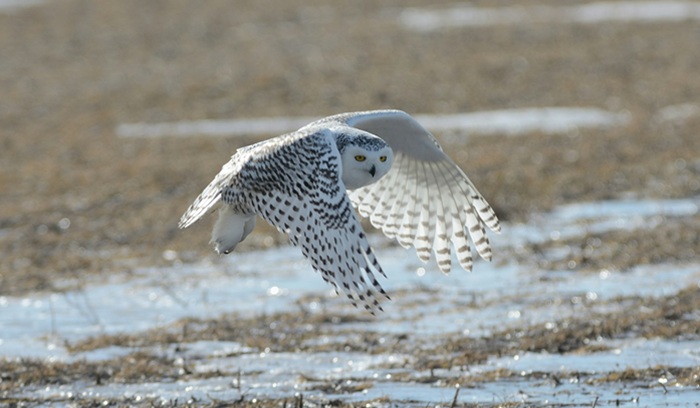
One hundred thirty-two nations gathered in Campo Grande, Brazil, on March 29, 2026 C.E., and voted to extend international legal protection to 40 new migratory species — among them the snowy owl, giant otter, striped hyena, and great hammerhead shark. The decision came at CMS COP15, the 15th conference of parties to the U.N. Convention on the Conservation of Migratory Species of Wild Animals, pushing the treaty’s total protected species count past 1,200. A new U.N. report released at the same summit found that 49% of populations already covered by the treaty are in decline, making the new migratory species protection listings both an achievement and an urgent warning.
At a glance
- Migratory species protection: CMS COP15 added 40 species to the treaty’s appendices, pushing the total count of protected species past 1,200 for the first time.
- Extinction risk: The State of the World’s Migratory Species: Interim Report (2026 C.E.) found that 24% of species on the treaty’s protection lists now face extinction.
- Policy timeline: Conservation priorities set at COP15 will shape international wildlife policy through at least 2029 C.E., when the next CMS conference is scheduled in Bonn, Germany.
What migratory species protection actually requires
The CMS treaty has been legally binding for 47 years, and that legal weight separates it from voluntary conservation pledges. When a species appears on one of its two appendices, member nations face real obligations — not aspirational goals.
Appendix I covers species in immediate danger of extinction across all or most of their range. Countries where these animals live must strictly prohibit killing, capturing, or disturbing them, with only narrow exceptions. They must also restore degraded habitats, remove barriers along migration routes, and coordinate cross-border threat reduction.
Appendix II applies to species that benefit from international coordination — requiring shared monitoring targets, joint action plans, and pooled research. The giant otter earned listings on both appendices, reflecting the depth of the crisis it faces across South American freshwater systems. That double listing is rare and signals exceptional concern.
Why these 40 species needed international help
Every one of the 40 newly added species shares a defining vulnerability: its survival depends on more than one country choosing to protect it.
The snowy owl breeds in Canada’s Arctic and then spreads across North America, Europe, and Asia each winter. No single government can secure its future alone. Zimbabwe’s cheetah population received specific new attention because only 150 to 170 individuals remain in the country. Several shark species joined the list as well, including the great hammerhead and three species of thresher shark, which face relentless pressure from commercial fishing bycatch and finning operations.
The flesh-footed shearwater, a seabird that crosses entire ocean basins, and the Patagonian narrownose smoothhound shark also received new coverage. Each species represents a population under accelerating pressure from habitat fragmentation, overexploitation, plastic pollution, and climate change. The summit also surfaced threats that no single government can address alone — deep-sea mining, underwater noise pollution, and the disruption of migration corridors by roads and dams.
Turning commitments into action on the ground
CMS Executive Secretary Amy Fraenkel put the challenge plainly at the close of the summit: half the species already on the treaty’s protection lists are still declining despite existing coverage. New listings expand the protected group, but the work of actually reducing threats happens on the ground, not in a conference hall.
The Cornell Lab of Ornithology, working alongside CMS, unveiled a new Americas Flyways Atlas at the conference — an online tool designed to help governments visualize and manage the migration routes crossing their borders. The more than 2,600 participants adopted 39 resolutions covering species conservation, habitat protection, and ecological connectivity.
The summit surfaced a notable absence. The United States did not send a representative to Campo Grande, and the Trump administration has separately explored removing protections for endangered species in the Gulf of Mexico. The 132 nations that did participate, along with the 27 E.U. member states, still represent the vast majority of the globe.
Brazil, which hosted COP15, now holds the CMS presidency for the next three years and has committed to driving implementation across South America and beyond. “While there are advances and important steps forward, many migratory species are approaching critical thresholds,” said Wildlife Conservation Society director Susan Liberman at the summit’s close.
The next CMS conference in Bonn in 2029 C.E. will mark 50 years since the treaty was signed. By then the world will have a clearer picture of whether the commitments made in Campo Grande translated into real change for the snowy owl, the hammerhead shark, and the 38 other species that now have a new layer of international protection. The IUCN Red List will be one of the key tools researchers use to track whether those commitments hold.
As the World Wildlife Fund’s wildlife corridor initiative has shown in other contexts, legal protection is only the first step — the harder work is building the political will and cross-border coordination to make it stick.
Read more
For more on this story, see: Woman’s World
For more from Good News for Humankind, see:
- Ghana designates a new marine protected area at Cape Three Points
- More good news from the Good News for Humankind archive
- The Good News for Humankind archive on wildlife conservation
About this article
- 🤖 This article is AI-generated, based on a framework created by Peter Schulte.
- 🌍 It aims to be inspirational but clear-eyed, accurate, and evidence-based, and grounded in care for the Earth, peace and belonging for all, and human evolution.
- 💬 Leave your notes and suggestions in the comments below — I will do my best to review and implement where appropriate.
- ✉️ One verified piece of good news, one insight from Antihero Project, every weekday morning. Subscribe free.
More Good News
-
Germany finishes 60-year project turning coal mines into a 23-lake district
Germany’s Lusatian Lakeland is now complete — a chain of 23 human-made lakes covering 14,000 hectares where open-cast coal mines once scarred the land between Berlin and Dresden. The final piece, Lake Sedlitz, opened to swimmers and boaters this April, and in June, five of the lakes will be linked by navigable canals into a continuous 5,000-hectare waterway. Engineers spent decades channeling river water into the old craters, securing embankments, and flushing out acid — work that would have taken nature a century. The region now welcomes around 800,000 overnight stays a year, with former miners finding work in hospitality…
-

Brazilian researchers find vitamin D boosts breast cancer chemo by 79%
Vitamin D may give breast cancer chemotherapy a meaningful boost, according to a new Brazilian trial in which 43% of women taking a daily supplement saw their tumors disappear completely, compared to 24% on a placebo. Researchers at São Paulo State University gave 80 patients a modest 2,000 IU dose alongside their standard pre-surgery chemo — a level safe enough for everyday use and cheap enough for almost anyone. Most women in the study were vitamin D-deficient to begin with, a pattern common in cancer patients worldwide. If larger trials confirm the finding, it points to something rare and hopeful…
-

Chinese solar exports double in last month to hit record high
China’s solar exports hit a record 68.03 gigawatts in March 2026, nearly doubling February’s volume as countries raced to replace disrupted Middle Eastern oil and gas. Fifty nations logged all-time-high imports of Chinese solar equipment that month, with African countries jumping 176% from February alone. Behind those numbers are governments that had been moving cautiously on renewables and suddenly found solar to be the fastest, cheapest answer on the table. Battery and electric vehicle shipments climbed alongside the panels, hinting at a clean-energy package moving together. The takeaway is hopeful even amid hard circumstances: when fossil fuels falter, the world…