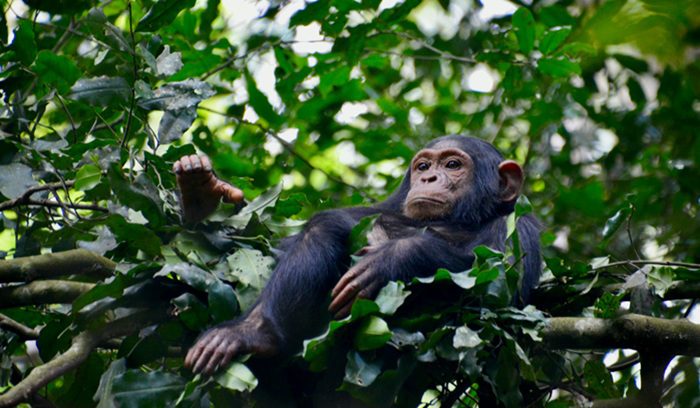
Walk from the community conservation area into Gola Rainforest National Park in Sierra Leone, and something shifts immediately. The morning chorus thickens. Birds layer in. And somewhere in the distance, chimpanzees drum on tree roots — fists and sticks against wood, a long-distance hello. A new study published in Conservation Science and Practice finds that this wall of sound is more than atmosphere. It is evidence that carbon financing is working.
At a glance
- REDD+ financing: Sierra Leone’s Gola Rainforest National Park has operated under the U.N. Reducing Emissions from Deforestation and forest Degradation program since 2012 C.E., and previous research found it cut deforestation by 30% compared to neighboring areas.
- Soundscape saturation: Researchers recorded audio at 133 sites across three land areas over 24 hours and found significantly richer, more varied sound in the REDD+-financed park than in a bordering community forest — a widely used proxy for biodiversity.
- DNA metabarcoding: Insect trap samples showed higher total arthropod diversity in the community forest, but beetle, ant, bee, and wasp diversity were equal across both areas — a nuanced result that complicates any simple conclusion.
Why sound tells us something real
The research team, led by conservation biologist H.S. Sathya Chandra Sagar of the University of Wisconsin-Madison, set up passive recording devices at 133 sites spread across three distinct land areas: Gola Rainforest National Park (REDD+-financed and formally protected), a community-owned agroforestry zone along its border (REDD+-financed but not formally protected), and a comparable protected area across the border in Liberia with no REDD+ funding at all.
Their framework draws on the acoustic niche hypothesis — the idea that in biodiverse environments, species evolve to occupy distinct sound frequencies so they can be heard by their own kind, the way instruments in an orchestra each hold a lane. More frequencies filled means more species present. Soundscape saturation was measurably higher in the national park than in the community forest, and the drop-off happened sharply at the border between the two. The researchers also checked that rainfall, slope, and elevation were roughly equal across the areas, ruling out non-REDD+ explanations for the difference.
“If you’re walking from the community conservation area, you’re listening to a soundscape of very complex early morning sounds,” Sagar says, “but then you just jump onto the other side and immediately the chorus is like a symphony.”
The bigger picture for carbon markets
Gola is one of the largest surviving fragments of the Upper Guinean Tropical Rainforest, which once stretched across roughly 700,000 square kilometers of West Africa. A century of logging and mining, followed by Sierra Leone’s devastating civil war in the 1990s, reduced that forest dramatically. Sierra Leone formally protected 700 square kilometers of what remained in 2010 C.E. and launched the Gola REDD+ project in 2012 C.E.
REDD+ works by issuing carbon credits to countries and communities that keep forests standing. Those credits can be sold as offsets to higher-emitting countries. The program has always been intended to protect biodiversity alongside carbon, but until now, nobody had tested whether it was actually doing that — whether the birds and mammals and insects of a REDD+-protected area genuinely seemed to benefit from the reduced deforestation the program brings.
Sagar’s study, published in Conservation Science and Practice in 2026 C.E., is among the first to make that link directly. “We see that if it’s done well, carbon financing initiatives do have the capability to protect both biodiversity, beyond just habitat, and carbon markets,” Sagar says.
What the insects complicated — and why that matters
The arthropod data introduced a wrinkle. Using DNA metabarcoding — a technique that can identify hundreds of species from a single sample by reading environmental DNA — the team found that total insect diversity was actually higher in the community forest than in the REDD+-protected park. Flies, moths, and butterflies were more abundant in the disturbed, patchwork habitat of the community land.
Sagar says this isn’t a contradiction. Many insects thrive on human-created disturbance and benefit from the mosaic of habitats that comes with agroforestry. Beetle, ant, bee, and wasp diversity were equal in both areas. The community forest isn’t failing — it has genuine ecological value of its own. What the results suggest is that formal protection and community-managed land can play complementary roles in a broader conservation strategy.
Toby Gardner, a senior research fellow at the Stockholm Environment Institute who was not involved in the study, called the research design “elegant” and its results “persuasive.” He was quick to note, though, that attributing biodiversity differences to a specific intervention is notoriously hard. “It’s very easy to find them,” Gardner says, “but to attribute them with some confidence to be due to the intervention is astonishingly difficult.”
Cheap monitoring that could change how carbon finance works
Perhaps the study’s most practical finding is this: passive acoustic recording is inexpensive, scalable, and tells you things that satellite imagery simply cannot. Most carbon finance programs track tree cover from space. They do not track whether the forest they are preserving is actually alive with the full range of species it should contain.
“If we value forests as living ecosystems, which we do, we want to know how well we are protecting them as living ecosystems, rather than just repositories of carbon,” Gardner says. “Unless we invest in understanding this, rather than just preventing people from clearing forests, we’re only doing part of the job.”
Sagar is already building on the work. He is developing machine-learning tools that will recognize gunshots and the calls of commonly hunted species — including the western red colobus monkey (Piliocolobus badius) — so that hunting pressure in Liberia can be better separated from REDD+ effects in future comparisons. The comparison with the Liberian protected area was murkier than expected, with some biodiversity metrics favoring one area and some the other, and hunting pressure is one likely factor the current study could not fully control for.
Still, what is already clear is that the chimpanzees drumming in Gola are not just good theater. They are data. And they are suggesting that protecting carbon and protecting life can, with the right conditions, be the same project.
Read more
For more on this story, see: Mongabay
For more from Good News for Humankind, see:
- Ghana creates a new marine protected area at Cape Three Points
- Alzheimer’s risk cut in half by drug in landmark prevention trial
- The Good News for Humankind archive on Sierra Leone
About this article
- 🤖 This article is AI-generated, based on a framework created by Peter Schulte.
- 🌍 It aims to be inspirational but clear-eyed, accurate, and evidence-based, and grounded in care for the Earth, peace and belonging for all, and human evolution.
- 💬 Leave your notes and suggestions in the comments below — I will do my best to review and implement where appropriate.
- ✉️ One verified piece of good news, one insight from Antihero Project, every weekday morning. Subscribe free.