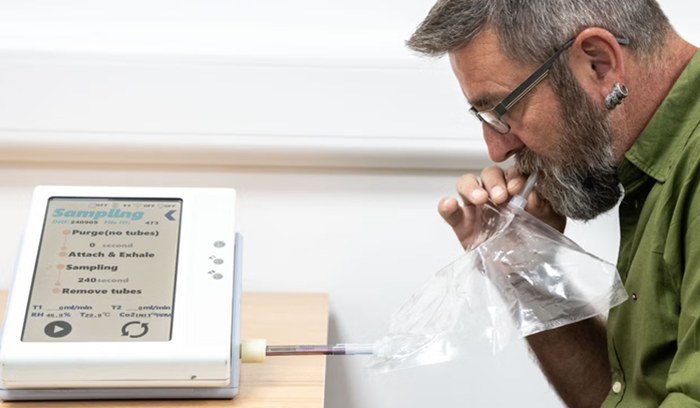
Pancreatic cancer is one of medicine’s most stubborn problems — not because treatment is impossible, but because the disease almost always wins the race against diagnosis. Now researchers at Imperial College London have developed a breath test that can detect the cancer in its earliest stages, and the National Health Service has launched one of the largest cancer diagnostic trials in recent U.K. history to prove it works at scale.
At a glance
- Pancreatic cancer breath test: Scientists at Imperial College London identified specific volatile organic compounds in exhaled breath that signal early-stage pancreatic cancer, with strong accuracy across more than 700 breath samples collected over two years of research.
- NHS trial scale: The validation study is now running at roughly 40 hospital sites across England, Wales, and Scotland, with a target of recruiting more than 6,000 patients who have an unconfirmed but suspected cancer diagnosis.
- Speed of results: Researchers expect results to reach a patient’s general practitioner within three days — far faster than CT scans or biopsies, and at a fraction of the cost.
Why pancreatic cancer is so hard to catch
The five-year survival rate for pancreatic cancer sits at roughly 13% in the United States. That figure has barely shifted in decades.
The reason is timing. More than 80% of cases are diagnosed only after the cancer has already spread beyond the pancreas — at which point curative surgery is rarely an option. The disease is not uniquely resistant to treatment. It is uniquely good at hiding until it has already gained an overwhelming head start. Catch it early, and surgery becomes possible. Miss it, and most interventions shift from curative to palliative.
That diagnostic gap is exactly what the Imperial College London team has spent years trying to close.
What the science actually does
Cancer cells metabolize differently from healthy cells. As they grow, they release chemical byproducts — volatile organic compounds, or VOCs — that enter the bloodstream and eventually appear in exhaled breath. The research team spent two years collecting and analyzing more than 700 breath samples, searching for the specific VOC signature that reliably indicates pancreatic cancer. They found a combination that performs with high accuracy.
The test uses a sensitive detection device roughly comparable in size and simplicity to a roadside breathalyzer. A patient breathes into the device. No needles, no imaging, no hospital-grade infrastructure required.
That portability matters enormously. The American Cancer Society has documented extensively how late-stage diagnosis drives poor survival outcomes in pancreatic cancer. The case for a fast, accessible early-detection tool has never been clearer — and a breath test can be deployed in a GP’s office, a community clinic, or any setting with space for a small device and a willing patient.
The NHS trial and what comes next
Promising research only becomes useful medicine after rigorous, large-scale validation. That is precisely what the NHS is now running.
The trial spans roughly 40 hospital sites across England, Wales, and Scotland, with a recruitment target of more than 6,000 patients. The goal is to confirm that the test performs accurately across diverse populations, age groups, and presentations of the disease — and to stress-test the real-world pipeline from breath sample to GP result in under three days.
For a cancer where even a few weeks of diagnostic delay can shift a patient from operable to inoperable, that speed is not a convenience. It is a clinical difference that could determine whether someone lives or dies. The Pancreatic Cancer Action Network has long argued that faster diagnostic pathways are among the highest-leverage interventions available, and this trial is the most serious attempt yet to build one.
A potential model beyond the U.K.
Because the breath test requires no complex infrastructure, it carries genuine potential for communities where CT scanners are scarce and specialist referrals take months. The World Health Organization has highlighted cancer diagnostic inequity as one of the defining challenges of global health — and a portable, low-cost test could meaningfully reduce the gap between who gets diagnosed in time and who does not.
That possibility is real, but it is not guaranteed. The technology still needs to clear regulatory review in each country where it might eventually be used. Healthcare systems need to fund it, integrate it, and prioritize it — and the communities most likely to benefit from low-cost diagnostics are also historically those least likely to receive early access to new tools. The NHS trial is a crucial next step, not a finish line.
Still, the direction is clear. Imperial College London has given medicine a credible, simple, fast new tool aimed at pancreatic cancer’s greatest and most persistent weakness. For the researchers, the patients, and the families who have watched this disease move faster than any intervention could follow, that is not a small thing. And if the NHS trial delivers the results researchers expect, it may soon become standard care across the U.K. — and eventually, far beyond it.
The broader shift toward biomarker-based early detection is reshaping what oncology can offer, and pancreatic cancer may be the most consequential place that shift has landed.
Read more
For more on this story, see: Wales Online
For more from Good News for Humankind, see:
- U.K. cancer death rates drop to their lowest level on record
- Ghana establishes a marine protected area at Cape Three Points
- The Good News for Humankind archive on global health
About this article
- 🤖 This article is AI-generated, based on a framework created by Peter Schulte.
- 🌍 It aims to be inspirational but clear-eyed, accurate, and evidence-based, and grounded in care for the Earth, peace and belonging for all, and human evolution.
- 💬 Leave your notes and suggestions in the comments below — I will do my best to review and implement where appropriate.
- ✉️ One verified piece of good news, one insight from Antihero Project, every weekday morning. Subscribe free.
More Good News
-

Poland to recognize same-sex marriages from E.U. states
Same-sex marriages performed elsewhere in the EU must now be formally recognized in Poland, the country’s Supreme Administrative Court ruled — a turning point for a nation that still offers no domestic legal recognition for same-sex unions. Rights groups estimate that 30,000 to 40,000 Polish citizens have married abroad, and many can now see those unions entered into Poland’s civil registry for the first time. The case began with a couple who wed in Germany in 2018 and were turned away by Warsaw officials; when the ruling was read, activists in the courtroom broke into applause. In a country where…
-

More than 50 nations attend world-first conference on phasing out fossil fuels
Fossil fuel phaseout talks just crossed a real threshold: for the first time, more than 50 nations sat down together specifically to plan a way off coal, oil, and gas. The two-day gathering in Santa Marta, Colombia, brought together an unusually wide mix — major producers like Australia, Norway, and Canada alongside Pacific island nations like Tuvalu and Vanuatu, with Europe and emerging economies in between. No binding deals were expected, but the recommendations will feed into a voluntary roadmap being shaped under Brazil’s COP30 leadership. It’s a small, hopeful shift: producers and consumers finally talking openly about a transition…
-

Singapore stops sourcing and breeding dolphins
Resorts World Sentosa, home to more than 20 Indo-Pacific bottlenose dolphins, is halting both wild sourcing and captive breeding at its Singapore oceanarium. The resort is now assembling an independent expert panel to figure out what’s next for the animals in its care, including a 7-year-old named Kenzo. It’s a meaningful shift from one of Asia’s most prominent entertainment venues, and one animal welfare groups have pushed toward for over a decade. With Mexico, Canada, and France already banning cetacean captivity for entertainment, this quiet decision in Singapore signals that the tide is turning across Asia too, reshaping what travelers…