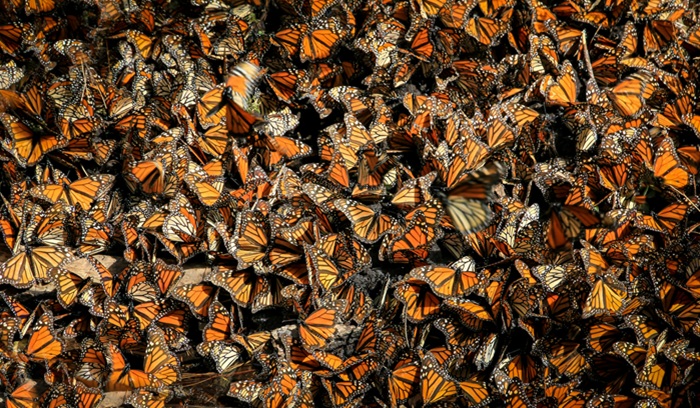
More than double the number of monarch butterflies now blanket the high-altitude forests of central Mexico compared to last year, marking one of the most dramatic single-year recoveries in the species’ recorded history. New survey data shows the monarch butterfly population occupied 2.49 hectares of forest this past winter, up from just 0.9 hectares the previous season. That 176 percent increase has given conservationists across North America a rare and genuine reason to celebrate.
- Fast Fact: The overwintering area grew from 0.9 hectares to 2.49 hectares — a 176 percent increase in a single season.
- Fast Fact: Favorable autumn weather helped more butterflies complete their roughly 3,000-mile migration south from the U.S. and Canada.
- Fast Fact: Local communities in the protected bioreserve have successfully reduced illegal logging, improving the quality of monarch habitat.
How scientists tracked the monarch butterfly population rebound
The annual survey was conducted by the National Alliance for the Conservation of the Monarch Butterfly, a coalition that includes the World Wildlife Fund and Mexico’s federal environment ministry. Researchers spend weeks counting trees fully covered by clustered insects across the mountain forests of Michoacán and Estado de México. Their counts serve as the most reliable annual measure of how the species is faring.
Scientists believe that unusually favorable temperatures across the U.S. and Canadian breeding grounds allowed more caterpillars to survive into adulthood this past summer. When migration season arrived, clear skies and cooperative winds helped a much higher share of the population complete the journey south. The combination of a strong breeding year and a safe passage delivered butterflies to Mexico in numbers not seen in years.
The condition of Mexico’s forests has also improved significantly. Government agencies have partnered with local residents to create jobs that do not depend on cutting trees, reducing illegal logging in the protected bioreserve. That intact canopy now shields resting butterflies from the freezing mountain nights that can prove fatal during the winter months. Detailed information on habitat standards in the region is available through the Commission for Environmental Cooperation.
Why the monarch butterfly population recovery matters for mountain communities
At a continental scale, this is a story about ecosystem health. At the village level, it is a story about economic survival. When butterflies return in large numbers, they draw thousands of tourists eager to witness the migration firsthand, and those visitors spend money at local cafes, hotels, and guided tour operations.
For guides and small business owners in communities like El Rosario, a strong butterfly season means a steady income that competes directly with the economic appeal of logging. That alignment of financial and conservation interests is one of the most durable forces protecting the forest. When local families profit from a living forest, they have every reason to defend it.
Monarchs also function as a living health indicator for the entire North American continent. Because they travel across three countries, their survival depends on healthy wildflower populations and clean water sources along the full length of their route. Their recovery suggests that the pollinator corridors being built by everyday gardeners and farmers are beginning to show results. The U.S. Fish and Wildlife Service offers guidance on how anyone can support monarchs in their own backyard.
Researchers urge caution as risks remain significant
Conservation scientists are encouraged by the data, but they are not declaring victory. The 2.49 hectares still falls well short of the six-hectare benchmark that researchers consider necessary for the species’ long-term survival. A single severe storm striking the wintering grounds at the wrong moment could destroy a large portion of the clustered population overnight.
Climate change continues to threaten the migration by disrupting the timing of blooming wildflowers and shifting temperature patterns that monarchs have relied on for thousands of years. Pesticide use across the agricultural heartland of the continent also suppresses milkweed — the only plant monarch caterpillars can eat — and remains a serious concern among biologists.
Organizations like Monarch Watch are asking people across the U.S. and Canada to plant milkweed and register their yards as official “waystations.” Each patch of habitat along the migration corridor reduces the distance a butterfly must travel without food or shelter. Researchers emphasize that sustained, multi-year commitment from ordinary people is as important as any government policy.
A blueprint for international cooperation on migratory species
The monarch’s recovery did not happen in one country alone. The U.S., Canada, and Mexico have each made commitments to coordinate conservation strategies, recognizing that a species crossing all three borders requires protection at every point along its path. This year’s results show that those agreements, when backed by action on the ground, can produce measurable results in a relatively short time.
Conservationists hope the monarch story can serve as a model for other migratory species currently in decline. If international partnerships, community economic incentives, and citizen science can combine to reverse the fortunes of one of the world’s most watched insects, the same approach could work elsewhere. As orange wings begin filling the Mexican forests each November, they offer a vivid illustration of what becomes possible when the conditions for recovery are put in place.
More stories of wildlife making a comeback
The monarch’s return is part of a larger, hopeful pattern of wildlife recovering when humans make deliberate choices to protect habitat and build sustainable local economies. In West Africa, Ghana established a new marine protected area at Cape Three Points, shielding coastal ecosystems and the communities that depend on them — a strategy that mirrors what Mexico’s mountain villages have done for monarchs. And in East Africa, Uganda reintroduced rhinos to Kidepo Valley, demonstrating that even severely depleted species can return when governments commit to long-term conservation goals.
You can read more stories like these in the Good News for Humankind archive, subscribe to the daily newsletter to get hopeful reporting delivered to your inbox, or explore the Antihero Project for deeper storytelling about the people driving change on the ground.
Sourcing
This story was generated by AI based on a template created by Peter Schulte. It was originally reported by The Guardian.
More Good News
-
Rhinos return to Uganda’s wild after 43 years in landmark conservation milestone
For the first time in 43 years, wild rhinos are roaming Uganda again. After poaching wiped out the population in the early 1980s, conservation authorities have successfully reintroduced rhinos into Kidepo Valley National Park — the result of decades of breeding, community engagement, and anti-poaching work. The milestone is one of Africa’s most significant wildlife recovery achievements in recent memory and offers a model for rewilding efforts across the continent.
-

UK cancer death rates fall to lowest level ever recorded in historic milestone
Cancer death rates in the United Kingdom have fallen to their lowest level ever recorded, Cancer Research UK announced in March 2026. Decades of investment in screening programs, early detection, and new treatments are behind the milestone. Despite the progress, researchers warn that geographic and socioeconomic inequalities in cancer outcomes remain significant, and that sustained funding and equitable access to care will be essential to drive further gains.
-
California condors nest on Yurok land in Pacific Northwest for first time in over a century
California condors are nesting in the Pacific Northwest for the first time in more than a century, confirmed on Yurok Tribe territory in Northern California. The Yurok, who regard condors as sacred relatives, launched their restoration program in 2003 and released the first birds in 2022. The nesting confirmation marks a milestone for both species recovery and Indigenous-led conservation, showing that when Native peoples lead ecological restoration on their own lands, the results can be extraordinary.