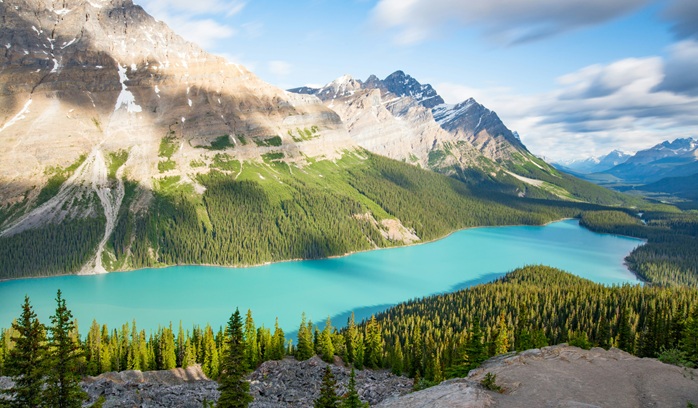
Canada has pledged $3.8 billion to protect nearly a third of its lands and waters by 2030 C.E. — one of the largest conservation investments in the country’s history. Prime Minister Mark Carney made the announcement as part of Canada’s commitment to the global 30×30 framework, which calls on nations to protect 30% of land and ocean areas within this decade. For a country that holds roughly 20% of the world’s freshwater and some of its most intact boreal forests, the stakes of this commitment extend well beyond Canada’s borders.
At a glance
- Canada 30×30 conservation: The $3.8 billion investment puts Canada on course to formally protect 30% of its lands and waters by 2030 C.E., up from roughly 13% of land and 8% of ocean currently protected.
- Indigenous partnership: Indigenous-led conservation is central to the plan, with significant funding directed toward Indigenous Guardians programs and Indigenous Protected and Conserved Areas, recognizing that Indigenous peoples steward some of Canada’s most biodiverse regions.
- Ocean protection: Marine protected areas are a major focus, covering critical habitat for species including beluga whales, Atlantic salmon, and Pacific herring — ecosystems under increasing pressure from warming waters and industrial activity.
Why 30×30 matters for the planet
Canada’s landmass is the second largest in the world, and its ecosystems — boreal forests, Arctic tundra, Pacific rainforests, Atlantic wetlands — regulate climate systems far beyond its own borders. Forests alone absorb carbon at a scale that makes their protection a global climate asset.
The 30×30 target emerged from the Kunming-Montréal Global Biodiversity Framework, adopted in 2022 C.E. by nearly 200 countries. Scientists broadly support 30% as a minimum threshold for halting biodiversity loss, though some researchers argue the more urgent need is for which 30% is protected, not just how much. Canada’s plan, with its emphasis on ecologically significant and currently intact areas, attempts to address that concern.
The funding will flow through multiple channels: expanding national parks, establishing new marine protected areas, supporting provincial and territorial conservation efforts, and critically, expanding the Indigenous Guardians network — a program that pays Indigenous land stewards to monitor, protect, and manage territories their communities have cared for over millennia.
Indigenous-led conservation at the center
Perhaps the most significant structural aspect of the announcement is what it signals about who leads conservation in Canada going forward. Indigenous Guardians programs, already operating in dozens of First Nations, Métis, and Inuit communities, have demonstrated measurably better outcomes for biodiversity than conventional park management in many areas.
Indigenous Protected and Conserved Areas — territories where Indigenous governments hold primary authority — are now a recognized and funded part of Canada’s conservation strategy. This marks a meaningful shift from the colonial model that historically displaced Indigenous communities from their own lands in the name of preservation.
Natural Resources Canada and Environment and Climate Change Canada are co-leading implementation, with oversight structures still being developed in consultation with Indigenous nations, provinces, and territories. Advocates note that the quality of that consultation process will determine whether the funding produces durable protection or paper parks.
A commitment that still has to prove itself
Conservation pledges of this scale have a complicated history. Canada has previously missed biodiversity targets — the country fell short of its 2020 C.E. Aichi targets under the Convention on Biological Diversity, protecting far less than it had promised. Advocates and scientists will be watching closely to see whether enforcement mechanisms, ecological monitoring, and community engagement match the scale of the financial commitment.
There are also questions about what “protection” means in practice. Some designations allow resource extraction, logging, or industrial activity to continue within protected boundaries — a standard that critics argue undermines the conservation purpose. The strength of the legal frameworks governing newly protected areas will matter as much as the dollar figure.
Still, the investment represents a meaningful acceleration. Canada’s boreal forest alone stores more carbon than the Amazon. Protecting the ecosystems that make that possible — and doing so in genuine partnership with the Indigenous peoples who know them best — is one of the highest-leverage climate and biodiversity actions available to any government on Earth. The announcement from Prime Minister Carney suggests a political will, at least at this moment, to match that scale of action.
For a world watching nature loss accelerate alongside climate change, international conservation bodies have pointed to national commitments like this one as essential signals — not sufficient on their own, but necessary preconditions for a livable planet. Canada’s 30×30 conservation pledge, backed by real money, is a rare piece of good news in a space that urgently needs more of them.
Read more
For more on this story, see: CBC News
For more from Good News for Humankind, see:
- Ghana establishes a new marine protected area at Cape Three Points
- Alzheimer’s risk cut in half by drug in landmark prevention trial
- The Good News for Humankind archive on marine conservation
About this article
- 🤖 This article is AI-generated, based on a framework created by Peter Schulte.
- 🌍 It aims to be inspirational but clear-eyed, accurate, and evidence-based, and grounded in care for the Earth, peace and belonging for all, and human evolution.
- 💬 Leave your notes and suggestions in the comments below — I will do my best to review and implement where appropriate.
- ✉️ One verified piece of good news, one insight from Antihero Project, every weekday morning. Subscribe free.
More Good News
-
Germany finishes 60-year project turning coal mines into a 23-lake district
Germany’s Lusatian Lakeland is now complete — a chain of 23 human-made lakes covering 14,000 hectares where open-cast coal mines once scarred the land between Berlin and Dresden. The final piece, Lake Sedlitz, opened to swimmers and boaters this April, and in June, five of the lakes will be linked by navigable canals into a continuous 5,000-hectare waterway. Engineers spent decades channeling river water into the old craters, securing embankments, and flushing out acid — work that would have taken nature a century. The region now welcomes around 800,000 overnight stays a year, with former miners finding work in hospitality…
-

Brazilian researchers find vitamin D boosts breast cancer chemo by 79%
Vitamin D may give breast cancer chemotherapy a meaningful boost, according to a new Brazilian trial in which 43% of women taking a daily supplement saw their tumors disappear completely, compared to 24% on a placebo. Researchers at São Paulo State University gave 80 patients a modest 2,000 IU dose alongside their standard pre-surgery chemo — a level safe enough for everyday use and cheap enough for almost anyone. Most women in the study were vitamin D-deficient to begin with, a pattern common in cancer patients worldwide. If larger trials confirm the finding, it points to something rare and hopeful…
-

Chinese solar exports double in last month to hit record high
China’s solar exports hit a record 68.03 gigawatts in March 2026, nearly doubling February’s volume as countries raced to replace disrupted Middle Eastern oil and gas. Fifty nations logged all-time-high imports of Chinese solar equipment that month, with African countries jumping 176% from February alone. Behind those numbers are governments that had been moving cautiously on renewables and suddenly found solar to be the fastest, cheapest answer on the table. Battery and electric vehicle shipments climbed alongside the panels, hinting at a clean-energy package moving together. The takeaway is hopeful even amid hard circumstances: when fossil fuels falter, the world…