Post-modernity (1945 - 2016 C.E.)

Post-modernity spans 1945 to 2016 C.E., an era defined by rapid technological acceleration, decolonization, the rise of the internet, and expanding civil rights. This archive collects milestones in science, medicine, governance, and culture from those seven decades of sweeping human progress.

ian simmonds zs cL DwE unsplash, for article on student loan death discharge

New Jersey ends debt collection from families of deceased students

New Jersey stopped collecting on dead students’ loans in 2016, ending a practice that had sent bills to grieving parents and estates for years. After ProPublica and the New York Times documented families hounded during mourning, the state agreed to discharge balances upon a borrower’s death, finally matching the standard federal student loans had long followed.

Toronto skyline at dusk, backdrop for discussions on Ontario's basic income pilot program, for article on reconciliation action plan

Ontario plans basic income pilot to lift residents out of poverty

Basic income came to Ontario in 2016, when the province launched one of North America’s most ambitious poverty experiments. About 4,000 low-income residents in Hamilton, Thunder Bay, and Lindsay received monthly payments, and early results pointed to better mental health and food security. Cut short in 2018, the pilot still reshaped how the world debates a guaranteed income floor.

Child with pen and paper, for article on kindergarten readiness gap

Learning gap between rich and poor kids in the U.S. narrows

The kindergarten readiness gap narrowed between 1998 and 2010, surprising the Stanford and UVA researchers who expected the opposite. Their 2016 studies found low-income children arrived at school 10 to 16 percent closer to their wealthier peers, with parents across income levels reading more and engaging earlier in their kids’ learning.

Canadian flag representing the country's high-speed internet basic service national standards

Canada declares high-speed internet a basic service for all citizens

High-speed internet became a basic right in Canada in December 2016, when regulators declared broadband as essential as phone or postal service. The ruling set a national target of 50 Mbps download speeds for every household and created a $750 million fund to reach rural, remote, and Indigenous communities long left behind by private providers.

Hillary Clinton at the Democratic presidential nomination ceremony, smiling and waving to supporters

Hillary Clinton becomes first woman nominated for US presidency by a major party

Hillary Clinton’s nomination came on July 26th, 2016, when Democratic delegates in Philadelphia made her the first woman ever nominated for president by a major American party. Speaker after speaker traced a longer lineage, from Geraldine Ferraro in 1984 to Barbara Mikulski in the Senate. A barrier that had long defined American politics by its absence finally moved.

Bears Ears National Monument Utah landscape with red rock formations and desert terrain

Obama designates Bears Ears and Gold Butte as national monuments

Bears Ears and Gold Butte became national monuments in December 2016, when President Obama used the 1906 Antiquities Act to protect 1.65 million acres across Utah and Nevada. Bears Ears broke new ground with a tribal advisory commission, giving five Native nations a formal voice in managing ancestral land long sought for federal protection.

Cyclists riding through Copenhagen's cycling infrastructure network with dedicated bike lanes along a city street

Copenhagen’s city centre now counts more bikes than cars

Bicycles outnumbered cars in Copenhagen’s historic centre for the first time in 2016, with about 265,700 bikes entering daily compared to 252,600 cars. The shift followed a billion-krone investment in dedicated lanes and 17 new bicycle bridges built between 2006 and 2019. A reminder that cycling cultures are engineered, not inherited.

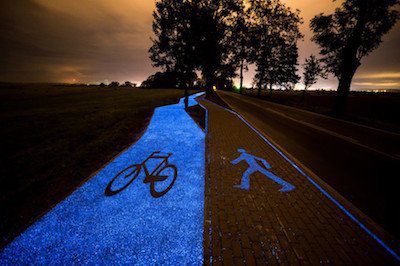
Glowing engine powering a glow-in-the-dark bicycle path at night

Poland’s glow-in-the-dark bicycle path runs entirely on solar power

A glow-in-the-dark bicycle path opened in the rural Polish town of Lidzbark Warminski, emitting deep blue light for up to 10 hours a night without touching the electrical grid. Luminophore particles embedded in the 328-foot surface soak up sunlight by day and release it after dark. A small, quiet experiment in making rural roads safer — and unexpectedly beautiful.

Guatemala flag, for article on river blindness elimination

Guatemala becomes the fourth country to eliminate river blindness

In September 2016, Guatemala was declared free of river blindness, ending a parasitic disease that had threatened sight and livelihoods in rural communities along fast-flowing rivers. The victory came after more than 20 years of twice-yearly Mectizan treatments reaching at least 85% of eligible people. It’s a reminder that patient, community-rooted public health work can undo old harms.

Sheriff Arpaio, central figure in racial profiling accountability debates and lawsuits

Arizona sheriff charged with criminal contempt in racial profiling case

Maricopa County, Arizona, 2016: federal prosecutors announced criminal contempt charges against Sheriff Joe Arpaio for defying a judge’s order to halt immigration patrols that had been ruled racially discriminatory against Latino drivers. By then, taxpayers had already spent $48 million on the case. For a community that had documented the harm for years, it was a rare moment of formal accountability.