Civil society

Civil society encompasses the nonprofits, advocacy groups, community organizations, and grassroots movements that operate outside government and business to advance the public good. This archive collects stories of civil society actors driving measurable progress on issues ranging from human rights and environmental protection to public health and civic participation.

Milky Way arching over dark desert sagebrush landscape for an article about Oregon Outback dark sky sanctuary, for article on dark sky sanctuary

Oregon outback becomes world’s largest dark sky sanctuary at 2.5 million acres

The Oregon Outback International Dark Sky Sanctuary has become the largest dark sky sanctuary on Earth, covering 2.5 million acres of southeastern Oregon’s Lake County after receiving official certification from DarkSky International. The designation protects skies already considered among the darkest in the world, with nearly 1.7 million acres managed by the Bureau of Land Management under commitments for ongoing monitoring and lighting improvements. Beyond stargazing, the protection matters for wildlife along the Pacific Flyway and species like bighorn sheep and sage grouse that depend on undisturbed terrain. Organizers hope the sanctuary could eventually expand to over 11 million acres.

Young trees, for article on African reforestation

The TREES program has planted tens of millions of trees across Africa since 2015

Reforestation done right looks less like a planting day and more like a four-year partnership with farmers — and the TREES program has quietly restored more than 41,000 hectares across nine African countries, an area roughly seven times the size of Manhattan. Instead of dropping seeds on remote land, TREES helps smallholder families build “forest gardens” of about 5,800 trees per hectare, weaving in fruit orchards, food crops, and windbreaks that feed households and generate a market surplus. In Kenya’s Kesouma region alone, 17,000 farmers have joined in. Earlier this year, the UN named it a World Restoration Flagship — a reminder that the most durable climate work tends to be the kind that pays the people doing it.

Dominican Republic forested landscape, for article on Plan Yaque land restoration

The Dominican Republic reforests a fifth of the country in 10 years

The Dominican Republic restored 18% of its territory in a single decade — not through sweeping mandates, but through conversations with farmers, one at a time. Plan Yaque, a coalition of 30 NGOs and government agencies, launched in 2009 with a simple premise: help landowners see trees as a path to water security and steadier farm income. Project leaders traveled farm by farm, and as restored hillsides began holding water and reviving streams, neighbors became the project’s most persuasive advocates. The result is one of the largest land recoveries in the Western Hemisphere this century — and a reminder that some of the most durable environmental wins come from trust, not enforcement.

Mangrove forest, for article on Pakistan mangrove restoration

Pakistan has expanded mangroves nearly threefold between 1986 and 2020

Pakistan’s mangrove forests have nearly tripled since 1986, growing from about 48,000 hectares to 144,000 hectares — a striking reversal of the global pattern of mangrove loss. Most of that expansion sits in the Indus Delta, where roughly 100,000 people depend on healthy mangroves for fishing livelihoods. The recovery has been driven by an unusual mix: provincial forest departments, international scientific partnerships, carbon credit financing, and fishing villages whose residents work as nursery hands and patrol against illegal cutting. In one coastal town, a single nursery holds 50,000 saplings ready for planting. As coastlines worldwide face rising seas and intensifying storms, Pakistan’s quietly persistent restoration offers a real-world template for what sustained, community-rooted conservation can achieve.

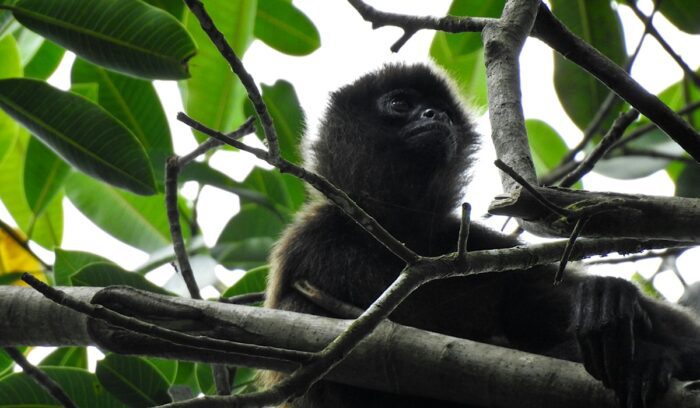
Squirrel monkey, for article on Indigenous-led land management

New fund supports Indigenous-led land management in biodiverse area of Bolivia

Indigenous communities in Bolivia’s Madidi Landscape just launched a dedicated conservation fund, opening with $650,000 from the Bezos Earth Fund to back work they’ve been doing for generations. Four nations — the Tacana, Lecos, T’simane Mosetene, and San José de Uchupiamonas — will direct the money themselves through an Indigenous-led board, finally putting resources behind territorial plans they first drafted twenty years ago. Madidi National Park is the most biodiverse protected area on land anywhere, home to more than 9,000 recorded species, from Andean condors to maned wolves. Globally, only a sliver of conservation funding reaches Indigenous hands directly, even though these communities steward most of the world’s remaining biodiversity. Funds like this one offer a hopeful blueprint for changing that.

Golden mahseer fish swimming, for article on putitor mahseer recovery

Indigenous effort in Bangladesh helps reverse endangered fish’s slide to extinction

Endangered putitor mahseer are swimming again in the springs of Bangladesh’s Chittagong Hill Tracts, where scientists had nearly written the species off. The turnaround started when Indigenous communities revived their traditional Village Common Forests, protecting headwaters and banning fishing in restored springs — with a fine of 5,000 taka per fish to back it up. Within three years of forest protection, villagers like Lika Chakma watched long-silent springs run year-round again, and the fish followed. As global freshwater biodiversity declines faster than life on land or in the sea, this small comeback in eastern Bangladesh offers a hopeful blueprint: when Indigenous stewardship is trusted and resourced, ecosystems can heal themselves.

Silhouette of an elephant, for article on African elephant populations

Elephant populations stabilize in southern Africa

African elephant populations across the southern range have stabilized for the first time in a century, with surveys of more than 290,000 savannah elephants showing a small but steady annual growth rate from 1995 to 2020. The most comprehensive study of its kind, drawing on 713 surveys across 103 protected areas, credits decades of anti-poaching work, community-based conservation, and expanded protected lands. Researchers also found that connected reserves, where elephants can move between habitats, produce healthier outcomes than isolated “fortress” parks. The takeaway feels quietly powerful: after generations of devastating loss, patient work by rangers, scientists, and local communities has interrupted the collapse — a reminder that stitching fragmented landscapes back together may be one of conservation’s most important tasks worldwide.

Wild Saiga antelopes in steppe near watering pond

Saiga no longer endangered with 1.9 million roaming Central Asian Steppe

The IUCN Red List status of this timeless talisman of the Central Asian steppes has been changed from Critically Endangered to Near Threatened. The dramatic downlisting reflects a remarkable rebound in saiga numbers, particularly its Kazakhstan stronghold, where populations have bounced back from a perilously low 48,000 individuals in 2005 to a new high of over 1.9 million.

Sahara scimitar Oryx, for article on scimitar horned oryx

North Africa’s scimitar horned oryx becomes first species ever to be downlisted from extinct in the wild to endangered

The scimitar horned oryx just made conservation history as the first species ever downlisted from Extinct in the Wild to Endangered by the IUCN. This pale, curve-horned antelope vanished from the Sahara before the millennium, hunted to zero in the wild. Now a self-sustaining herd roams Chad’s Ouadi Rimé–Ouadi Achim Reserve, a protected area roughly the size of Scotland, rebuilt from zoo populations through nearly four decades of patient international collaboration. Even better, the oryx grazes grasslands open and helps slow the Sahara’s spread, making its return a quiet act of climate repair. For the 94 other species still surviving only in human care, it’s proof that “extinct” need not be the final word.