
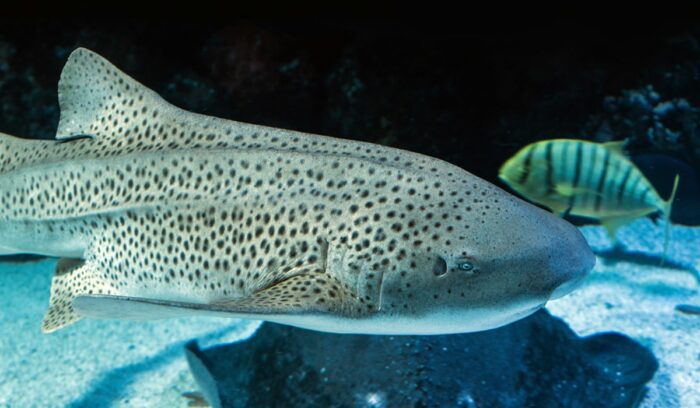
In the waters of Raja Ampat, a remote archipelago in eastern Indonesia, one of the ocean’s most graceful predators has nearly vanished. The zebra shark — once abundant across these coral-rich seas — now numbers as few as 20 individuals in a region spanning 6 million hectares. But a global coalition of aquariums, scientists, and conservation groups is attempting something that has never been done before: rewilding sharks by shipping fertilized eggs across the Pacific Ocean and hatching them in an Indonesian nursery.
At a glance
- Zebra shark rewilding: The StAR Project — Stegostoma tigrinum Augmentation and Recovery — is the first program in the world to translocate sharks from aquariums to a wild hatchery for eventual release into their native habitat.
- ReShark coalition: The project operates under ReShark, a global alliance of more than 90 conservation organizations, aquariums, and government agencies working to recover threatened sharks and rays worldwide.
- Rewilding target: Conservationists aim to release 500 zebra sharks into Raja Ampat’s protected waters within 10 years of the project’s 2022 C.E. launch — enough to rebuild a genetically diverse breeding population.
Why zebra sharks matter
The zebra shark (Stegostoma tigrinum) is a striking species of carpet shark native to the tropical Indo-Pacific, found from the Marshall Islands to the Red Sea. Juveniles display bold yellow stripes — thought to mimic the banded sea snake as a defense — which fade into small black spots as the animal matures. Their tails can grow nearly as long as the rest of their bodies, making them unmistakable swimmers along coral reefs.
They are also ecologically vital. As nocturnal predators of mollusks, crustaceans, and small fish, zebra sharks help regulate prey populations across reef ecosystems. Raja Ampat sits at the heart of the Coral Triangle — home to roughly 75% of all known coral species on Earth — making the loss of a key predator here a loss felt across one of the planet’s most biodiverse marine environments.
Overfishing drove much of the collapse. Through the 1990s and early 2000s, zebra sharks were heavily targeted for their meat, fins (used in shark fin soup), and liver oil. Their populations fell by up to 70% in a single decade. Conservation International researchers conducted more than 15,000 hours of in-water surveys in Raja Ampat between 2001 and 2021 C.E. — and found just three individuals. The IUCN Red List classifies the species as Endangered, and the organization estimates at least 200 individuals are needed just to prevent extinction.
Eggs on a trans-Pacific journey
The solution, first proposed by Conservation International’s Asia-Pacific team, is as bold as it is precise. Adult zebra sharks from the Eastern Indonesian-Oceania subpopulation — identified through genetic testing — have been located at accredited aquariums around the world and enrolled as breeding stock. Their fertilized egg cases, hardy enough to survive long-haul shipping, are then sent to Raja Ampat.
Participating facilities include the Shark Reef Aquarium in Las Vegas, SEA LIFE Sydney Aquarium in Australia, Cairns Marine in Australia, and the Georgia Aquarium in Atlanta. Once a female lays her large, leathery brown eggs — about 17 centimeters long — staff monitor them until an embryo is visible. At roughly week ten of development, the eggs are packed into coolers and flown across the Pacific. Week fifteen is the deadline: beyond that point, the eggs cannot safely make the journey.
On arrival at the Raja Ampat Research and Conservation Centre (RARCC) on the island of Kri, the eggs are carefully acclimatized to local water conditions before being placed in hatchery tanks. Pups emerge at about 25 centimeters, then grow in nursery tanks under the care of trained aquarists — dubbed “shark nannies” — until they reach around 50 centimeters. At that point, they receive both RFID microchip tags and acoustic fin tags that transmit location data to a network of 16 underwater receivers in the Wayag release zone.
Buddy, Marshal, and the sharks before them
Two of the most recent hatchlings — named Buddy and Marshal — emerged from a December 2023 C.E. shipment of 11 eggs sent by Cairns Marine. When journalists visited the RARCC hatchery in January 2024 C.E., Marshal was four months old and approaching readiness for transfer to a sea pen, where sharks spend about a month adjusting to open-water conditions before release.
Four sharks from an earlier cohort — Mali, Audrey, Charlie, and Kathlyn, all originating from SEA LIFE Sydney Aquarium — had already been released into Raja Ampat’s waters by that point. Their movements are tracked actively every two to three months, with full movement pattern analysis every six months.
Maryrose Tapilatu, the Indonesian shark aquarist who runs the RARCC hatchery, described the emotional weight of each release. “For me, it’s hard to release her to the wild, but I’m really hoping the best for her, so she can grow well, eats lots of food, and find her siblings out there,” she said of Marshal.
A protected home to return to
The project’s odds improve significantly because Raja Ampat is one of the best-protected marine environments in the world. The entire archipelago has been declared a shark and ray sanctuary — no harvesting of either is permitted. Nine marine protected areas (MPAs) cover more than 2 million hectares of the region, with strictly enforced no-take zones and regular marine patrols.
The results are visible. Reef sharks and manta rays have rebounded strongly. Reefs bombed flat in the early 2000s are now alive with coral and fish at every level of the food chain. The zebra shark’s slow reproductive rate means it cannot recover on its own — but in a protected, thriving ecosystem, reintroduced individuals have a real chance.
Nesha Ichida, a marine conservation scientist and program manager for the StAR Project, put it plainly: “It’s one of the few places in the world that marine biodiversity is actually getting better.”
Challenges that remain
Not every egg survives the journey. During the first shipment in August 2022 C.E., three of six eggs died en route — victims of lengthy quarantine and permitting delays that left them oxygen-depleted before they reached the hatchery. One early pup released too soon died shortly after entering the sea. These setbacks shaped more careful protocols for later shipments.
Shark finning also remains a threat. Despite legal protections, the economic pull of fin exports is strong enough that some fishing still occurs. Conservationists say the long-term answer involves improving livelihoods for local fishing communities so that leaving sharks alive — and leveraging their value to the booming dive tourism economy — makes more financial sense than catching them.
The IUCN estimates the designated release areas could support between 1,000 and 2,000 sharks. Reaching that number would transform Raja Ampat from a place where a dive guide of ten years has seen just three zebra sharks into one where they are once again a living part of the reef. If the StAR Project succeeds, it will also serve as a model for recovering other functionally extinct marine species — a possibility that has drawn support from conservation groups on every continent.
Read more
For more on this story, see: Mongabay — Rewilding program ships eggs around the world to restore Raja Ampat zebra sharks
For more from Good News for Humankind, see:
- Ghana establishes a new marine protected area at Cape Three Points
- Indigenous land rights: 160 million hectares recognized ahead of COP30
- The Good News for Humankind archive on marine conservation
About this article
- 🤖 This article is AI-generated, based on a framework created by Peter Schulte.
- 🌍 It aims to be inspirational but clear-eyed, accurate, and evidence-based, and grounded in care for the Earth, peace and belonging for all, and human evolution.
- 💬 Leave your notes and suggestions in the comments below — I will do my best to review and implement where appropriate.
- ✉️ One verified piece of good news, one insight from Antihero Project, every weekday morning. Subscribe free.