
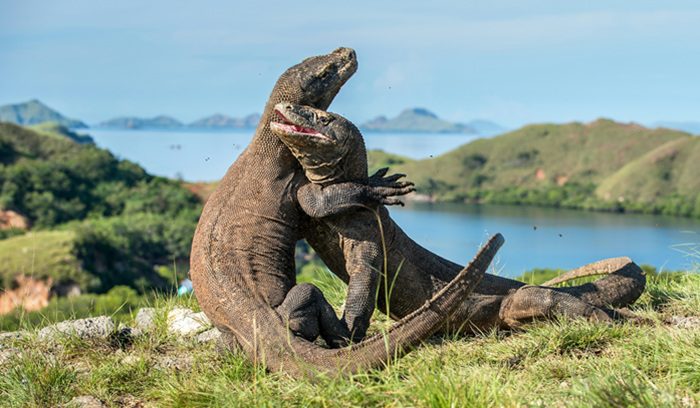
Indonesian police have broken up a major wildlife trafficking syndicate that smuggled juvenile Komodo dragons from the island of Flores to buyers in Thailand — where the animals fetched nearly $29,000 each. The April 2026 C.E. announcement named 11 suspects and exposed a supply chain that stretched across sea, air, road, and rail routes through Java, Sumatra, and into Southeast Asia.
At a glance
- Komodo dragon trafficking: Between January 2025 C.E. and February 2026 C.E., the syndicate moved at least 17 juvenile Komodo dragons out of Flores, concealing them inside short lengths of plastic pipe to evade detection during transit.
- Pangolin scales seizure: Police also seized 140 kilograms of pangolin scales — representing an estimated 980 Sunda pangolins killed — with a street value of roughly $484,000.
- Wildlife rehabilitation: The three Komodo dragons recovered in the final foiled attempt are now in the care of a government wildlife rehabilitation center in East Java, with plans for release once legal proceedings conclude.
Why Komodo dragons are so vulnerable
The Komodo dragon (Varanus komodoensis) is the world’s largest living lizard and is classified as endangered. Most of Indonesia’s population lives within Komodo National Park, where protections are enforced. But around 700 individuals are estimated to live outside official protected areas, including in the Pota area of Flores’s East Manggarai district — and that is precisely where traffickers focused their efforts.
Buyers in Pota paid roughly 5.5 million rupiah (about $320) per animal. By the time a dragon reached Java, that price had nearly sextupled. In Thailand, the black-market value climbed to the equivalent of $29,000. That price gradient is what sustains these networks and makes enforcement so difficult.
The method of concealment — stuffing baby reptiles into plastic piping — reflects how traffickers exploit the complexity of multi-modal logistics. Investigators say the syndicate used a combination of maritime, air, road, and rail links, deliberately spreading the route to reduce the risk of detection at any single checkpoint.
A broader network hiding in plain sight
The investigation reached further than Komodo dragons. Several suspects were members of an online “animal lovers” Facebook group that functioned as a front for trading endemic Indonesian species. That discovery widened the case considerably.
Among the other species recovered were 13 Talaud bear cuscus (Ailurops melanotis), a critically endangered marsupial; three Sulawesi dwarf cuscus (Strigocuscus celebensis), listed as near-threatened; six green tree pythons (Morelia viridis); and a mangrove monitor lizard (Varanus indicus). The breadth of the haul shows this was not a single-species operation — it was an opportunistic network trading in whatever Indonesia’s forests and islands could offer.
All 11 suspects face prosecution under Indonesia’s law on the conservation of biological resources and ecosystems, which carries serious penalties for trafficking protected wildlife.
What this bust means for conservation
Indonesia sits at the center of one of the world’s most biodiverse regions. The IUCN Red List classifies the Komodo dragon as endangered, with habitat loss and illegal collection among the primary threats. The Convention on International Trade in Endangered Species (CITES) lists the species on Appendix I, banning all commercial international trade.
Enforcement actions like this one matter beyond the immediate rescue. They disrupt established routes, expose the social media tactics traffickers use, and signal to buyers that supply chains are being monitored. TRAFFIC, the wildlife trade monitoring network, has long documented how dismantling one node of a trafficking ring can raise costs and risks for others operating in the same region.
The Sunda pangolin (Manis javanica) — the species whose scales were seized in this case — is itself classified as critically endangered by the WWF, driven to the edge by demand for scales in traditional medicine markets. The 140-kilogram seizure represents a meaningful disruption of that trade, even if it cannot undo the estimated 980 animals already lost.
An honest look at the challenge ahead
One enforcement success, however significant, does not end the trade. Demand in destination markets — particularly for exotic pets and traditional medicine ingredients — remains strong, and trafficking networks are adaptable. The Pota area outside any national park boundary remains a structural vulnerability, where dragons are accessible and protections are thinner.
Still, the multi-agency effort that cracked this syndicate — tracing a supply chain across multiple islands and an international border — shows that coordinated enforcement can reach further than traffickers expect.
Read more
For more on this story, see: United Cultures of the World
For more from Good News for Humankind, see:
- Ghana establishes a new marine protected area at Cape Three Points
- Indigenous land rights recognized across 160 million hectares ahead of COP30
- The Good News for Humankind archive on Indonesia
About this article
- 🤖 This article is AI-generated, based on a framework created by Peter Schulte.
- 🌍 It aims to be inspirational but clear-eyed, accurate, and evidence-based, and grounded in care for the Earth, peace and belonging for all, and human evolution.
- 💬 Leave your notes and suggestions in the comments below — I will do my best to review and implement where appropriate.
- ✉️ One verified piece of good news, one insight from Antihero Project, every weekday morning. Subscribe free.
More Good News
-
California announces biggest state park expansion in decades
California’s state park system just grew by three brand-new parks plus expansions to several others, adding hundreds of protected acres from the Central Valley to the redwood coast. Among the highlights: a 2,000-acre oak woodland becomes Yuba County’s very first state park, and the Bakersfield-area camp that inspired Steinbeck’s Grapes of Wrath will be preserved for future generations. Near Fresno, six riverfront properties totaling 874 acres will secure public access that was at risk of disappearing. It’s the biggest expansion of the system in decades, now totaling 283 parks. As climate pressures mount and access to nature remains uneven, this…
-
Indonesia dismantles wildlife trafficking ring targeting Komodo dragons
Indonesian police have dismantled a wildlife trafficking ring that was smuggling juvenile Komodo dragons inside short lengths of plastic pipe, charging 11 suspects and rescuing three of the endangered lizards now recovering at a government rehabilitation center in East Java. The investigation traced a supply chain winding by sea, air, road, and rail from the island of Flores all the way to buyers in Thailand. Along the way, officers also recovered 140 kilograms of pangolin scales and rescued other rare creatures, including 13 critically endangered Talaud bear cuscus. Busts like this do more than save individual animals — they expose…
-

France launches plan to ditch all fossil fuels by 2050
France just became the first country to set hard deadlines for ditching every fossil fuel: coal by 2030, oil by 2045, and gas by 2050. The roadmap was unveiled at a conference in Santa Marta, Colombia, where roughly 60 nations gathered to share their own transition plans after a global agreement stalled at COP30 last November. What makes France’s plan unusual isn’t a single bold target but the fact that it draws one clear line across all three fuels, covering everything from power plants to home heating to transport. As climate envoy Benoît Faraco noted, almost no other country has…