Indonesia

This archive collects solutions-journalism stories and milestones from Indonesia — covering health, environment, community development, and more. Each entry highlights real progress made by people, organizations, and communities across the archipelago.

Komodo dragons hugging, for article on Komodo dragon trafficking

Indonesia dismantles wildlife trafficking ring targeting Komodo dragons

Indonesian police have dismantled a wildlife trafficking ring that was smuggling juvenile Komodo dragons inside short lengths of plastic pipe, charging 11 suspects and rescuing three of the endangered lizards now recovering at a government rehabilitation center in East Java. The investigation traced a supply chain winding by sea, air, road, and rail from the island of Flores all the way to buyers in Thailand. Along the way, officers also recovered 140 kilograms of pangolin scales and rescued other rare creatures, including 13 critically endangered Talaud bear cuscus. Busts like this do more than save individual animals — they expose the social media fronts and multi-island routes traffickers rely on, raising the cost of preying on some of the world’s most extraordinary wildlife.

A wild Sumatran elephant walking through forest undergrowth for an article about Indonesia elephant riding ban — 14 words

Indonesia bans elephant riding in a win for captive animal welfare

Indonesia’s elephant riding ban marks a landmark step for animal welfare in Southeast Asia, ending a practice long documented as physically and psychologically harmful to captive elephants. The Indonesian government has formally prohibited tourists from riding elephants at registered wildlife tourism facilities, including conservation-linked elephant camps. The ban matters because captive elephants used for riding typically endure a brutal conditioning process causing lasting trauma, and because Indonesia is home to the critically endangered Sumatran elephant. While the policy does not address habitat loss or informal operators, it establishes a meaningful standard in a region where captive elephant tourism has deep historical roots.

Rows of natural history specimen jars in a European museum archive, for an article about colonial repatriation of Indonesian artifacts

The Netherlands is returning thousands of colonial-era artifacts to Indonesia

Colonial repatriation is reshaping how Indonesia reclaims its scientific and cultural heritage, as the Netherlands transfers thousands of fossils, botanical specimens, and historical artifacts collected during the Dutch East Indies era. Formalized through a bilateral government agreement, this return is among the largest of its kind in recent memory. Indonesian researchers and museums will now hold primary materials directly, eliminating the access barriers that have long shaped who produces knowledge and on whose terms. The agreement signals that large-scale repatriation is both logistically achievable and diplomatically sustainable, offering a potential model for other former colonial powers still resisting similar claims.

Indonesian children smiling, for article on Indonesia free meals program

Indonesia launches free meals program to feed millions of children and pregnant women

Indonesia’s free meal program kicked off in January 2025 by serving rice, vegetables, tempeh, chicken, and oranges to 740 students at a single primary school outside Jakarta — the opening day of an effort that aims to feed nearly 90 million people by 2029. The program targets a stunting crisis affecting more than one in five Indonesian children under five, extending meals to pregnant women because healthy development begins in the womb. Nearly 2,000 local cooperatives will supply the food, channeling income to rice growers, fisherfolk, and livestock producers along the way. It’s a generational bet that nourishing kids today builds the human foundation any country needs to thrive tomorrow.

Aerial view of a turquoise French Polynesian atoll for an article about French Polynesia marine protected area, for article on debt-for-nature swap, for article on coral reef protection

$35 million debt-for-nature deal aims to protect Indonesia’s coral reefs

A $35 million debt-for-nature swap between the U.S. and Indonesia will channel money that would have gone toward sovereign debt payments into coral reef protection over the next nine years. It’s the first agreement of its kind focused specifically on coral, and it targets nearly two million acres of reef across the Coral Triangle — the most biodiverse marine region on Earth, holding close to two-thirds of all known coral species. Indonesian nonprofits and local communities will guide the work, with a grant committee including civil society voices. As warming oceans threaten reefs worldwide, deals like this offer a model for tying debt relief to the ecosystems millions of people depend on.

Leopard shark / Zebra shark, for article on zebra shark rewilding

Rewilding program ships eggs around the world to restore Raja Ampat zebra sharks

Zebra shark rewilding has begun in Raja Ampat, where fewer than 20 of these gentle, spotted predators remain across 6 million hectares of reef. A coalition of aquariums from Sydney to Atlanta is shipping fertilized eggs across the Pacific to a hatchery on the island of Kri, where Indonesian “shark nannies” raise the pups until they’re ready for the open sea. Four young sharks have already been released, and conservationists hope to send 500 more swimming into protected waters within a decade. In one of the few corners of the ocean where marine life is genuinely recovering, this quiet experiment could become a blueprint for bringing other vanishing species back from the edge.

Sumatran hillside, for article on ancestral forest rights

Indonesian government recognizes ancestral forests in Aceh for first time

Ancestral forest rights just took a historic step forward in Indonesia: eight traditional communities in Aceh received legal title to 22,549 hectares of forest they have stewarded for generations. It’s the first time the country’s environment ministry has formally recognized the mukim system, a centuries-old way of governing land on the northern tip of Sumatra. Communities plan to zone protected areas, safeguard clean water, and grow crops like cacao and betel palm with the state’s backing. The timing matters, too, since Indonesia’s new carbon market could turn that stewardship into income. When Indigenous communities hold real title to their land, forests tend to stay standing — and that’s a quiet but powerful climate story unfolding worldwide.

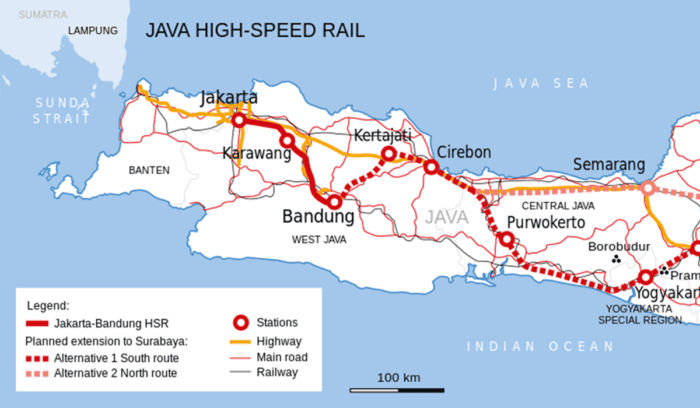
Java train map, for article on Indonesia high-speed rail

Indonesia opens Southern Hemisphere’s first high-speed train

High-speed rail just arrived in the Southern Hemisphere for the first time, with Indonesia’s new Jakarta–Bandung line cutting a three-hour trip down to 46 minutes. Trains glide along the 142-kilometer route at around 350 km/h, linking two cities home to nearly 14 million people on one of the most densely populated islands on Earth. Plans are already in motion to extend the corridor to Surabaya, which could turn an eight-hour journey across Java into a two- or three-hour ride. Beyond the convenience, electrified rail is the cleanest way to move people long distances, and tends to pull travelers off short-haul flights. For the wider Global South, it’s a hopeful sign that world-class low-carbon transport isn’t reserved for wealthier corners of the map.