
Nepal outlaws custom of exiling women during their periods
The ancient Hindu tradition of Chhaupadi, whereby women are confined to animal sheds during menstruation to keep “impurity” out of the home, was banned by the supreme court in 2005.
This archive covers stories about how religious communities, institutions, and leaders are driving positive change — from interfaith cooperation and humanitarian relief to social justice and community healing. It highlights moments when faith becomes a force for measurable good in people’s lives.

The ancient Hindu tradition of Chhaupadi, whereby women are confined to animal sheds during menstruation to keep “impurity” out of the home, was banned by the supreme court in 2005.

The General Synod, meeting in York, voted in favour of the move by 284 votes to 78. It was the second time in two days that it gave overwhelming support to motions seen as positive towards LGBT people, suggesting to some a significant change of mood.

The Kirk’s general assembly, meeting in Edinburgh, instructed officials to consider changes to church law that would allow ministers to preside over same-sex-marriage ceremonies.

Rastafari took shape in early 1930s Jamaica, rising from Kingston’s poorest neighborhoods and the hills above them. Shaped by Marcus Garvey’s pan-African vision and the crowning of Haile Selassie, it gave Afro-Jamaicans a spiritual language for dignity under colonial rule. Today, an estimated 700,000 to 1 million practitioners carry that vision across the world.

A-Ma Temple rose on the rocky southern tip of the Macau peninsula in 1488, built by Fujianese fishermen and traders who needed somewhere to pray before facing the South China Sea. When Portuguese sailors later asked locals the name of the place, the answer eventually became “Macau.” A working people’s sanctuary, quietly lending its name to a city.

Ibn Khaldun, a Tunis-born scholar, withdrew to a remote Algerian castle in 1375 and wrote the Muqaddimah, a sweeping preface to a world history that quietly founded the social sciences. Drawing on decades in North African and Andalusian courts, he argued civilizations rise and fall through observable patterns — centuries before anyone called that sociology.

In October 1279, the Buddhist monk Nichiren inscribed the Dai-Gohonzon, a mandala carved into a half-log of Japanese camphorwood in gold and black lacquer. He did so days after peasant farmers were tortured and three beheaded for refusing to renounce his teachings. For his followers, enlightenment belonged to everyone — not just monks and aristocrats.
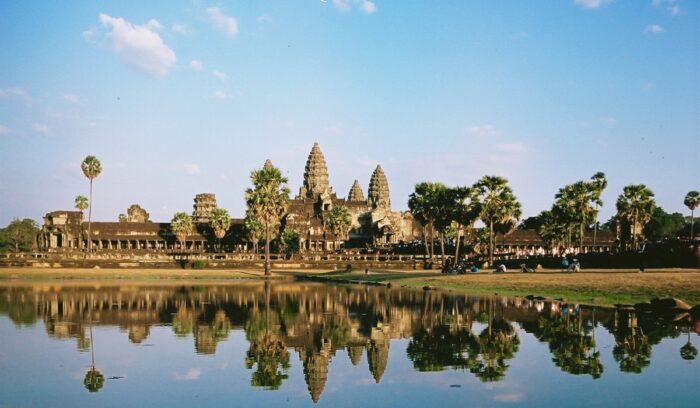
Angkor Wat construction began around 1113 C.E., when Khmer King Suryavarman II set tens of thousands of laborers to work on the plains of present-day Cambodia. Over roughly three decades, they floated millions of sandstone blocks from a mountain 25 miles away. Nine centuries later, it remains the world’s largest religious complex.

The Edict implicitly granted Christianity the status of religio licita, a worship that was recognized and accepted by the Roman Empire.

A codex known as the “Yuta Tnoho” that belonged to the Mixtec culture in the 1500s B.C.E. is the earliest historical record of psilocybin use in human history.