
San Francisco creates world’s first ever transgender cultural district
The creation of Compton’s Transgender Cultural District is to stop the displacement of trans people from a place they were traditionally welcomed in, and to teach trans history.
This archive covers cultural milestones from communities around the world — from the revival of endangered languages and Indigenous traditions to shifts in how societies celebrate, create, and connect. These stories report on real progress in the arts, heritage preservation, and shared human expression.

The creation of Compton’s Transgender Cultural District is to stop the displacement of trans people from a place they were traditionally welcomed in, and to teach trans history.

When a traditional healer burned hot clay into the chest of two-year-old Kushbu Lal, she died. Now moves are afoot to criminalize a practice that continues to cost lives.

Rastafari took shape in early 1930s Jamaica, rising from Kingston’s poorest neighborhoods and the hills above them. Shaped by Marcus Garvey’s pan-African vision and the crowning of Haile Selassie, it gave Afro-Jamaicans a spiritual language for dignity under colonial rule. Today, an estimated 700,000 to 1 million practitioners carry that vision across the world.

Ram Mohan Roy, born in Bengal in 1772, spent his life weaving Vedantic philosophy, Islamic theology, and Enlightenment thought into a movement for human dignity. Haunted by watching his sister-in-law burned in sati as a child, he campaigned for decades until Britain banned the practice in 1829. His Bengali Renaissance opened doors that shaped Indian thought for generations.

Spain’s Golden Age bloomed under Philip II, who took the throne in 1556 and poured royal wealth into art, architecture, and letters. He built El Escorial, drew El Greco to Toledo, and set the stage for Cervantes and Velázquez. Nearly two centuries of creative work followed, shaping literature and painting far beyond Iberia.

Māori settlers reached Aotearoa around 1350 C.E., completing one of history’s great navigational feats aboard double-hulled waka guided by stars, swells, and birds. They found giant moa, vast forests, and a climate unlike anything in Polynesia. New Zealand was among the last large landmasses humans reached — the final leg of a journey that began in Africa.

Samurai rose from hired estate guards to the rulers of Japan in 1185 C.E., when Minamoto no Yoritomo founded the Kamakura shogunate. A warrior class that began as “attendants” ended up governing the country, in one form or another, for nearly 700 years — shaping Japanese art, ethics, and craft long after the fighting stopped.

Around 1000 C.E., the Thule people began pushing east from the Bering Strait, and within roughly a century their descendants had reached Greenland. Traveling by dogsled and hunting bowhead whales from open boats, they carried a toolkit refined for the Arctic’s edge. Their journey seeded the Inuit world that stretches, unbroken, from Siberia to Greenland today.
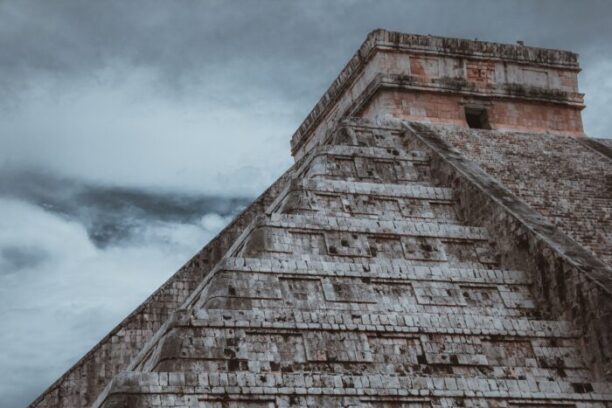
The Pyramid of Kukulcan rose at Chich’en Itza between 800 and 900 C.E., built by Maya hands as both temple and working calendar. Its four staircases hold 91 steps each, plus the top platform — 365 in all, one for every day of the solar year. A civilization writing mathematics into stone.

Heian-kyō, founded in 794 C.E. when Emperor Kammu moved Japan’s capital to what is now Kyoto, opened a four-century era of extraordinary cultural flowering. Freed from Chinese influence after 838, court writers like Murasaki Shikibu used the new hiragana script to craft works still read today. Its literary and aesthetic legacy shaped Japanese identity for centuries.