
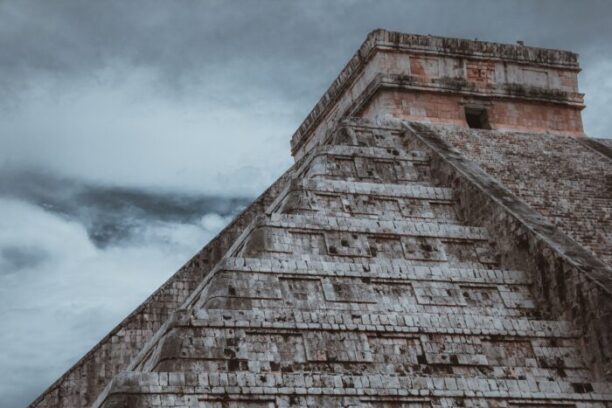
Around 800 C.E., Maya builders at Chich’en Itza broke ground on one of the most mathematically precise structures ever raised by human hands. The Pyramid of Kukulcan — a stepped temple dedicated to the feathered serpent god — was not merely a monument. It was a calendar you could walk around, a clock you could watch, and a cosmic statement encoded in stone.
What the evidence shows
- Pyramid of Kukulcan: Construction began over a preexisting temple between 800 and 900 C.E., during the Terminal Classic period of Maya civilization, when Chich’en Itza was emerging as the dominant power of the Yucatán Peninsula.
- Maya calendar architecture: Each of the pyramid’s four staircases holds 91 steps — 364 total — with the temple platform counted as the 365th, encoding the solar year directly into the structure’s dimensions.
- Chich’en Itza construction: The pyramid rises 24 meters and measures 53.3 meters on each side at its base, making it the largest structure at a site that, at its peak, housed an estimated 35,000 people across roughly 10 square kilometers.
A city at the height of its power
By the time construction began on the Pyramid of Kukulcan, Chich’en Itza had become something close to a metropolis by the standards of its era. Its population rivaled many cities of medieval Europe. Its rulers commanded trade networks stretching across Mesoamerica, connecting the Yucatán to highland Mexico, the Gulf Coast, and Central America.
Kukulcan — known as Quetzalcoatl in Aztec tradition and Gucumatz among the Quiché Maya of what is now Guatemala — was not a local deity. He was a pan-Mesoamerican figure: a feathered serpent who brought rain, wind, and life itself. Building his pyramid at the heart of Chich’en Itza was a declaration of the city’s place in a shared civilizational world.
The pyramid was constructed over an older temple, a common practice in Mesoamerican architecture. Earlier sacred spaces were not demolished — they were enclosed, honored, and built upon. Archaeological work at the site has confirmed at least two earlier structures beneath the visible pyramid, including what may be one of the oldest ceremonial platforms at the site.
Mathematics written in stone
The precision of the Pyramid of Kukulcan’s design reflects a civilization that had developed one of the most sophisticated calendrical systems in human history. The Maya used at least two interlocking calendars: the 365-day solar calendar and the 260-day ritual calendar. The pyramid encodes the solar year in steps, and its nine terraces — bisected by four staircases — represent the 18 months of the Maya year.
The orientation of the structure, angled slightly northeast, was almost certainly calculated deliberately. During the spring and autumn equinoxes, the afternoon sun casts a series of seven triangular shadows along the northern staircase, creating the illusion of a giant serpent descending toward the massive stone serpent head at the pyramid’s base. Smithsonian Magazine has described this as one of the most sophisticated uses of astronomical alignment in ancient architecture anywhere in the world.
This was not decoration. It was theology made physical — the god arriving on schedule, on the day his people expected him.
Hidden depths, literally
In 2015 C.E., researchers using electrical resistivity tomography discovered a large cenote — a natural sinkhole filled with water — directly beneath the pyramid. It measures roughly 35 meters across and more than 20 meters deep. The Maya considered cenotes sacred: portals to the underworld, sources of water in a landscape without rivers. The pyramid may have been placed over this cenote intentionally, positioning the temple of the feathered serpent directly above a gateway to the realm below.
A handclap near the base of the pyramid produces an unusual chirping echo — an acoustic effect researchers have compared to the call of the sacred quetzal bird. Whether this was an intentional design feature or a fortunate coincidence remains debated, but it adds another layer to a structure that rewards close attention.
Lasting impact
The Pyramid of Kukulcan endures as evidence of what Indigenous civilizations in the Americas had built long before European contact. It is a UNESCO World Heritage Site and was named one of the New Seven Wonders of the World in 2007 C.E. — a recognition voted on by more than 100 million people worldwide.
Its influence extends beyond tourism. The pyramid’s astronomical alignments have shaped how scholars understand Maya knowledge systems — not as mythology loosely attached to observation, but as rigorous scientific practice embedded in ritual. The same civilization that built this pyramid also developed the concept of zero independently of other cultures, produced detailed astronomical tables, and predicted solar and lunar eclipses with remarkable accuracy.
The site also anchors an ongoing conversation about land, sovereignty, and cultural stewardship. The Yucatec Maya people have never disappeared. Their descendants live throughout the Yucatán today, and advocacy around Indigenous land rights and heritage recognition continues to shape how ancient sites like Chich’en Itza are managed and interpreted.
Blindspots and limits
The historical record of Chich’en Itza’s construction is incomplete. Most of what we know comes from archaeology and Spanish colonial accounts written centuries after the city’s peak — sources that carry their own distortions and omissions. The names of the architects, laborers, and astronomers who designed and built the Pyramid of Kukulcan are not preserved. The workers who quarried and lifted those stones remain anonymous, as they do for nearly every monumental structure from the ancient world.
The date range of 800–900 C.E. is broadly accepted, but the precise start of construction and the full sequence of building phases remain subjects of ongoing research. What the pyramid meant to the people who built it — beyond what later texts and oral traditions suggest — is something archaeology can approach but never fully recover.
Read more
For more on this story, see: Atlas Obscura — Pyramid of Kukulcan, Chich’en Itza
For more from Good News for Humankind, see:
- Maya civilization reaches its peak in what is now Belize
- Neolithic peoples begin building the first monument at Stonehenge in England
- The Good News for Humankind archive on Mexico
About this article
- 🤖 This article is AI-generated, based on a framework created by Peter Schulte.
- 🌍 It aims to be inspirational but clear-eyed, accurate, and evidence-based, and grounded in care for the Earth, peace and belonging for all, and human evolution.
- 💬 Leave your notes and suggestions in the comments below — I will do my best to review and implement where appropriate.
- ✉️ One verified piece of good news, one insight from Antihero Project, every weekday morning. Subscribe free.


