Clean & renewable energy

This archive tracks real progress in clean and renewable energy — from solar and wind expansion to grid upgrades and policy wins. Each story focuses on what’s working, where, and why it matters for people and the planet.

Ocean Thermal Energy Generator Barge, for article on ocean thermal energy conversion

World’s first commercial-scale ocean thermal energy generator to be built off the coast of São Tomé and Príncipe

Ocean thermal energy conversion just crossed a threshold that has eluded engineers for nearly 140 years. UK-based Global OTEC Resources received independent certification for the cold-water riser pipe at the heart of its floating platform — the very component that has sunk previous attempts to turn ocean temperature gradients into electricity. The flagship vessel, Dominique, is a 1.5-MW system planned for deployment off São Tomé and Príncipe, an island nation of about 220,000 people that currently leans on imported fossil fuels. Because deep ocean temperatures stay constant, a working OTEC plant generates power around the clock, offering tropical island communities something solar and wind cannot: steady, locally produced baseload clean energy on the front lines of climate change.

Offshore wind farm, for article on offshore wind capacity

Biden-Harris administration approves largest offshore wind project in U.S. history

Coastal Virginia Offshore Wind, approved by federal regulators in 2023, could power more than 900,000 homes once its 176 turbines start spinning about 23.5 nautical miles off Virginia Beach. By late October that year, the first eight monopile foundations had already arrived at the Portsmouth Marine Terminal — a tangible sign the project had moved from paperwork into steel. Dominion Energy also committed to fishery mitigation funds and vessel speed limits to protect whales, sea turtles, and Atlantic sturgeon during construction. Alongside four other approved projects, CVOW is helping seed an offshore wind industry that barely existed in American waters a decade ago, with Hampton Roads positioning itself as a lasting hub for the clean-energy supply chain.

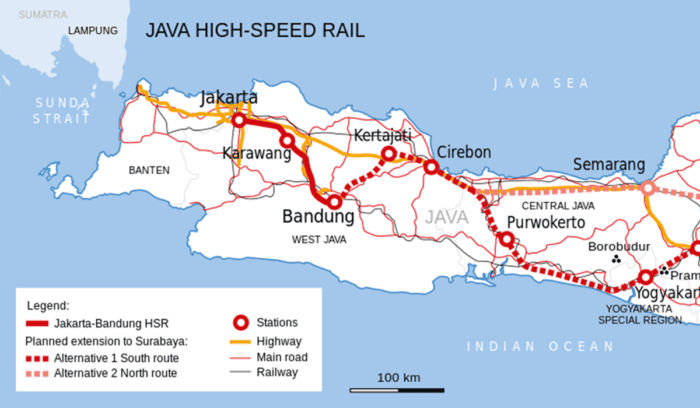
Java train map, for article on Indonesia high-speed rail

Indonesia opens Southern Hemisphere’s first high-speed train

High-speed rail just arrived in the Southern Hemisphere for the first time, with Indonesia’s new Jakarta–Bandung line cutting a three-hour trip down to 46 minutes. Trains glide along the 142-kilometer route at around 350 km/h, linking two cities home to nearly 14 million people on one of the most densely populated islands on Earth. Plans are already in motion to extend the corridor to Surabaya, which could turn an eight-hour journey across Java into a two- or three-hour ride. Beyond the convenience, electrified rail is the cleanest way to move people long distances, and tends to pull travelers off short-haul flights. For the wider Global South, it’s a hopeful sign that world-class low-carbon transport isn’t reserved for wealthier corners of the map.

Solar farm, for article on U.S. electric grid investment

U.S. announces ‘largest ever’ investment in its electric grid to advance climate goals

A $3.46 billion federal investment is rewiring America’s electric grid, spreading across 58 projects in 44 states to make power more reliable and ready for clean energy. The projects are designed to bring more than 35 gigawatts of new renewable energy online — roughly half the country’s utility-scale solar capacity as of 2022. They’ll also fund 400 microgrids, giving hospitals, neighborhoods, and rural communities a way to keep the lights on when storms take down the main grid. Each project had to direct benefits toward communities historically hit hardest by outages and pollution. For a clean energy future to actually reach everyone, the wires connecting it all matter just as much as the panels and turbines — and this is what modernizing with equity in mind looks like.

A fossil fuel-free ammonia plant at the Kenya Nut Company, for article on green ammonia fertilizer

The Kenya Nut Company to become world’s first farm to produce fossil-free fertilizer on site

Green ammonia is about to be made on a working farm for the first time anywhere, at a macadamia operation outside Nairobi producing one ton per day. The plant runs on solar power, splitting water for hydrogen and pulling nitrogen from the air — skipping the natural gas that fertilizer production has depended on for over a century. That matters because the average bag of fertilizer in sub-Saharan Africa travels 10,000 kilometers to reach a farm, leaving growers exposed to every global price shock. Built by U.S. startup Talus Renewables, the system is small enough for a single farm and designed for places where supply chains are long and fragile. If it works, it offers a glimpse of food systems that are both cleaner and more self-reliant.

Charging an EV, for article on Australia EV market share

EVs exceed 10% of monthly auto sales in Australia for first time ever

Australia’s EV market hit a milestone in September 2023, with plug-in vehicles making up 10.6% of new car sales — the first time the country has crossed double digits in a single month. That meant nearly 10,000 plug-in cars found new homes, led by the Tesla Model Y, which outsold every passenger car except two utes. The shift reflects more than new models on lots: salary sacrifice schemes, Chinese automakers expanding their reach, and access programs for public sector workers are bringing EVs to buyers who once found them out of reach. With transport responsible for nearly a fifth of Australia’s emissions, this kind of broad-based momentum is exactly what the climate transition looks like when it finally clicks into gear.