
In 1979 C.E., Ecuador drew a boundary around one of the most extraordinary places on the planet. The newly designated Yasuní National Park — roughly 10,000 square kilometers tucked between the Napo and Curaray Rivers in the Amazonian lowlands — became a protected zone at a moment when the sheer scale of its biodiversity was only beginning to register with the outside world. Scientists would later confirm what Indigenous peoples had long understood: this particular patch of rainforest has no equal.
What the evidence shows
- Yasuní National Park: Established in 1979 C.E., the park covers approximately 10,000 km² in Pastaza and Orellana Provinces of Amazonian Ecuador, roughly 250 km from Quito.
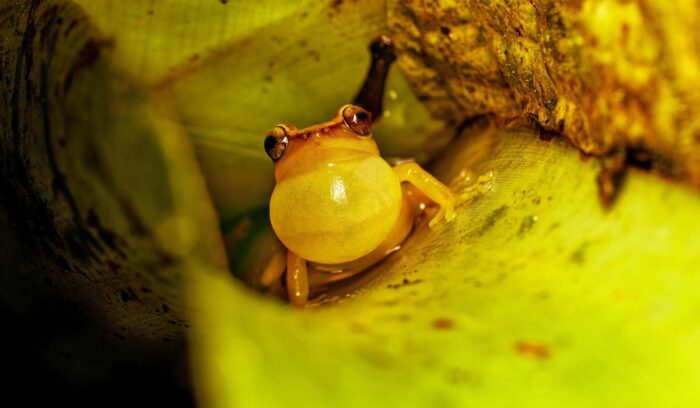
- Amazon biodiversity: Despite covering less than 0.15% of the Amazon Basin, the park is home to approximately one-third of all Amazonian amphibian and reptile species, at least 596 bird species, and more than 100,000 insect species per single hectare.
- Indigenous territory: The park sits within the ancestral lands of the Huaorani people and shelters two uncontacted groups, the Tagaeri and the Taromenane, who continue to live within its boundaries.
A convergence unlike anywhere else
What makes Yasuní so remarkable is its position. The park sits at the intersection of three major geographic zones: the equator, the Andes Mountains, and the Amazon rainforest. That convergence creates conditions where amphibian, bird, mammal, and vascular plant diversity all reach their peak levels simultaneously within the western hemisphere.
The numbers are genuinely hard to absorb. A single hectare of Yasuní contains more insect species than exist across all of North America. The park holds world records for local-scale tree, amphibian, and bat species richness. It is one of only nine places on Earth with more than 4,000 vascular plant species per 10,000 square kilometers. Scientists have documented at least 382 fish species in its waterways — and that figure is likely an undercount, given how much cryptic diversity remains hidden from morphological surveys.
The park’s slow-moving blackwater rivers, known as igapós, are high in tannins and support entirely different plant communities than the main Amazonian waterways. Spine-covered palms and aquatic grasses line their edges. Giant otters — endangered, and found in rivers in and around the park — navigate the seasonal flooding that reshapes food availability year by year.
The Huaorani and the human dimension
The formal 1979 C.E. designation recognized a geography. It did not create the relationship between people and land — that had existed for generations. The Huaorani had long moved through these forests, using the river networks as their primary routes of travel and organizing their lives around the rhythms of a forest they understood in detail no outside survey could replicate.
The Tagaeri and Taromenane, groups who have chosen no contact with the outside world, remain within the park’s territory today. Their continued presence is both a sign of the park’s protection and a reminder that “protected area” has different meanings depending on who is doing the protecting — and for whom.
In 1989 C.E., UNESCO designated Yasuní a Biosphere Reserve, along with the adjacent Waorani Ethnic Reserve. That dual designation acknowledged what the 1979 C.E. park boundaries implied: that human cultures and biological systems here are inseparable.
Lasting impact
The establishment of Yasuní National Park helped anchor the legal and scientific framework for Amazonian conservation at a critical moment. It created a reference point — a place where researchers could document baseline biodiversity before degradation, and where arguments for protection could be grounded in verifiable record-breaking data.
The park became a center of serious science. A 50-hectare Forest Dynamics Plot, established in 1995 C.E. through a collaboration between the Pontificia Universidad Católica de Ecuador, Aarhus University in Denmark, and the Smithsonian’s ForestGEO network, has generated some of the most detailed long-term data on tropical forest structure available anywhere. That research has informed conservation models far beyond Ecuador’s borders.
The 1979 C.E. designation also seeded a political tradition of treating Yasuní as worth defending. In 2007 C.E., President Rafael Correa launched the Yasuní-ITT Initiative — a proposal to leave approximately 1.7 billion barrels of oil beneath the park untouched in exchange for international compensation. The proposal was ahead of its time, even if its outcome was not what advocates hoped. And in August 2023 C.E., Ecuadorians voted in a national referendum to halt oil drilling inside the park — a direct, democratic act of protection that drew international attention and renewed the park’s significance as a site of both conservation and civic will.
Yasuní has also shaped the global conversation about protected areas in biodiversity hotspots. The argument that some places contain irreplaceable concentrations of life — and that protecting them has value beyond national borders — gained evidentiary weight from the decades of research conducted here.
Blindspots and limits
The park’s designation did not prevent oil extraction. Drilling began inside Yasuní in 2016 C.E. and expanded in 2019 C.E., despite opposition from Indigenous communities and scientists who had spent decades documenting what was at stake. The 2023 C.E. referendum result was a victory, but it came after years of damage, and enforcement remains an ongoing challenge. The Tagaeri and Taromenane, whose territory overlaps with extraction zones, had no formal mechanism to consent to or refuse what happened on their land.
The park’s boundaries also leave significant surrounding habitat unprotected, and deforestation pressures across the broader Amazon continue to threaten the ecological corridors that make Yasuní’s diversity possible in the first place.
Read more
For more on this story, see: Wikipedia — Yasuní National Park
For more from Good News for Humankind, see:
- Colombia creates landmark territory to protect uncontacted Indigenous groups
- Neolithic long house transforms how farming communities live together
- The Good News for Humankind archive on Ecuador
About this article
- 🤖 This article is AI-generated, based on a framework created by Peter Schulte.
- 🌍 It aims to be inspirational but clear-eyed, accurate, and evidence-based, and grounded in care for the Earth, peace and belonging for all, and human evolution.
- 💬 Leave your notes and suggestions in the comments below — I will do my best to review and implement where appropriate.
- ✉️ One verified piece of good news, one insight from Antihero Project, every weekday morning. Subscribe free.


