
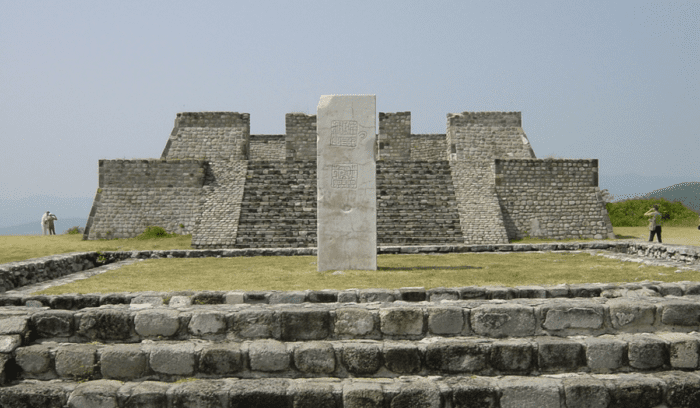
Around 650 C.E., a group of Maya traders from what is now Campeche made a calculated decision. They chose a hilltop in the region of present-day Morelos, Mexico — not for its farmland, which was poor, but for something more valuable: position. The site of Xochicalco sat at the crossroads of several major Mesoamerican trade routes, and the people who built it intended to command them.
What the evidence shows
- Xochicalco founding: The Olmeca-Xicallanca, a group of Maya traders from Campeche, established the settlement around 650 C.E. at a strategically fortified hilltop in what is now the Mexican state of Morelos.
- Mesoamerican trade routes: The city-state grew into a major commercial and religious hub during the Epiclassic period (700–900 C.E.), reaching a population of 10,000 to 20,000 people engaged in craft production and long-distance trade.
- Xochicalco architecture: The site’s temples, pyramids, ball courts, and an underground solar observatory reflect artistic influences from Teotihuacan, the Maya lowlands, and the Matlatzinca culture of the Toluca Valley.
A city built on trade and defense
The name Xochicalco translates from Nahuatl as “in the house of flowers.” But the city itself was anything but ornamental. Its founders — the Olmeca-Xicallanca — chose a naturally defensible hill and leveled its top to build a ceremonial center, then carved long terraces down the slopes for residential use.
The surrounding agricultural land was too poor to support a major population on its own. That reality tells researchers something important: Xochicalco was not built to farm. It was built to control movement, goods, and knowledge across a vast network of exchange.
Its population grew steadily through the Epiclassic period, reaching somewhere between 10,000 and 20,000 people at its peak. Many of them worked as artisans or traders. UNESCO, which designated Xochicalco a World Heritage Site, describes it as one of the most important political, religious, and commercial centers of its era in Mesoamerica.
Where cultures converged
What makes Xochicalco remarkable is how many traditions it absorbed and synthesized. The Temple of the Feathered Serpent — its most celebrated structure — bears relief carvings that blend Teotihuacan iconography with clear Maya influences. Some seated figures on the pyramid look distinctly Maya. Towns that paid tribute to Xochicalco are depicted in stone on the high walls.
Scholars have speculated that the city may have hosted a community of artists and craftspeople from across Mesoamerica. That would help explain the unusual stylistic range on display at a single site. In a period when Teotihuacan — the dominant power of the region — was declining, Xochicalco emerged as a gathering point for people, ideas, and goods from multiple cultural traditions.
The city may have done more than benefit from Teotihuacan’s fall. Some researchers have speculated it played an active role in that collapse — though the evidence remains debated.
The underground observatory
One of Xochicalco’s most striking features is almost entirely invisible from above. A cave beneath the ceremonial center was modified into a solar observatory — its walls plastered and painted black, yellow, and red, with a hexagonal chimney carved upward to the surface.
For 105 days each year, from late April to mid-August, sunlight enters through that chimney. On two specific dates — around May 14 and July 28 — the sun reaches its zenith at astronomical noon, and a beam of light falls directly onto the cave floor, projecting a circular image of the sun. The builders knew exactly what they were doing.
This was not just an astronomical tool. The precision of its construction suggests that solar observation at Xochicalco was woven into religious ceremony, agricultural timing, and civic life. It reflects a depth of astronomical knowledge that was widespread across Mesoamerican civilizations long before European contact.
Lasting impact
Xochicalco operated as a major center for roughly two and a half centuries before it was burned and abandoned around 900 C.E. The destruction was apparently swift — excavated houses still contained objects left in place, as if residents fled without time to take their belongings.
A small population remained on the lower slopes. Around 1200 C.E., the site was reoccupied by the Nahuatl-speaking Tlahuica people, ancestors of the communities living in Morelos today.
The city’s legacy extends well beyond its physical remains. As a crossroads where Maya, Teotihuacan, and other Mesoamerican traditions mixed and evolved, Xochicalco contributed to the broader transmission of artistic forms, astronomical knowledge, and trade networks that shaped later cultures — including those that built their own complex cities in the Valley of Mexico.
The site was first formally described by explorer Antonio Alzate in 1777 C.E. and later by Alexander von Humboldt in 1810 C.E. Major excavations by Mexican archaeologists Eduardo Noguera, César Saenz, and later Norberto González Crespo and Silvia Garza of the Instituto Nacional de Antropología e Historia (INAH) have gradually revealed the full scope of what was built here.
Blindspots and limits
Much of Xochicalco’s residential area remains unexcavated, and the written record of its internal history is thin — most of what we know comes from archaeology, not texts. The founding attribution to the Olmeca-Xicallanca is widely cited but based on limited direct evidence, and scholarly debate continues about the city’s exact political relationships and its role in regional power shifts during the Epiclassic period.
There is also an active threat: a 2009 mining concession granted to a Canadian company near the site drew serious concern from INAH archaeologists, a reminder that even UNESCO-protected heritage can face pressure from extractive industries.
Read more
For more on this story, see: Wikipedia — Xochicalco
For more from Good News for Humankind, see:
- Indigenous land rights gain major recognition at COP30
- Ghana establishes marine protected area at Cape Three Points
- The Good News for Humankind archive on the early Middle Ages
About this article
- 🤖 This article is AI-generated, based on a framework created by Peter Schulte.
- 🌍 It aims to be inspirational but clear-eyed, accurate, and evidence-based, and grounded in care for the Earth, peace and belonging for all, and human evolution.
- 💬 Leave your notes and suggestions in the comments below — I will do my best to review and implement where appropriate.
- ✉️ One verified piece of good news, one insight from Antihero Project, every weekday morning. Subscribe free.