
Around 1200 B.C.E., something was shifting in the heart of Europe. Across a vast stretch of land running from western Hungary to eastern France, from the Alps toward the North Sea, communities were changing the way they honored their dead — and in doing so, were knitting together one of the most consequential cultural traditions the ancient world had ever seen.
Key findings
- Urnfield culture: Emerging from the earlier Tumulus culture around 1300 B.C.E. and reaching a clear consolidation point near 1200 B.C.E., this tradition spread across central Europe and eventually reached Italy, the Iberian Peninsula, and the Atlantic coast.
- Cremation burial: The defining practice — burning the dead and placing their ashes in ceramic urns buried in communal fields — likely originated in Hungary, where the rite had been common since the early second millennium B.C.E., and spread steadily westward and southward.
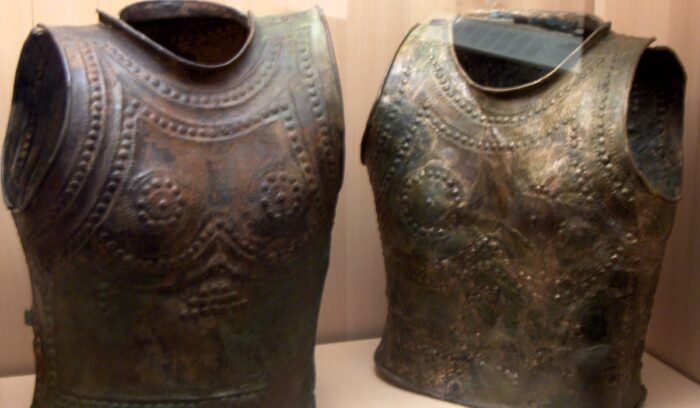
- Bronze Age metalworking: Alongside new burial customs, the period saw the rapid spread of sheet-bronze technology and fortified hilltop settlements, pointing to growing specialization, long-distance trade networks, and increasingly complex social hierarchies.
A culture grown from deep roots
The Urnfield tradition did not appear suddenly. It grew gradually from the Tumulus culture that preceded it, with transitions visible in both pottery styles and burial practices. In some parts of what is now Germany, cremation and older inhumation burial existed side by side for generations, as if communities were holding two worldviews at once before committing to the new.
Ritual continuity ran deep. At Ellmoosen in southern Germany, 16 pins deposited in a swamp span the entire period from the Middle Bronze Age through the early Urnfield phase — a quiet, watery archive of unbroken tradition. At river fords along the Loire, Seine, and Rhône, deposits reach back to the late Neolithic, accumulating layer by layer across thousands of years.
This is not a story of conquest replacing the old. It is a story of gradual adoption, adaptation, and exchange — the kind of slow, human-scale transformation that rarely makes dramatic headlines but shapes everything that follows.
A network, not a nation
One of the most striking things about the Urnfield world is how it functioned as a network rather than a centralized power. Pottery styles varied sharply from region to region, sometimes with borders so consistent that archaeologists suspect they reflect tribal or political boundaries. But metalwork tells a different story: bronze objects moved freely across those same boundaries, probably produced in specialized workshops serving elites across wide areas.
This dual pattern — local identity preserved in everyday ceramics, shared prestige goods circulating among leaders — is a recognizable feature of many interconnected ancient societies. The Urnfield world was, in this sense, surprisingly modern in its structure: local on the surface, cosmopolitan underneath.
Communities from what are now Slovakia, northern Hungary, and the Lusatian region of central Europe each developed their own variant of the tradition, while remaining linked through trade, shared ritual, and probably kinship. The Cambridge Archaeological Journal has published extensive research on how Bronze Age Europe sustained exactly these kinds of long-distance elite networks through material culture exchange.
From urns to Rome — and beyond
The downstream consequences of the Urnfield tradition are almost impossible to overstate. In Italy, the Proto-Villanovan and Canegrate cultures drew directly on Urnfield practices, eventually giving rise to the Villanovan culture and, through that chain, to the Italic peoples. The Latins — who would build Rome — descended from this lineage.
In northern Italy, the Golasecca culture developed with direct continuity from the Canegrate culture, itself a western expression of the Rhine-Switzerland-Eastern France Urnfield tradition. Inscriptions from the Golasecca region in the Lepontic Celtic language confirm that the population spoke a Celtic tongue — making it probable that at least parts of the western Urnfield world were Celtic-speaking, or proto-Celtic-speaking, as far back as 1300 B.C.E.
Some linguists and archaeologists have argued that the Urnfield culture represents the ancestral homeland of the Proto-Celtic language family — the common root of Irish, Welsh, Scottish Gaelic, Breton, and the now-extinct Continental Celtic languages. The evidence is suggestive rather than conclusive, but the cultural chain is real: Urnfield layers at the famous Hallstatt site in Austria — Hallstatt A and B — directly precede the Iron Age Hallstatt culture (Ha C and D), which is firmly associated with early Celtic peoples. From there, the La Tène culture carries the thread into the full bloom of Celtic civilization across Europe.
Lasting impact
The Urnfield tradition mattered not just for what it produced but for how it moved. By the close of the second millennium B.C.E., the spread of cremation burial, hilltop fortifications, and sheet-bronze technology across Europe represented one of the broadest cultural synchronizations the continent had experienced since the spread of farming millennia earlier.
That spread laid the groundwork for the Celtic world, which at its height stretched from Ireland to Anatolia. It contributed to the ancestral cultures of Rome. It introduced burial practices and metalworking techniques that shaped how Iron Age Europeans understood death, status, and community for centuries.
The British Museum’s Bronze Age collections document how these influences reached as far as Britain and Iberia, carried by trade routes and elite exchange networks that were already centuries old by 1200 B.C.E. The Urnfield world was not just a central European phenomenon — it was a Europe-wide conversation.
For anyone curious about how human cultures spread and transform, the Urnfield tradition is a remarkable example. It shows that even in the Bronze Age, Europe was not a collection of isolated groups but a web of interacting communities sharing ideas, goods, and ways of making meaning — including, ultimately, how to say goodbye to the dead.
Blindspots and limits
The archaeological record for the Urnfield culture is uneven. Dating relies heavily on typological sequences — changes in pottery and metalwork styles — rather than on radiocarbon or dendrochronology, and scholars have noted that more scientific dating would be highly desirable. The dates assigned to the sub-phases (Ha A1, Ha A2, Ha B1, etc.) are acknowledged to be schematic, and they may not be strictly contemporaneous across the whole region.
Earlier theories linking the Urnfield expansion directly to the Bronze Age Collapse of the Eastern Mediterranean — positing that displaced “Sea Peoples” or related groups drove the culture’s spread — are no longer widely accepted. The connection between Urnfield culture and Celtic linguistic origins also remains a scholarly hypothesis rather than established consensus. Women’s voices and non-elite lives are largely invisible in the record, reconstructed from grave goods that skew toward higher-status burials.
Read more
For more on this story, see: Wikipedia — Urnfield culture
For more from Good News for Humankind, see:
- Indigenous communities secure land rights for 160 million hectares
- Ghana establishes marine protected area at Cape Three Points
- The Good News for Humankind archive on the Bronze Age
About this article
- 🤖 This article is AI-generated, based on a framework created by Peter Schulte.
- 🌍 It aims to be inspirational but clear-eyed, accurate, and evidence-based, and grounded in care for the Earth, peace and belonging for all, and human evolution.
- 💬 Leave your notes and suggestions in the comments below — I will do my best to review and implement where appropriate.
- ✉️ One verified piece of good news, one insight from Antihero Project, every weekday morning. Subscribe free.