
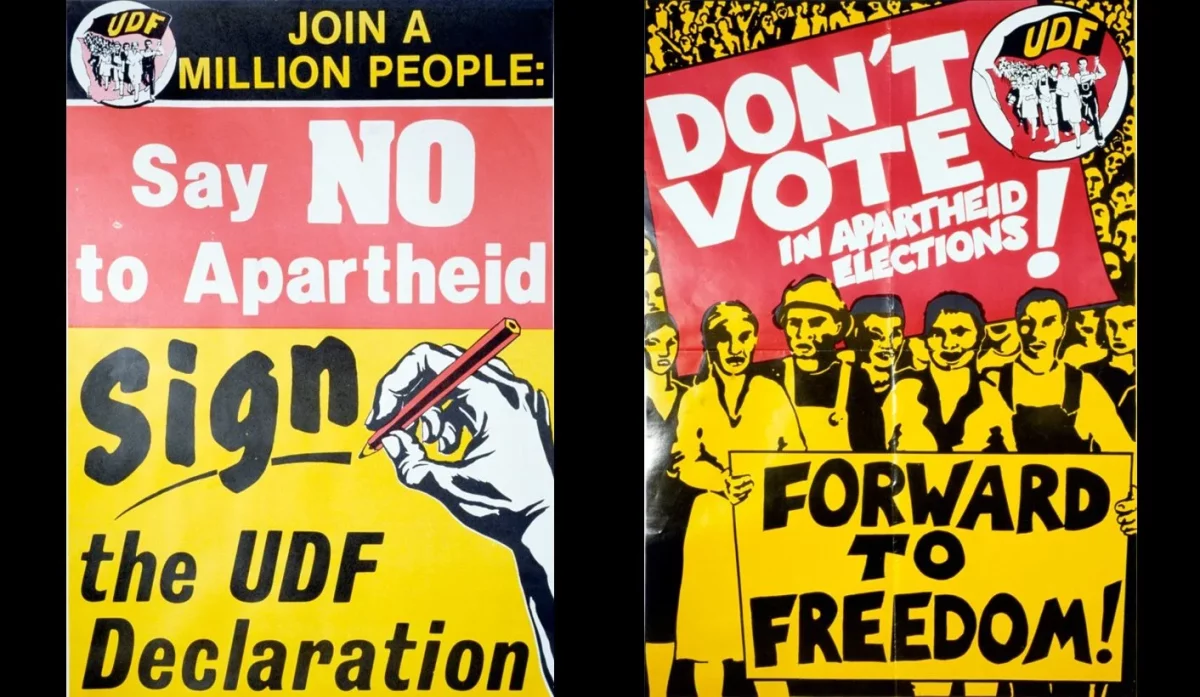
On August 20, 1983 C.E., roughly 10,000 people packed a community hall in Mitchell’s Plain, near Cape Town, for a rally that would reshape the fight against apartheid. Delegates from 575 organizations had just formally launched the United Democratic Front South Africa — a coalition so broad, so deliberately multiracial, and so rooted in ordinary community life that the apartheid state would spend the next several years trying to destroy it.
Key facts about the UDF launch
- United Democratic Front South Africa: The UDF was formally launched on August 20, 1983 C.E., at the Rocklands community hall in Mitchell’s Plain, Cape Town, after delegates from 575 organizations gathered to oppose the newly proposed Tricameral Parliament.
- Anti-apartheid coalition: The front ultimately united more than 400 — and eventually nearly 1,000 — affiliated groups: trade unions, student bodies, women’s organizations, civic associations, and churches, all bound by the shared goal of ending institutional racism.
- Nonracial democracy: The UDF’s stated mission was to establish “a non-racial, united South Africa in which segregation is abolished,” with its guiding slogan — “UDF Unites, Apartheid Divides” — deliberately framing inclusion as the movement’s core identity.
What triggered the launch
The immediate spark was the Tricameral Parliament, a constitutional scheme introduced by the white-minority National Party government in 1983 C.E. It offered limited representation to Coloured and Indian South Africans, while continuing to exclude Black South Africans entirely. To many activists, the reform was designed not to share power but to legitimize apartheid by giving it a veneer of inclusivity.
The idea for a unified front came from Reverend Allan Boesak in January 1983 C.E. at a conference in Johannesburg. His call for a broad coalition of “churches, civic associations, trade unions, student organizations, and sports bodies” was reportedly unscripted — and was met with immediate enthusiasm. Regional committees formed across Natal, the Transvaal, and the Cape Province in the months that followed, and the national launch was timed deliberately to coincide with the day the government planned to introduce the Tricameral Constitution.
The UDF sent out over 400,000 letters, flyers, and brochures before the launch. The scale of the organizing effort was itself a statement.
A coalition built from the ground up
What made the UDF structurally different from many resistance movements was its deliberately decentralized design. Power flowed upward from local organizations, not downward from a central leadership. Youth movements, civic groups, professional societies, and churches could all affiliate, regardless of race, religion, or gender, as long as they shared the goal of ending apartheid.
By 1986 C.E., 700 organizations operated under the UDF umbrella. Eventually that number would reach nearly 1,000.
The movement’s philosophical foundation blended African nationalism, socialism, and Christianity — a combination that reflected the genuine diversity of anti-apartheid thought in South Africa rather than a single ideological line. The African National Congress, then banned, was not officially part of the UDF, but the two shared a vision of a nonracial democratic South Africa, and the apartheid state repeatedly charged that the UDF was functioning as the ANC’s internal proxy.
Momentum came not from the top but from the youngest members and local organizers. After September 1984 C.E., UDF affiliates coordinated rent boycotts, school protests, worker stay-aways, and a systematic boycott of the Tricameral system. The state’s response was swift and often brutal — police opened fire on demonstrators in Langa in 1984 C.E., and mass arrests followed throughout 1985 C.E. Treason charges were brought against dozens of UDF leaders, including Albertina Sisulu, Frank Chikane, and Cassim Saloojee.
Women’s voices and internal accountability
The UDF was not without internal contradictions. Feminist members raised persistent concerns that women held second-class status within the organization and that issues of gender discrimination and sexual harassment were not being adequately addressed. Those concerns led to the formation of the UDF Women’s Congress in April 1987 C.E., which brought together women’s organizations from across the country.
Albertina Sisulu, one of the most prominent figures in the anti-apartheid movement, was elected to the national council of the Women’s Congress. Her presence — and her role in 1989 C.E. conveying a message of nonviolence and compassion to audiences in the United States and United Kingdom — helped shape the UDF’s international image during a period when the movement was fighting both government bans and the imprisonment of most of its activists.
Lasting impact
The UDF dissolved in March 1991 C.E., shortly after the ANC and other banned organizations were unbanned in February 1990 C.E. Its leaders recognized that the political space it had occupied was now being filled by the organizations it had always supported.
But its eight years of existence left a lasting mark. The UDF demonstrated that a mass civil society movement could resist a heavily militarized authoritarian state through organizing, boycotts, legal challenges, and international advocacy — without abandoning the principle of nonracialism. It built a democratic political culture among Black, Coloured, and Indian South Africans at a time when the state was working to prevent exactly that.
The movement also drew on decades of prior organizing: the 1973 Durban strikes that had established a tradition of Black trade unionism, and the 1976 Soweto student uprising that had demonstrated the willingness of a new generation to confront apartheid directly. The UDF was, in many ways, the institutional expression of those two traditions working together.
South Africa’s eventual transition to multiracial democracy in 1994 C.E. was shaped by many forces, but the civic infrastructure the UDF built — the relationships between unions and churches, students and community organizations — formed part of the foundation on which that transition rested.
Blindspots and limits
The UDF’s own record shows that coalition-building across race did not automatically mean equity within the organization — women’s concerns were marginalized for years before a formal structure addressed them. The UDF also operated under constant legal harassment, and by late 1987 C.E. a majority of its activists were imprisoned, limiting what the coalition could achieve in its final years. The apartheid system it fought against was not ended by civil society alone; international economic pressure, internal armed resistance by the ANC’s military wing, and negotiations involving the National Party government all played roles the UDF could not play by itself.
Read more
For more on this story, see: United Democratic Front (South Africa) — Wikipedia
For more from Good News for Humankind, see:
- South Africa ends apartheid with its first fully democratic election
- British Parliament bans the Atlantic slave trade after 20 years of campaigning
- The Good News for Humankind archive on South Africa
- Racial justice: the wins advancing equality, rights, and repair
About this article
- 🤖 This article is AI-generated, based on a framework created by Peter Schulte.
- 🌍 It aims to be inspirational but clear-eyed, accurate, and evidence-based, and grounded in care for the Earth, peace and belonging for all, and human evolution.
- 💬 Leave your notes and suggestions in the comments below — I will do my best to review and implement where appropriate.
- ✉️ One verified piece of good news, one insight from Antihero Project, every weekday morning. Subscribe free.


