
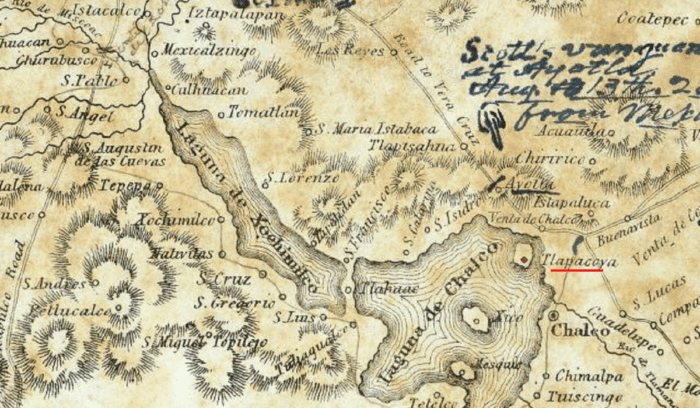
Long before the pyramids of Teotihuacan rose from the Valley of Mexico, a community of people on the shores of Lake Chalco were already building something remarkable. At a site now called Tlapacoya, at the foot of a volcano southeast of present-day Mexico City, the Tlatilco culture established what archaeological evidence suggests may be one of the oldest known settlements in Mesoamerica — with some findings hinting at human presence stretching back tens of thousands of years.
What the evidence shows
- Tlapacoya settlement: The site sits at the base of Tlapacoya volcano on the former shore of Lake Chalco, and served as a major center for the Tlatilco culture during the Preclassic Period, roughly 1500–300 B.C.E.
- Tlapacoya skull dating: Researcher Silvia González and colleagues directly dated one human skull from the site to approximately 9,730 years B.P. (before present), making it among the earliest directly dated human remains in Mexico.
- Early occupation evidence: Animal bones found in middens associated with ancient hearths, along with a buried obsidian blade, have been dated by some researchers to between 21,700 and 25,000 years B.P., though these findings carry citation gaps and remain contested among scholars.
A community shaped by lake and volcano
The geography of Tlapacoya made it an ideal place to settle. Lake Chalco provided fish, waterfowl, and freshwater resources. The surrounding highlands offered obsidian — one of the ancient world’s sharpest cutting materials — and fertile soil for cultivation. The volcano itself may have carried spiritual significance for the people who lived in its shadow.
The Tlatilco culture, known across central Mexico between roughly 1800 and 200 B.C.E., was not a single city-state but a network of related communities sharing artistic traditions, burial practices, and trade connections. Tlapacoya was one of their most significant nodes. Artifacts recovered from the site show contact with distant cultures, including stylistic influences from the Olmec tradition of the Gulf Coast — a signal that Tlapacoya was part of a wider web of exchange, not an isolated settlement.
The figurines and what they tell us
Among the most striking finds at Tlapacoya are its ceramic figurines — small, detailed earthenware figures typically dated to 1500–300 B.C.E. These objects are not just art. They are records of how the Tlatilco people understood bodies, gender, spirituality, and social life. Many figurines depict women, suggesting roles of significance in ceremony or community identity that written history has often failed to preserve.
The site also produced so-called “Dragon Pots” — flat-bottomed cylindrical bowls decorated with incised imagery drawn from Olmec symbolic vocabulary, particularly the were-jaguar motif. That the Tlatilco people at Tlapacoya were producing objects in conversation with a tradition hundreds of miles away speaks to a degree of cultural connectivity that challenges older assumptions about isolated pre-Columbian peoples.
A woman who preserved the record
The modern understanding of Tlapacoya owes a significant debt to Beatriz Barba, who in 1955 became the first Mexican woman to earn the title of archaeologist. Her master’s thesis — Tlapacoya: un sitio preclásico de transición — was among the first studies to examine not just the objects found at a Mexican site, but the full socio-economic and political life of the people who made them. Barba placed the Tlatilco people within their regional context, tracing their trade relationships and the influences that shaped their development.
Her approach was ahead of its time. Where many mid-century archaeologists catalogued artifacts, Barba asked: who were these people, how did they live, and how did they connect with their world?
Lasting impact
Tlapacoya sits at the beginning of a long chain of urban and cultural development in the Valley of Mexico. The lake-shore communities of the Preclassic Period — including those at Tlapacoya — laid the agricultural, social, and spiritual foundations that would eventually produce Teotihuacan, one of the largest cities in the ancient world, and later the Aztec capital of Tenochtitlan.
If the more contested early dates for human presence at Tlapacoya are eventually verified, the implications would extend far beyond Mexico. Evidence of human activity in the Americas dating to 22,000–25,000 years B.P. would require a substantial rethinking of when and how the first peoples arrived on the continent — a debate that is already shifting as new genetic and archaeological evidence accumulates globally.
The site also reminds us that “first cities” are rarely singular events. They grow from generations of people learning to live together, building relationships with land and water, and finding shared ways to mark what is sacred. Tlapacoya represents that slow, cumulative process of becoming — one of the earliest chapters in the long story of human settlement in the Americas.
Blindspots and limits
The most dramatic claims about Tlapacoya — particularly the 22,000–25,000-year dates — remain unverified and are not supported by peer-reviewed consensus, which is why the Wikipedia source itself flags them with citation-needed markers. The site has also suffered severe physical damage: freeway construction has destroyed much of what once stood there, and a substantial portion of the archaeological record is simply gone. The communities whose ancestors built Tlapacoya have rarely been centered in the telling of the site’s significance, and that absence is a real gap in how this history has been framed.
Read more
For more on this story, see: Wikipedia — Tlapacoya archaeological site
For more from Good News for Humankind, see:
- Indigenous land rights gain ground ahead of COP30
- Ghana expands marine protection at Cape Three Points
- The Good News for Humankind archive on prehistory
About this article
- 🤖 This article is AI-generated, based on a framework created by Peter Schulte.
- 🌍 It aims to be inspirational but clear-eyed, accurate, and evidence-based, and grounded in care for the Earth, peace and belonging for all, and human evolution.
- 💬 Leave your notes and suggestions in the comments below — I will do my best to review and implement where appropriate.
- ✉️ One verified piece of good news, one insight from Antihero Project, every weekday morning. Subscribe free.