
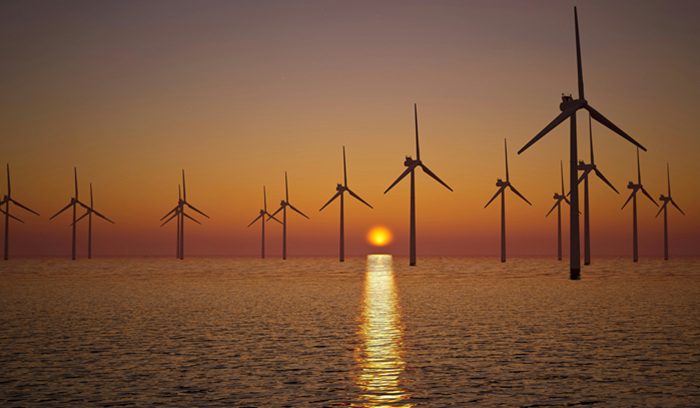
The United Kingdom’s latest clean energy auction has delivered its biggest result ever, awarding contracts to projects totaling 8.4 gigawatts of new generating capacity — enough to power roughly 12 million homes. The contracts, awarded under the government’s Contracts for Difference scheme, mark a decisive rebound after a painful setback just one year earlier, when the same auction mechanism attracted zero offshore wind bids.
At a glance
- U.K. offshore wind: The auction awarded contracts to 131 renewable energy projects across offshore wind, onshore wind, and solar, with offshore wind accounting for the dominant share of new capacity.
- Contracts for Difference: The CfD scheme guarantees developers a fixed “strike price” per unit of electricity, reducing investor risk and making large projects bankable at scale.
- Clean power target: The result brings Britain significantly closer to its goal of fully decarbonizing its electricity grid by 2030 C.E., a central pledge of the current Labour government.
Why this auction felt urgent
The 2023 C.E. auction round was a warning shot. Developers walked away after the government’s maximum strike price failed to keep pace with surging construction and financing costs. The outcome spooked investors and raised real questions about whether the U.K. could meet its clean energy ambitions on any reasonable timeline.
The government responded by raising strike price caps and tightening communication with the industry before the new round launched. The results vindicated the adjustment. Offshore wind projects — including large developments in the North Sea — came back to the table in force, and the auction cleared at prices that analysts described as competitive given current market conditions.
For communities along the Scottish and English coastlines, where many of the supply chain jobs are concentrated, the news carries direct economic weight alongside its climate significance.
What 8.4 gigawatts actually means
Scale can be hard to picture. Eight-point-four gigawatts is roughly equivalent to eight large nuclear power stations running simultaneously. It is also more offshore wind capacity than most countries have installed in total.
The Department for Energy Security and Net Zero framed the result as a platform for industrial as well as environmental progress. Offshore wind now supports tens of thousands of jobs across the U.K., from steel fabrication in the northeast of England to specialist marine logistics in Aberdeen. Analysts at Cornwall Insight noted that the auction’s success should also help stabilize electricity prices over the long term, since wind power has no fuel costs once turbines are installed.
The road to a clean grid by 2030
The Labour government, which took office in mid-2024 C.E., made clean power by 2030 C.E. one of its signature commitments. Independent assessments from groups including National Grid ESO have described the target as achievable but demanding — requiring not only new generation but major upgrades to grid infrastructure and energy storage.
This auction result is necessary, but it is not sufficient on its own. Critics and supporters alike point out that planning bottlenecks and grid connection delays remain the most stubborn obstacles between signed contracts and electrons flowing to homes. Winning a CfD contract is the start of a years-long development process, and some projects face connection waits extending well past 2030 C.E.
The Climate Change Committee, the independent body that advises the U.K. government on emissions targets, has consistently flagged grid modernization as the area most at risk of falling behind. Offshore wind turbines generating record-setting power are only useful if the cables and substations exist to carry that power to where it is needed.
A signal beyond Britain’s borders
The auction’s success carries weight beyond any single country’s energy mix. Europe’s offshore wind industry had been watching closely after the 2023 C.E. failure, and similar stumbles occurred in Denmark and Germany as developers pushed back against price caps that no longer reflected real-world costs.
A successful, large-scale U.K. auction at workable prices sends a signal that the sector can recalibrate. WindEurope, the continent’s main industry body, has pointed to adequate strike price levels as the single variable most within government control — and the U.K. now offers a concrete example of what a corrected course looks like.
The result is also a reminder that clean energy transitions are not smooth lines on a graph. They stall, get recalibrated, and resume. What matters is whether governments absorb the lessons quickly enough to stay on track.
Read more
For more on this story, see: Good News for Humankind
For more from Good News for Humankind, see:
- Alzheimer’s risk cut in half by drug in landmark prevention trial
- U.K. cancer death rates down to their lowest level on record
- The Good News for Humankind archive on renewable energy
About this article
- 🤖 This article is AI-generated, based on a framework created by Peter Schulte.
- 🌍 It aims to be inspirational but clear-eyed, accurate, and evidence-based, and grounded in care for the Earth, peace and belonging for all, and human evolution.
- 💬 Leave your notes and suggestions in the comments below — I will do my best to review and implement where appropriate.
- ✉️ One verified piece of good news, one insight from Antihero Project, every weekday morning. Subscribe free.