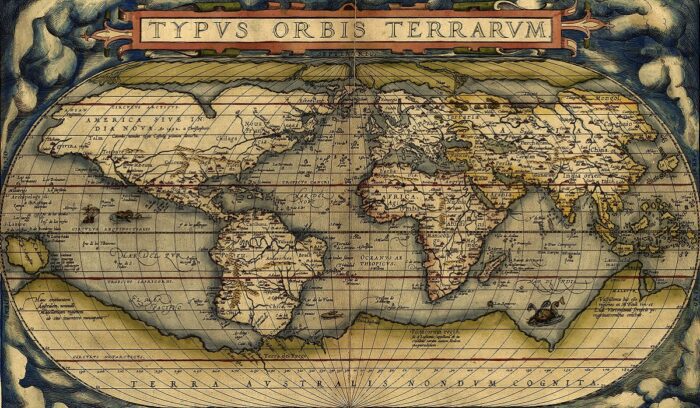
A German mathematician and globe-maker may have drawn an imaginary continent into existence. When Johannes Schöner constructed his 1523 globe — now lost to history — he almost certainly became the first cartographer to depict Terra Australis as a distinct southern landmass, inscribing on it the tantalizing phrase “recently discovered but not yet completely explored.” The continent he drew did not exist. But the idea he mapped would shape exploration, science, and geopolitics for the next 250 years.
Key findings
- Terra Australis: The hypothetical southern continent first appeared on Schöner’s lost 1523 C.E. globe, which French mathematician Oronce Finé is thought to have used as the basis for his famous 1531 double heart-shaped world map.
- Johannes Schöner: The German cosmographer had already built a 1515 globe depicting a southern landmass he called “Brasilie Regio,” drawing on a misread Portuguese voyage report — making the 1523 globe a refinement of an idea he had been developing for nearly a decade.
- Lost globe: Because the 1523 globe no longer survives, its influence is inferred largely from Finé’s 1531 map and Schöner’s own 1533 written tract, Opusculum geographicum, in which he named and described the continent at length.
A continent born from ancient theory
The idea behind Terra Australis was not Schöner’s invention. It stretched back to antiquity. Aristotle, writing in the fourth century B.C.E., reasoned that land in the Northern Hemisphere must be counterbalanced by an equivalent landmass in the south. Ptolemy, in the second century C.E., imagined the Indian Ocean enclosed by southern land. By medieval times, the concept had settled into European geographical thinking under the name “Antipodes” and appeared on zonal maps of the world.
What Schöner did was different. He moved the idea from philosophical theory to mapped reality — and he did it on a foundation of misread evidence.
A 1514 German pamphlet called the Newe Zeytung auss Presillg Landt described a Portuguese voyage near the River Plate. It mentioned a strait between the southern tip of South America and a land to the southwest, referred to as vndtere Presill — meaning, in context, Brazil’s lower latitudes. Schöner read this as describing a separate landmass entirely. On that misreading, he built a circum-Antarctic continent that he gave an unusual ring shape.
What Schöner wrote about the southern land
In his 1533 C.E. tract Opusculum geographicum, Schöner described “Brasilia Australis” with surprising specificity. He wrote that it was “an immense region toward Antarcticum, newly discovered but not yet fully surveyed.” He described its people as living “good, honest lives,” free of monarchy but respectful of elders. He placed the island of Zanzibar near its coast — a geographic confusion that reveals how much guesswork underpinned even his most confident-sounding claims.
He also noted that the body of water beyond the tip of South America should be called “Mare Magellanicum” — one of the first recorded uses of Ferdinand Magellan’s name in cartographic context, linking the real achievement of circumnavigation to the imaginary continent drifting south of it.
How the idea spread
Schöner’s 1523 C.E. globe is thought to have directly influenced Oronce Finé’s landmark 1531 C.E. double cordiform map — a visually striking heart-shaped projection of the world that circulated widely across Europe. Through Finé and others, the idea of Terra Australis gained cartographic momentum. Gerardus Mercator, whose 1569 C.E. projection still shapes how many people picture the world today, included a large southern continent on his maps. Alexander Dalrymple argued for its existence as late as 1767 C.E.
As explorers sailed further south, newly discovered coastlines were frequently assumed to be the northern edge of the missing continent. Each time, closer inspection revealed open ocean. The landmass kept retreating further south on the maps.
When James Cook circumnavigated the Southern Ocean between 1772 C.E. and 1775 C.E., he came close enough to the Antarctic ice shelf to make a continent there seem unlikely — though he never ruled it out entirely. The actual continent of Antarctica was not confirmed until the 1820s C.E., nearly 300 years after Schöner drew his ring-shaped ghost.
Lasting impact
Schöner’s Terra Australis, however misguided, did real intellectual work. It gave explorers a reason to keep sailing south. It structured centuries of geographic debate about hemispheric symmetry. And it left a naming legacy that persists to this day: Australia takes its name from Terra Australis, applied to what was then called New Holland by British explorer Matthew Flinders in his 1814 C.E. book A Voyage to Terra Australis. The actual frozen continent to the south eventually received a new name — Antarctica — coined in the 1890s C.E.
The story of Terra Australis is also a story about how ideas circulate before evidence catches up with them. Schöner’s globe connected ancient Greek theory, garbled Portuguese voyage reports, and Renaissance cosmography into a single compelling image. That image proved more durable than most verified facts of its era.
It is worth remembering that Indigenous peoples of the Southern Hemisphere — in coastal southern Africa, the Pacific Islands, and South America — had navigated southern waters for millennia before any European cartographer placed a hypothetical continent there. Their knowledge of actual southern geography did not flow into European mapmaking in any meaningful way during Schöner’s lifetime.
Blindspots and limits
The most significant limit of this story is the one built into it: Schöner’s 1523 C.E. globe no longer exists, and its content is reconstructed from circumstantial evidence — primarily Finé’s later map and Schöner’s own writings. Scholars use the qualifier “probably” for good reason. It is also worth noting that Schöner’s 1515 C.E. globe already depicted a southern landmass under a different name, making the claim of a clean “first” more complicated than it appears. The tradition of imagining a southern continent stretches back through Macrobius, Ptolemy, and Aristotle — Schöner was a node in a long chain, not its origin point.
Read more
For more on this story, see: Wikipedia — Terra Australis
For more from Good News for Humankind, see:
- Ghana creates a new marine protected area at Cape Three Points
- Indigenous land rights win puts 160 million hectares on the table at COP30
- The Good News for Humankind archive on the early modern era
About this article
- 🤖 This article is AI-generated, based on a framework created by Peter Schulte.
- 🌍 It aims to be inspirational but clear-eyed, accurate, and evidence-based, and grounded in care for the Earth, peace and belonging for all, and human evolution.
- 💬 Leave your notes and suggestions in the comments below — I will do my best to review and implement where appropriate.
- ✉️ One verified piece of good news, one insight from Antihero Project, every weekday morning. Subscribe free.