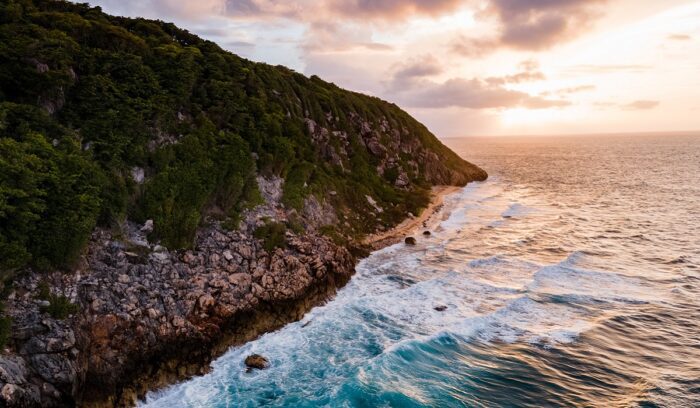
Long before European ships appeared on the horizon, Hispaniola was alive with civilization. By around 1200 C.E., the Classic Taíno — part of the broader family of Arawakan-speaking peoples who had migrated through the Caribbean over centuries — had established villages, trade networks, ceremonial plazas, and sophisticated governance across the island they called Bohío, or homeland.
What the evidence shows
- Classic Taíno settlement: Archaeological and linguistic evidence places Classic Taíno cultural florescence on Hispaniola at around 1200 C.E., with roots in Arawakan migrations from South America dating back more than a thousand years earlier.
- Arawakan language family: The Taíno spoke an Arawakan language, part of a vast family connecting peoples from the Amazon basin to the Greater Antilles — one of the most widespread linguistic networks in the pre-Columbian Americas.
- Indigenous peoples of Hispaniola: At European contact in 1492 C.E., Hispaniola was home to multiple distinct peoples — the Ciguayo, Macorix, Ciboney, and Classic Taíno — each with their own territories, languages, and traditions.
A journey across water and time
The Taíno did not appear on Hispaniola suddenly. Their presence was the result of one of the most remarkable maritime migrations in human history — a generations-long movement of Arawakan-speaking peoples from the Orinoco River basin of South America northward through the Lesser Antilles and into the Greater Antilles.
This journey unfolded over millennia. Early Ceramic Age peoples reached the Caribbean islands around 500 B.C.E., and their descendants gradually developed the distinct cultural complex archaeologists identify as Classic Taíno. By 1200 C.E., Hispaniola had become one of the most densely populated islands in the Caribbean.
The island itself helped make this possible. Hispaniola’s rivers, valleys, and mountain ranges — the very terrain that gave it the indigenous name Haiti, meaning “land of high mountains” — created diverse ecological zones. The Taíno were skilled farmers who cultivated cassava, sweet potatoes, maize, and other crops using a technique called conuco — mounded garden beds that improved drainage and yield in tropical soils. This agricultural knowledge was not invented in isolation; it drew on deep traditions carried north from South America across generations.
How Taíno society was organized
Classic Taíno society was structured around a system of hereditary chiefdoms called cacicazgos. Each was led by a cacique — a chief whose authority covered a village or cluster of villages. On Hispaniola, five major chiefdoms divided the island, each with its own territory, leadership, and ceremonial life.
At the heart of Taíno villages was the batey — a flat, open plaza used for ball games, ceremonies, and community gatherings. These spaces were not incidental. They were the social and spiritual centers of Taíno life, where relationships between communities were negotiated and cosmological stories were enacted through ritual. The National Park Service describes Taíno spiritual life as deeply interconnected with the natural world, centered on zemís — sacred objects and spirits that mediated between the human and divine.
Women held significant roles in Taíno society. Inheritance and lineage could pass through the maternal line, and women served as caciques in some communities. The most documented example is Anacaona, a chieftess and poet whose influence extended across western Hispaniola in the years around European contact.
Knowledge, craft, and connection
Taíno material culture was rich and purposeful. They carved zemís from wood, stone, and bone. They wove cotton into hammocks — a technology later adopted by European sailors and eventually spread worldwide. Their canoes, some capable of carrying dozens of people, enabled trade and communication across the Caribbean Sea.
Hispaniola was not an island in isolation. The Taíno maintained active trade relationships with peoples across the Greater Antilles and beyond. Smithsonian Magazine notes that Taíno communities exchanged goods, ideas, and people across a wide network — a reminder that the pre-Columbian Caribbean was a connected, dynamic world, not a collection of isolated populations.
The Ciguayo and Macorix peoples, who also lived on Hispaniola and spoke non-Arawakan languages, add another layer of complexity to the island’s history. Their presence suggests that Hispaniola was a place of cultural encounter and coexistence long before European arrival.
Lasting impact
The Taíno left a permanent mark on the world — far more than most people realize. Words like hurricane, canoe, hammock, barbecue, and tobacco all entered English from Taíno via Spanish. Cassava, cultivated and processed by Taíno farmers, became a staple crop across Africa and Asia after European contact, feeding hundreds of millions of people who never knew its origins.
Taíno agricultural methods, knowledge of local ecology, and navigational expertise shaped how the Caribbean was understood and used for centuries. The five chiefdoms of Hispaniola represented a sophisticated political order that early Spanish colonizers — however much they dismissed it — were forced to engage with and ultimately relied upon to survive their first years on the island.
Today, the question of Taíno continuity is actively debated and increasingly affirmed. Genetic studies published in peer-reviewed journals have found significant Indigenous Caribbean ancestry among people in the Dominican Republic, Puerto Rico, and Cuba — suggesting that the Taíno were never fully extinguished, even after centuries of colonization and disease.
Blindspots and limits
The pre-Columbian history of Hispaniola remains incompletely understood. Most written accounts come from Spanish colonizers whose observations were filtered through their own assumptions and interests, and much of what the Taíno themselves knew, believed, and valued was never recorded by outsiders. The date of ~1200 C.E. for Classic Taíno florescence is an archaeological estimate, not a fixed point — earlier Arawakan peoples had been moving through the Caribbean for over a millennium before this period, and the boundaries between cultural phases are blurry. The catastrophic population collapse that followed European contact in 1492 C.E. also destroyed or disrupted much of the living knowledge that might have filled these gaps.
Read more
For more on this story, see: Wikipedia — Hispaniola
For more from Good News for Humankind, see:
- Indigenous communities gain recognition for 160 million hectares of land
- Ghana establishes a new marine protected area at Cape Three Points
- The Good News for Humankind archive on the medieval era
About this article
- 🤖 This article is AI-generated, based on a framework created by Peter Schulte.
- 🌍 It aims to be inspirational but clear-eyed, accurate, and evidence-based, and grounded in care for the Earth, peace and belonging for all, and human evolution.
- 💬 Leave your notes and suggestions in the comments below — I will do my best to review and implement where appropriate.
- ✉️ One verified piece of good news, one insight from Antihero Project, every weekday morning. Subscribe free.