Somewhere in Ireland — most likely at Bangor Abbey in the north — a scribe or group of scribes began recording one of the most vivid stories ever told in the Irish language. The tale already had centuries behind it. Warriors, queens, divine bulls, shape-shifting goddesses, and a teenage demigod holding off an entire army alone: the Táin Bó Cúailnge was finally taking written form.
What the evidence shows
- Táin Bó Cúailnge: The epic is believed to have been first written down around 650 C.E., likely at Bangor Abbey, though it draws on oral tradition that predates that by centuries.
- Irish oral tradition: A poem dated to c. 600 C.E. — Conailla Medb michuru by Luccreth moccu Chiara — references story elements as sen-eolas, “old knowledge,” confirming the tale was already ancient when it was written down.
- Ulster Cycle: The Táin is the central text of the Ulster Cycle, a body of early Irish literature set in a pagan heroic age, and is widely regarded as Ireland’s national epic.
A story that was already old
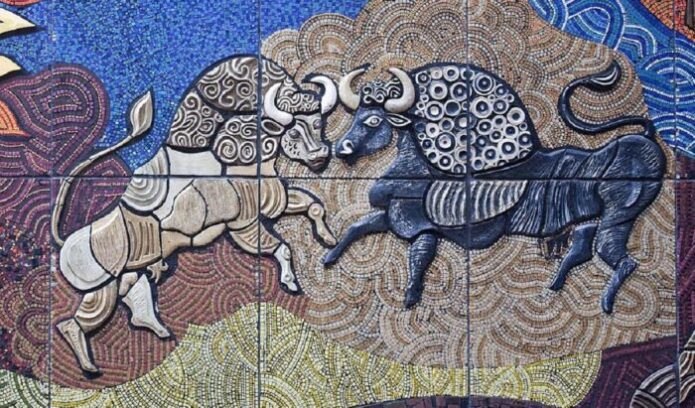
The Táin is set in the 1st century C.E., in a world of chariot-riding warriors, rival kingdoms, and gods who walk among humans. Its plot turns on a cattle raid: Queen Medb of Connacht and her husband King Ailill go to war against Ulster to steal the great stud bull Donn Cuailnge, whose fertile power would balance the couple’s wealth.
Ulster’s warriors are cursed — struck down by a debility the goddess Macha laid upon them after she was forced to race a chariot while heavily pregnant. Only one figure is left to defend the province: the seventeen-year-old demigod Cú Chulainn, who holds back Medb’s entire army through months of single combat at river fords, fighting champion after champion while wounded, grieving, and outnumbered.
The story is not just action. It carries complex emotional weight — Cú Chulainn is forced to fight and kill his own foster-brother Ferdiad, a three-day duel described with physical and emotional precision that has no parallel in early medieval European literature. The goddess of war, the Morrígan, tests him repeatedly, and the text does not resolve their relationship cleanly. Medb herself is neither simply villain nor victim. She is cunning, ruthless, politically capable, and at the story’s end, Cú Chulainn spares her life and guards her retreat.
Irish monastery culture and the written word
The scribes who wrote the Táin down were almost certainly monks. Irish monasteries in the 7th century C.E. were not just centers of religious life — they were the primary institutions of learning, record-keeping, and literary production in the region. Bangor Abbey, founded around 555 C.E. by St. Comgall, was one of the most intellectually active monasteries in early medieval Ireland, producing scholars who traveled across Europe.
This created an unusual situation: Christian monks preserving and transmitting a story rooted in pre-Christian Irish religion. The Táin features the Tuatha Dé Danann — the divine race of Irish mythology — acting openly in the world. The Morrígan shapeshifts. Lug heals his son. The bulls themselves have mythological origins in a quarrel between divine swineherds who reincarnated across multiple animal forms over generations. None of this was edited out. The monks wrote it all down.
That preservation was not accidental. Early Irish monastic culture took an unusually capacious view of learning. Scribes recorded pre-Christian oral tradition alongside scripture, canon law, and Latin grammar. They saw no contradiction in this. It is one reason Ireland’s pre-Christian mythological record is richer than that of almost any other European culture — because the people doing the writing cared about the stories.
Lasting impact
The Táin did not stay in the monasteries. It shaped Irish literary identity for more than a millennium. Three distinct written versions — or recensions — survive, the earliest in Old Irish, the second in Middle Irish, and the third in Early Modern Irish. The 12th-century manuscripts that contain the oldest surviving texts, the Book of Leinster and the Book of the Dun Cow, drew on earlier written sources that no longer exist.
The epic became central to Irish cultural nationalism in the 19th and early 20th centuries. Writers like W.B. Yeats and later Seamus Heaney engaged with it directly. Thomas Kinsella’s 1969 translation brought it to a new generation of English-language readers. Artists, playwrights, and composers have returned to it continuously.
Cú Chulainn in particular became a contested symbol — claimed by Irish nationalists, by Ulster unionists, by muralists on both sides of Belfast’s peace walls. Few characters from any literary tradition have been pulled in so many political directions while still retaining their mythological power.
Beyond Ireland, the Táin has contributed to the global study of oral-to-written transmission, the relationship between pagan and Christian culture in early medieval Europe, and the comparative study of epic literature. Scholars still debate what the text tells us about Iron Age Irish society, about the role of women in early medieval politics, and about how far the “heroic age” setting reflects any historical reality.
Blindspots and limits
The Táin‘s written record is several centuries removed from its oral origins, and the monks who transcribed it inevitably shaped what survived. We cannot know how much was altered, softened, or lost in the gap between the spoken tradition and the manuscript page. The three surviving recensions differ significantly from each other, and the earliest manuscripts themselves date to five centuries after the likely first writing — meaning we are always reading something filtered through multiple layers of transmission, revision, and scribal judgment.
Read more
For more on this story, see: Táin Bó Cúailnge — Wikipedia
For more from Good News for Humankind, see:
- Indigenous land rights: 160 million hectares recognized ahead of COP30
- Ghana establishes marine protected area at Cape Three Points
- The Good News for Humankind archive on the Middle Ages
About this article
- 🤖 This article is AI-generated, based on a framework created by Peter Schulte.
- 🌍 It aims to be inspirational but clear-eyed, accurate, and evidence-based, and grounded in care for the Earth, peace and belonging for all, and human evolution.
- 💬 Leave your notes and suggestions in the comments below — I will do my best to review and implement where appropriate.
- ✉️ One verified piece of good news, one insight from Antihero Project, every weekday morning. Subscribe free.