Sometime around 3500 B.C.E., farmers in the Indian subcontinent did something that would shape kitchens, trade routes, and survival strategies for the next five millennia: they took a wild plant and made it theirs. Sesame — small-seeded, drought-resistant, and extraordinarily rich in oil — became one of the earliest domesticated crops in human history, and arguably the oldest oilseed crop we know of.
What the evidence shows
- Sesame domestication: Charred sesame seeds recovered from archaeological sites in the Indian subcontinent date to approximately 3500–3050 B.C.E., placing domestication at least 5,500 years before the present day.
- Wild sesame origins: Most wild relatives of sesame are native to sub-Saharan Africa, but Sesamum indicum — the cultivated species — originated in India, where it was selectively grown and shaped by human hands over generations.
- Ancient trade networks: By around 2000 B.C.E., archaeobotanist Dorian Q. Fuller documents active trading of sesame between Mesopotamia and the Indian subcontinent, suggesting early regional commerce built around this crop.
A plant worth choosing
Why sesame? The answer lies partly in what it could survive. Sesame grows in drought conditions, tolerates high heat, and can thrive on residual soil moisture after monsoons fade. It can take root at the edge of deserts, in poor soils, in places where other crops fail entirely. Sesame breeder Derald Ray Langham gave it a name that captures this quality plainly: the survivor crop.
Its seeds carry one of the highest oil contents of any plant — around 50% fat by dry weight. For early farming communities, that meant a reliable source of cooking oil, caloric density, and a product with real trading value. Sesame oil doesn’t just feed people; it preserves food, fuels lamps, and serves as medicine. The ancient Egyptians recorded it in the Ebers Papyrus, a medical scroll dating to around 1550 B.C.E., listing sesame among therapeutic compounds. Baskets of sesame seeds were found among the grave goods of King Tutankhamun around 1350 B.C.E.
The crop’s oil content also made it linguistically influential. The word “sesame” traces back through Latin and Greek to ancient Semitic languages — rooted in the Akkadian šamaššamu — and the words derived from it carried a generalized meaning of “oil” or “liquid fat.” In Sumerian, it was illu; in Akkadian, ellu — strikingly similar to the Dravidian words for sesame still in use today in Kannada, Malayalam, and Tamil.
The Indus Valley connection
The timing of sesame’s domestication places it squarely in the long run-up to the Indus Valley Civilization, one of the ancient world’s largest and most sophisticated urban cultures. It is plausible — though not confirmed — that Indus Valley communities exported sesame oil to Mesopotamia, where it was already known by name. Whether or not a direct export trade existed, sesame was clearly moving across the ancient world well before written records could fully capture its journey.
That movement speaks to something important about early agriculture. Domestication was rarely a single act by a single people in a single place. It was a long, cumulative process — generations of farmers selecting seeds, observing what grew best, and passing that knowledge forward. The sesame that eventually reached Egypt, Mesopotamia, and beyond carried within it thousands of years of accumulated human observation.
Lasting impact
Sesame’s influence on global food culture is hard to overstate. It is a core ingredient in cuisines across the Middle East, South Asia, East Asia, and Africa. Global production reached 6.7 million tonnes in 2022 C.E., with Sudan, India, and Myanmar leading output. Sesame oil — particularly from roasted seeds — remains central to Japanese cooking. Tahini, made from ground sesame, underpins hummus and dozens of other dishes across the Mediterranean and beyond.
Beyond flavor, sesame seeds are a nutritional powerhouse. They are rich in calcium, iron, and magnesium, and supply significant amounts of B vitamins and protein. For communities in arid and semi-arid regions where other crops struggle, sesame has long represented food security in seed form.
The crop also contributed to early trade infrastructure. A high-value, storable, oil-bearing seed that travels well is exactly the kind of commodity that encourages long-distance commerce. Sesame helped stitch together the ancient economies of the Indian subcontinent, the Persian Gulf, and the eastern Mediterranean — not dramatically, but persistently, over centuries.
The word “benne,” still used for sesame in parts of the American South, traces a different route: through the Gullah Creole spoken by enslaved African Americans, back to the Malinke language of West Africa. Enslaved people brought sesame to the Americas, where it became part of the agricultural and culinary fabric of the region — a reminder that the crop’s human journey has been neither simple nor painless.
Blindspots and limits
The archaeological record for sesame domestication is real but incomplete. Charred seeds tell us where sesame was being used and processed, not always whether it was fully domesticated in the modern sense — selectively cultivated over many generations for specific traits. Some scholars note the possibility that domestication occurred independently or in parallel in multiple locations, and the role of communities in sub-Saharan Africa, where most wild sesame relatives are native, remains an open question in the archaeobotanical literature.
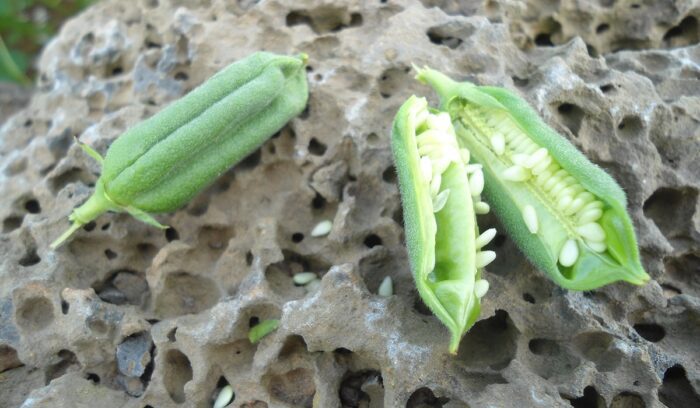
Sesame also has one persistent agronomic problem that thousands of years of cultivation have not fully solved: the seedpod shatters when ripe, scattering seeds before farmers can harvest them. A non-shattering mutant was discovered in 1943 C.E., and agronomists have been working on mechanically harvestable varieties ever since — but dehiscence remains a real constraint on industrial-scale production today.
Read more
For more on this story, see: Wikipedia — Sesame
For more from Good News for Humankind, see:
- Indigenous land rights: 160 million hectares secured ahead of COP30
- Ghana establishes marine protected area at Cape Three Points
- The Good News for Humankind archive on ancient history
About this article
- 🤖 This article is AI-generated, based on a framework created by Peter Schulte.
- 🌍 It aims to be inspirational but clear-eyed, accurate, and evidence-based, and grounded in care for the Earth, peace and belonging for all, and human evolution.
- 💬 Leave your notes and suggestions in the comments below — I will do my best to review and implement where appropriate.
- ✉️ One verified piece of good news, one insight from Antihero Project, every weekday morning. Subscribe free.