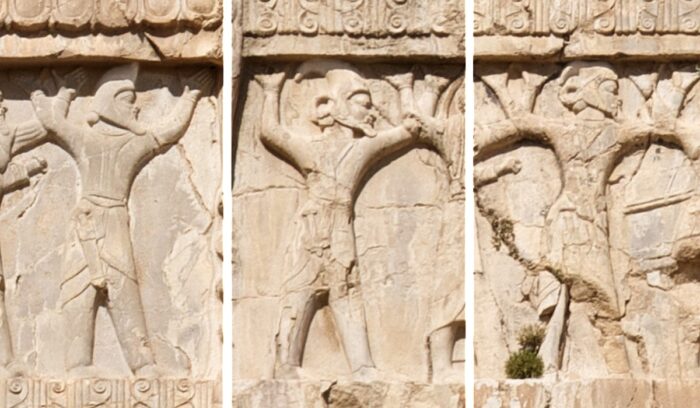
Across thousands of miles of open grassland, a people without cities built one of the ancient world’s most sophisticated cultures. Around 750 B.C.E., the Saka nomads were at the height of their power — riding, trading, and warring across the vast eastern Eurasian Steppe, from the Caspian Sea to the Altai Mountains and beyond into the Tarim Basin. They left behind no written records of their own, yet the evidence they left in the earth is extraordinary.
Key findings
- Saka nomads: The Saka were Eastern Iranian-speaking peoples who emerged on the Eurasian Steppe in the early Iron Age, closely related to the western Scythians but occupying the northern and eastern steppe zones — from the Caspian lowlands east through modern Kazakhstan, Kyrgyzstan, and into western China.
- Kurgan burial mounds: Monumental burial mounds called kurgans — some of extraordinary scale — preserve remarkable evidence of Saka material culture, including the famous Arzhan site in Tuva and the Pazyryk burials in the Altai, which yielded textiles, horses, and tattooed human remains frozen in permafrost.
- Animal style art: A distinctive artistic tradition known as Animal style — featuring dynamic, interlocking depictions of predators, horses, and deer — appears earliest in the eastern steppe and Yenisei River region, suggesting the Saka and their eastern neighbors were the originators of a visual language that would spread west across the entire steppe world.
Who the Saka were
The Saka were not a single unified nation. They were a constellation of related Eastern Iranian-speaking groups who shared a language family, a material culture, and a way of life organized around horses, herds, and seasonal migration. Ancient Persian inscriptions distinguish at least three Saka sub-groups: the Sakā tigraxaudā (pointed-hat Saka), the Sakā haumavargā (haoma-drinking Saka), and others living beyond the Danube. Ancient Greeks called all steppe nomads Scythians. Babylonians called them Cimmerians. The names shifted depending on who was doing the naming — but the people themselves were real, numerous, and formidable.
Their name likely derived from the Iranian root sak-, meaning “to go” or “to roam.” In a meaningful sense, the name encoded their identity: a people defined by movement.
Genetic and archaeological research now confirms that Saka culture did not spring fully formed from a single homeland. Different Saka sub-groups arose through local cultural adaptation across the steppe, shaped by contact with Siberian, East Asian, and Central Asian populations. This was not a simple westward or eastward migration — it was a distributed cultural flowering, arising simultaneously across an enormous landscape.
What they built and how they lived
Nomadic does not mean simple. The Saka were skilled metallurgists, producing weapons, horse trappings, and ornaments in gold, bronze, and iron. Their Animal style artwork — rendered on belt plaques, sword scabbards, horse bridles, and felt hangings — shows a people with sophisticated aesthetic values and symbolic imagination. The earliest known examples of this artistic tradition appear in the eastern steppe around the 10th century B.C.E., predating the more famous western Scythian examples by generations.
Their burial practices speak to complex social hierarchies and deep spiritual lives. Elite kurgans, some measuring tens of meters across, were furnished with weapons, horses, food offerings, and treasures from distant lands. The Pazyryk burials in the Altai Mountains, frozen for centuries, preserved organic materials almost never found in ancient graves — woolen textiles with Near Eastern motifs, Chinese silk, and the tattooed skin of the buried themselves. These were people in active exchange with the wider ancient world.
Women in some Saka communities held roles as warriors and ritual specialists. Archaeological finds across the steppe have repeatedly uncovered women buried with weapons and armor, giving concrete form to ancient Greek accounts of Amazons — likely a distorted reflection of real Saka and Scythian practices. This challenges assumptions about gender roles in ancient pastoral societies that persist even today.
A network, not an island
The Saka did not exist in isolation. They were embedded in the connective tissue of the ancient world. Achaemenid Persian records document their encounters with Darius I, who campaigned against eastern steppe nomads around 520–518 B.C.E. Saka warriors served in Persian armies. Saka goldsmiths absorbed and transformed artistic influences from the Near East, China, and South Asia. The famous Issyk kurgan in modern Kazakhstan yielded a burial costume covered in thousands of gold ornaments — an object as sophisticated as anything produced by the settled civilizations of the same era.
Trade routes that would later coalesce into the Silk Road ran through Saka territory. Long before merchants gave those routes a name, Saka riders were already moving goods, ideas, and genes across the continent. Their role as intermediaries between East and West shaped the ancient world in ways that formal histories rarely credit.
Chinese records from the Han dynasty refer to peoples called the Sək in the Ili and Chuval valleys — placing Saka communities directly in contact with East Asian civilizations. In the Tarim Basin, Saka settlers established communities at Khotan, Kashgar, and Yarkand, where their languages survived into the first millennium C.E. as the Khotanese and Tumshuqese languages.
Lasting impact
The Saka’s most durable contribution may be invisible: they helped carry Iranian languages, technologies, and cultural forms across the breadth of Asia. Their descendants and cultural heirs shaped the Indo-Scythian kingdoms of northwestern India, influenced the Parthian Empire, and left linguistic traces in the Tarim Basin that survived for a thousand years after the steppe culture that produced them had transformed beyond recognition.
The Animal style they helped originate spread westward across the steppe world and influenced artistic traditions from the Black Sea to Scandinavia. The sophisticated horsemanship and military tactics of steppe nomads, perfected across generations of Saka and Scythian life, informed cavalry warfare for centuries. When we picture mounted archers on the ancient steppe, we are picturing, in part, the Saka.
Their example also challenges a persistent bias in how we tell the story of civilization. Cities, writing, and monuments have long served as the markers of “advanced” societies. The Saka remind us that complexity, artistry, and far-reaching influence can arise from peoples who built not in stone but in felt, leather, wood, and gold — and who carried their culture on horseback across a continent.
Indigenous knowledge systems organized around mobility and ecological attunement — like those of the Saka — are increasingly recognized by researchers as sophisticated adaptive strategies, not deficits. The archaeology of nomadic cultures has grown substantially in recent decades, recovering voices that sedentary-centered historiography long treated as marginal.
Blindspots and limits
Because the Saka left no written records of their own, almost everything we know about them comes from the accounts of their neighbors — Persians, Greeks, and Chinese — who often described them as threats, curiosities, or inferiors. Archaeological recovery has improved dramatically, but the steppe is vast and many sites remain unexcavated or disturbed by looting. The internal diversity of Saka groups, their self-understandings, and the texture of everyday life beyond elite burials remain largely beyond our reach. What we call “Saka culture” is necessarily a reconstruction, assembled from the outside looking in.
Read more
For more on this story, see: Wikipedia — Saka
For more from Good News for Humankind, see:
- Indigenous peoples secure land rights for 160 million hectares at COP30
- Ghana establishes marine protected area at Cape Three Points
- The Good News for Humankind archive on ancient history
About this article
- 🤖 This article is AI-generated, based on a framework created by Peter Schulte.
- 🌍 It aims to be inspirational but clear-eyed, accurate, and evidence-based, and grounded in care for the Earth, peace and belonging for all, and human evolution.
- 💬 Leave your notes and suggestions in the comments below — I will do my best to review and implement where appropriate.
- ✉️ One verified piece of good news, one insight from Antihero Project, every weekday morning. Subscribe free.
More Good News
-

Ghana declares its first marine protected area to rescue depleted fish stocks
Ghana’s marine protected area — the country’s first ever — marks a historic turning point for a nation gripped by a quiet fisheries crisis. Established near Cape Three Points in the Western Region, the protected zone restricts or bans fishing activity to allow severely depleted fish populations to recover. Ghana’s coastal stocks have fallen by an estimated 80 percent from historic levels, threatening food security and the livelihoods of millions of small-scale fishers. The declaration also carries regional significance, potentially inspiring neighboring Gulf of Guinea nations to establish coordinated protections of their own.
-

U.S. researchers cut Alzheimer’s risk by half in first-ever prevention trial
Alzheimer’s prevention may have reached a turning point after a landmark trial showed that removing amyloid plaques before symptoms appear can cut the risk of developing the disease by roughly 50%. Researchers at Washington University School of Medicine studied people with rare genetic mutations that make Alzheimer’s nearly inevitable, finding that early, aggressive treatment can genuinely alter the disease’s course. The results, published in The Lancet Neurology, mark the first time any intervention has shown potential to prevent Alzheimer’s from appearing at all, not merely slow its progression. That distinction matters enormously, since amyloid begins accumulating in the brain two…
-

Marie-Louise Eta becomes first female head coach in men’s top-five European leagues
Female head coach Marie-Louise Eta made history on April 11, 2026, when Union Berlin appointed her as interim head coach — becoming the first woman ever to hold a head coaching position in any of men’s top-five European leagues. The Bundesliga club made the move after dismissing Steffen Baumgart, with five matches remaining and real relegation stakes on the line. Eta, 34, had served as assistant coach since 2023 and was already a familiar, trusted presence within the squad. This was no ceremonial gesture — she was handed a survival fight, which is precisely what makes the milestone significant.