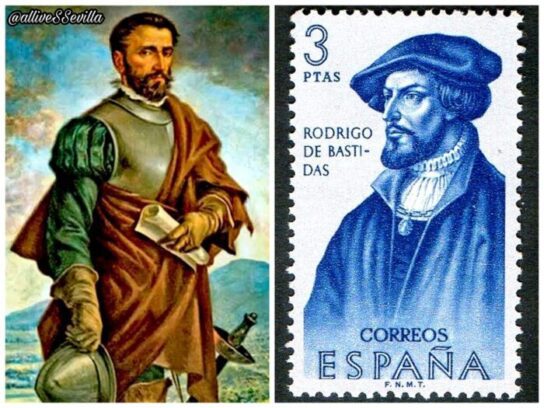
In 1501 C.E., a Spanish explorer sailing southwest from Venezuela became the first European to chart the eastern coastline of the Isthmus of Panama — a narrow strip of land that would soon become one of the most strategically important places on Earth. Rodrigo de Bastidas didn’t know what he had found. But the consequences of that voyage would ripple through centuries of trade, colonization, and the forced movement of millions of people.
What the evidence shows
- Rodrigo de Bastidas: A Seville-born notary and merchant, Bastidas secured a contract from the Spanish Crown and sailed westward from present-day Venezuela in 1501 C.E., becoming the first documented European to reach and sail along the Caribbean coast of the Isthmus of Panama.
- Isthmus of Panama: The narrow land bridge connecting North and South America had been home to complex, diverse Indigenous societies for thousands of years — including Chibchan-, Choco-, and Cueva-speaking peoples numbering possibly up to 200,000 at the time of European contact.
- European exploration timeline: Bastidas arrived roughly a year before Christopher Columbus explored the same coastline on his fourth voyage, and nearly a decade before the first permanent European settlement on the American mainland was established at Santa María la Antigua del Darién in 1510 C.E.
A land already known
Long before Bastidas arrived, the isthmus was alive with human activity. Archaeological evidence places pottery-making cultures in central Panama as far back as 2500 B.C.E. — among the earliest in the Americas. The peoples of the isthmus hunted, fished, grew corn and cacao, and traded along established regional routes. Monumental stone sculptures at the Barriles site in Chiriquí province and elaborate polychrome pottery from the Gran Coclé tradition speak to cultures of real sophistication.
The Cueva people, likely the largest group on the isthmus at the time, may have served as a lingua franca across communities. Early European accounts describe “diverse native isthmian groups exhibiting cultural variety” — a snapshot of a world that had been developing for millennia.
There is even evidence of pre-Columbian contact between the Pacific coast of Panama and the Philippines, with coconuts reaching Panama from across the Pacific. The isthmus was already stitched into broader human networks before any European set foot there.
What Bastidas actually did
Bastidas sailed along the eastern Caribbean coast of the isthmus — mapping, observing, and trading. He was accompanied on the voyage by Juan de la Cosa, the celebrated cartographer whose maps would help shape Europe’s early understanding of the Americas. Bastidas was known, even by the standards of his era, for relatively peaceful relations with Indigenous communities — a distinction that set him apart from many of his contemporaries.
His route would be retraced and extended by Columbus the following year, and then by a wave of Spanish expeditions that would transform the isthmus into the hinge of a global empire. By 1519 C.E., Vasco Núñez de Balboa had already crossed the isthmus and become the first European to see the Pacific Ocean from the Americas — a crossing made possible in part by knowledge Bastidas and others had gathered about the shape of the land.
Lasting impact
The exploration of the Isthmus of Panama triggered one of the most consequential geographic pivots in history. Within decades, Spanish administrators had built the Camino Real and Camino de Cruces — trans-isthmian overland routes linking the Atlantic and Pacific — making Panama the transfer point for an extraordinary volume of wealth extracted from the Americas. Historians estimate that between 1531 and 1660 C.E., some 60% of all gold entering Spain from the New World passed through the isthmus.
Panama City, founded in 1519 C.E., became the first European city on the Pacific coast of the Americas. The city’s position made it a crossroads not just of trade goods but of peoples, languages, and cultures — a role it has never entirely stopped playing.
The isthmus also became a critical node in the transatlantic slave trade, with Genoese merchants operating the port of Panama under Spanish concession from around 1520 C.E. The forced movement of enslaved Africans through Panama left a deep mark on the region’s demographics and culture — one whose full weight is still being reckoned with.
Centuries later, the same geographic logic that drew Bastidas to the isthmus drove the construction of the Panama Canal, completed in 1914 C.E. The canal remains one of the most important maritime passages in the world, handling roughly 5% of global trade.
Blindspots and limits
The framing of Bastidas as the “first European to explore” Panama is accurate but incomplete — it describes an arrival, not a discovery. The isthmus had been thoroughly known, mapped in human memory, and traversed for thousands of years before 1501 C.E. The word “explore” belongs to the European vantage point, not to the land itself.
The historical record of this voyage is also thin. Much of what we know comes from colonial-era accounts that were written to serve Spanish imperial interests, meaning Indigenous voices, knowledge systems, and perspectives on first contact are largely absent from the documentary trail. What those communities experienced in 1501 C.E. and in the years that followed is a story still being reconstructed — slowly, and incompletely — from archaeological evidence and oral tradition.
Bastidas himself returned to the Americas. He later founded the city of Santa Marta in present-day Colombia in 1525 C.E. — a tenure marked by conflicts with settlers who resented his attempts to protect Indigenous people from the worst abuses of the encomienda system. He was stabbed by mutinous colonists and died of his wounds in Cuba in 1527 C.E.
He was, by the measures of his time, an unusual figure: a man of commercial ambition who nonetheless drew lines others refused to draw. That complexity is part of the record too.
The story of Panama’s “discovery” is really the story of a meeting — between one world that had been building for millennia and another that was only beginning to understand the shape of the Earth. What came next was neither simple nor clean. But the isthmus endured, and so did its peoples, in forms that continue to assert themselves today.
Read more
For more on this story, see: History of Panama — Wikipedia
For more from Good News for Humankind, see:
- Ghana establishes a marine protected area at Cape Three Points
- Indigenous land rights: 160 million hectares recognized ahead of COP30
- The Good News for Humankind archive on the early modern era
About this article
- 🤖 This article is AI-generated, based on a framework created by Peter Schulte.
- 🌍 It aims to be inspirational but clear-eyed, accurate, and evidence-based, and grounded in care for the Earth, peace and belonging for all, and human evolution.
- 💬 Leave your notes and suggestions in the comments below — I will do my best to review and implement where appropriate.
- ✉️ One verified piece of good news, one insight from Antihero Project, every weekday morning. Subscribe free.