
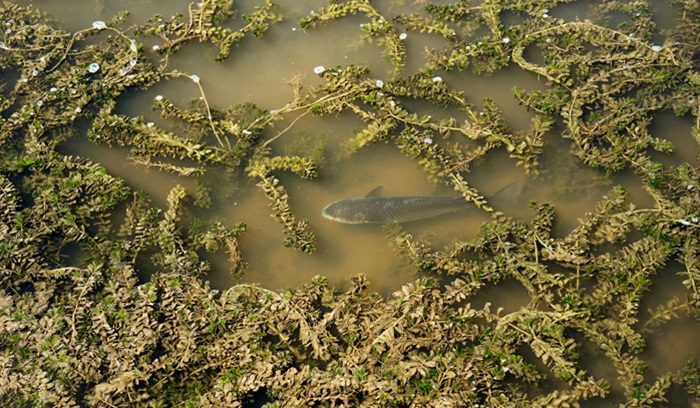
Along the coast near Mackay in Queensland, Australia, tidal gates and embankments built 50 to 60 years ago are coming down — and the ecosystems they suppressed for decades are surging back. Saltwater is flowing inland again, juvenile barramundi are appearing in restored waterways, and an invasive grass that had smothered native vegetation is dying off. What was once drained and fenced for cattle pasture is becoming wetland again.
At a glance
- Tidal gate removal: Between 500 and 600 tidal gates exist in the Mackay area alone, with thousands more across Queensland — dozens have now been removed as part of a coordinated restoration effort.
- Barramundi habitat: Fisheries ecologist Matt Moore and rancher Christopher Rek have already recorded juvenile barramundi using the reestablished tidal waterways, confirming the ecosystem is responding quickly.
- Invasive grass control: The return of saltwater through a channel dug through an artificial embankment has killed off roughly 80% of Hymenachne, a weed of national significance, in the area around Cape Palmerston National Park.
How salt became the solution
For decades, the logic seemed straightforward: keep the ocean out, drain the land, graze cattle. Tidal gates and earthen embankments made it possible. But the cost to the broader ecosystem was steep.
Salt marshes and estuarine habitats — among the most productive ecosystems on Earth — were cut off from the tidal pulses they depend on. Mangroves, which need regular saltwater inundation, were outcompeted by Hymenachne, an introduced grass originally brought to Queensland as cattle fodder. Fish species like barramundi lost the brackish nursery channels they had used for spawning for thousands of years before European settlement.
As understanding of these ecosystems grew, so did the case for undoing what earlier generations had built. The solution, it turned out, was elegantly simple: remove the gates and let the tide back in.
A rancher gives the land back
Christopher Rek, a 60-year-old rancher whose family grazed cattle on land near Mackay, agreed to let Catchment Solutions — a water management company involved in the restoration — remove the tidal gates on his property. His reasoning was direct.
“I stole from nature by using all my cows and now it’s time to give the land back and let nature do its thing,” he told ABC News Australia.
What followed was rapid. Tidal waters returned, channels refilled, and barramundi — a species culturally and economically important across northern Australia — began using the waterways almost immediately. Before settlement, these same channels functioned as critical corridors linking the sea to inland spawning grounds. The fish, it seems, remembered the routes.
Yuwi traditional owners witness a spiritual restoration
The restoration near Mackay is not only ecological — it carries deep cultural weight. The Yuwi Indigenous Corporation, whose members are the traditional owners of the land in this region, worked alongside Greening Australia, Catchment Solutions, and Queensland Parks and Wildlife Service to dig a 45-foot channel through a 180-foot embankment that had blocked the ocean’s tides from entering Yuwi native title lands.
When the channel opened and saltwater flowed back onto country, Yuwi elders were present. They described it as “a very special and spiritual moment.”
For the Yuwi, the return of tidal water is not simply an environmental fix — it is a reconnection with a living landscape their ancestors have known for tens of thousands of years. Their involvement in the restoration reflects a broader shift in how land management in Australia is beginning to center Indigenous ecological knowledge rather than override it.
A model with room to grow
The scale of what remains is significant. Mackay alone has between 500 and 600 tidal gates. Across Queensland, the number runs into the thousands. Each one represents a potential restoration site — a place where salt marsh, mangrove forest, and estuarine fish habitat could return if the infrastructure holding them back were removed.
The trend extends well beyond Queensland. Dam and barrier removal projects are accelerating across the United States, Europe, and parts of Asia, driven by growing evidence that restoring natural water movement benefits both ecology and local economies — particularly fishing communities. A 2023 C.E. study published in Nature found that removing barriers from rivers significantly increases fish biodiversity within just a few years of restoration.
Wetland restoration also plays a measurable role in carbon sequestration. Coastal wetlands — including mangroves and salt marshes — store carbon at rates far higher than most terrestrial forests, which gives tidal restoration added urgency in the context of climate change.
Still, removing tidal gates at scale requires sustained coordination between landowners, government agencies, Indigenous communities, and conservation groups. The Mackay effort shows it can work — but replicating it across hundreds or thousands of sites will take time, funding, and continued political will that isn’t guaranteed.
For now, the barramundi are back. The mangroves are recovering. And on Yuwi country, the tide has come home.
Read more
For more on this story, see: Good News Network
For more from Good News for Humankind, see:
- Ghana establishes a new marine protected area at Cape Three Points
- Indigenous land rights recognized across 160 million hectares ahead of COP30
- The Good News for Humankind archive on Australia
About this article
- 🤖 This article is AI-generated, based on a framework created by Peter Schulte.
- 🌍 It aims to be inspirational but clear-eyed, accurate, and evidence-based, and grounded in care for the Earth, peace and belonging for all, and human evolution.
- 💬 Leave your notes and suggestions in the comments below — I will do my best to review and implement where appropriate.
- ✉️ One verified piece of good news, one insight from Antihero Project, every weekday morning. Subscribe free.