Thousands of years before the first cities rose along the rivers of Mesopotamia, a distinctive group of people were making sophisticated stone tools in the highlands of what is now Lebanon. Their flint-knapping techniques were so consistent and recognizable that, nearly 12,000 years later, archaeologists would give them their own name: the Qaraoun culture.
Key findings
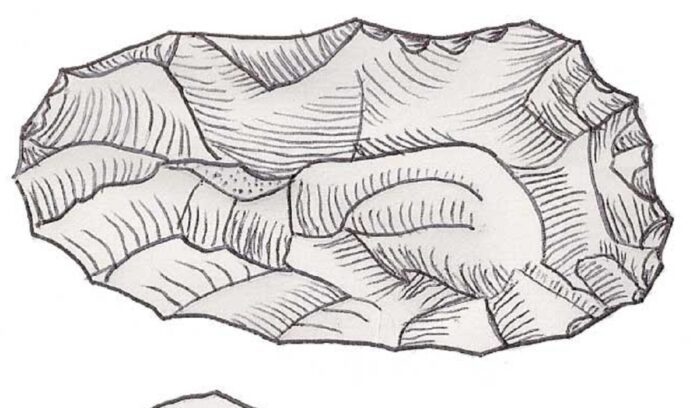
- Qaraoun culture: A recognized variant of the Neolithic in the Lebanese highlands, centered around Qaraoun in the Beqaa Valley and defined by a distinctive heavy flint tool industry known as the Gigantolithic or Heavy Neolithic.
- Gigantolithic tools: The large, robust flint implements associated with this culture suggest specialized land use and resource processing — a technology finely adapted to the highland environment of the Levant.
- Beqaa Valley archaeology: The site was identified in 1954 C.E. by Jesuit priest and geologist Henri Fleisch, who collected over 100 flint tools in a single two-hour survey — a density that pointed immediately to sustained, deliberate human activity.
A culture written in stone
Around 10,000 B.C.E., the Beqaa Valley was a very different place. The climate was shifting at the end of the last glacial period, and human communities across the Levant were adapting to new landscapes, new animals, and new possibilities for food and settlement.
The people of the Qaraoun culture were part of this broader wave of change. They left behind no written records, no monuments, and no graves that have yet been identified with certainty. What they left were tools — heavy, carefully worked flint implements that archaeologists classify as Neolithic or proto-Neolithic in character.
The tools are not delicate. They are large, robust, and built for serious work. That heaviness is actually what makes the Qaraoun industry distinctive — and what led to the term “Gigantolithic,” meaning roughly “made of giant stones.” In a region where many Neolithic traditions favored smaller, more refined blades, the Qaraoun toolkit stood apart.
Henri Fleisch and the 1954 discovery
The modern recognition of the Qaraoun culture has a specific date: September 2, 1954 C.E. That afternoon, Henri Fleisch — a Jesuit priest, geologist, and passionate student of Lebanese prehistory — walked a hillside near Qaraoun and picked up more than 100 flint tools in two hours.
The density of tools told him something important was here. He brought his findings to two of the most respected prehistoric archaeologists of the 20th century: Alfred Rust, known for his excavations of Paleolithic sites in Germany and the Levant, and Dorothy Garrod, the first woman to hold a professorship at the University of Cambridge and a pioneering figure in Levantine prehistory.
Both confirmed that the tools showed Neolithic elements. Garrod offered a careful characterization: in the absence of stratigraphic evidence — meaning no layered excavation context to fix the tools in time — the Qaraoun culture could be considered Mesolithic or proto-Neolithic. That dating places it broadly in a window of 5,000 to 20,000 years before present, with 10,000 B.C.E. sitting near the center of that range.
Lasting impact
The Qaraoun culture matters for several reasons beyond its immediate archaeology. It is one of the clearest early examples of a regionally distinct tool tradition in the Levant — evidence that human communities were not simply doing the same things everywhere, but developing local responses to local environments.
The Beqaa Valley itself would go on to become one of the most historically significant corridors in the ancient world. It sits between the Lebanon and Anti-Lebanon mountain ranges and has served for millennia as a route for migration, trade, and cultural exchange across the Fertile Crescent. The people of the Qaraoun culture were among the earliest known inhabitants to leave a material signature in this landscape.
Their tools also contributed to the growing scholarly picture of the Levant as a crossroads of human prehistory — a region where African, European, and Asian populations met, mixed, and innovated across hundreds of thousands of years. The Qaraoun tradition is one thread in that much larger story.
Dorothy Garrod’s involvement is itself historically significant. Her willingness to engage seriously with Fleisch’s surface finds, and to offer a careful scholarly assessment without overstating the evidence, modeled the kind of rigorous humility that good archaeology requires. She had already transformed understanding of the Natufian culture — the immediate predecessors of agriculture in the Levant — and her confirmation of the Qaraoun culture’s Neolithic elements carried real weight in the field.
Blindspots and limits
The Qaraoun culture remains poorly understood by the standards of modern archaeology. No stratified excavation has definitively confirmed the culture’s age, and Garrod’s own framing — “in the absence of all stratigraphical evidence” — is a reminder of how much is still unknown. The broad date range of 5,000 to 20,000 years before present covers an enormous span of human history, and without more precise dating, the culture’s relationship to other Levantine traditions remains speculative.
It is also worth remembering that surface finds, however dense, represent only what survived and was found on one afternoon in 1954 C.E. The full extent of Qaraoun culture — its geographic range, its seasonal patterns, its relationship to contemporaneous communities in the Jordan Valley or coastal Lebanon — remains an open question that future excavation may one day answer.
Read more
For more on this story, see: Wikipedia — Qaraoun culture
For more from Good News for Humankind, see:
- Ghana establishes a major marine protected area at Cape Three Points
- Indigenous land rights: 160 million hectares recognized ahead of COP30
- The Good News for Humankind archive on prehistory
About this article
- 🤖 This article is AI-generated, based on a framework created by Peter Schulte.
- 🌍 It aims to be inspirational but clear-eyed, accurate, and evidence-based, and grounded in care for the Earth, peace and belonging for all, and human evolution.
- 💬 Leave your notes and suggestions in the comments below — I will do my best to review and implement where appropriate.
- ✉️ One verified piece of good news, one insight from Antihero Project, every weekday morning. Subscribe free.