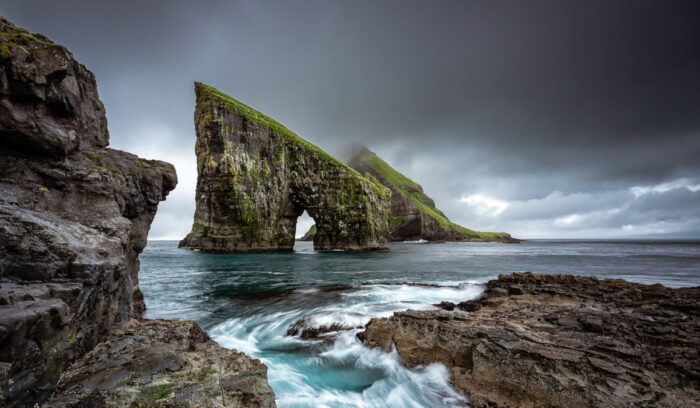
Halfway between Norway and Iceland, the Faroe Islands look like the edge of the world — a cluster of wave-battered volcanic rock rising from the North Atlantic. For generations, historians assumed the Vikings were the first to find them, making landfall around the ninth century C.E. once improved navigation made such voyages possible. New archaeological evidence overturns that story entirely.
What the evidence shows
- Pre-Viking settlement: Excavations beneath a Viking longhouse on the Faroes uncovered two distinct layers of burnt peat ash containing barley grains — unambiguous evidence of human habitation predating the Norse arrival by centuries.
- Radiocarbon dating: One ash layer dates to somewhere between the fourth and sixth centuries C.E., the other between the sixth and eighth centuries — placing people in the islands at least 500 years before the Vikings.
- Faroe Islands settlers: The identity of these early inhabitants remains unknown; candidates include peoples from Ireland, Scotland, Shetland, and Scandinavia — all cultures that grew barley and burned peat for fuel in the early medieval period.
A dig beneath the longhouse
The discovery came from a team led by Durham University archaeologist Michael Church and Símun V. Arge, curator at the National Museum of the Faroe Islands. Working beneath the foundations of a Viking longhouse, they found what turned out to be a remarkably ordinary set of remains: burnt peat ash, spread across a sandy surface to control erosion.
That practice was common throughout the North Atlantic in the early medieval period. Households burned peat for heat, then scattered the ash to stabilize loose ground. It was practical, unremarkable — and, in this case, preserved across more than a thousand years.
The barley grains embedded in the ash are what clinched it. Barley doesn’t grow wild in the Faroes. Someone brought it there, planted it, harvested it, and built enough of a domestic life to leave traces in the soil. “All we know is that they cut peat and grew barley,” Church told Archaeology magazine. “They lived in sporadic, small-scale settlements.”
The Irish monk hypothesis
Who were these people? The honest answer is: we don’t know. But Church points to one compelling thread. Sixth-century Irish monastic texts describe islands to the north that some scholars have identified as the Faroes. Monks of that era — following the tradition of peregrinatio pro Christo, or wandering for Christ — were known to make extraordinary sea voyages in search of solitude and spiritual proximity to God.
The Irish monk Dicuil, writing around 825 C.E., described islands in the northern sea that had been inhabited by monks for roughly a century before Norse raiders arrived. His account has long circulated as circumstantial evidence of Irish monastic presence in the Faroes. The new archaeological evidence gives that account something concrete to stand next to.
But Church is careful not to overreach. People from Scandinavia, Scotland, and the Shetland Islands also fit the archaeological profile. All of them grew barley. All of them burned peat. The ash layers don’t carry a signature that points to one group over another.
Lasting impact
The find reshapes what we know about early North Atlantic exploration. Before this discovery, the standard narrative held that sustained human movement into the deep North Atlantic began with the Vikings — a story that credited Norse navigational skill almost exclusively.
What Church’s team found suggests something older and quieter. Small groups, motivated by faith or necessity or simple restlessness, were reaching remote island chains in the early medieval period using technologies that historians had tended to underestimate. The Irish currach — a small, hide-covered boat — was capable of open-ocean voyaging, as Tim Severin’s 1976–1977 recreation of St. Brendan’s voyage demonstrated. These were not accidental landings.
The discovery also shifts attention toward peoples and traditions that rarely appear in the central frame of North Atlantic history. If the early settlers were Irish monks — or Scots, or Shetlanders — their presence represents a chapter of exploration that left almost no written record in the dominant historical sources, and nearly no archaeological trace once the Vikings arrived.
“The Viking invasion in the ninth century would have destroyed most of the evidence for them,” Church notes. What survived did so by accident: ash spread on sand, covered by centuries of sediment, then sealed beneath a Norse longhouse.
Blindspots and limits
The evidence here is real but thin. Two ash layers and some barley grains confirm human presence; they do not confirm identity, numbers, permanence, or the nature of the society that left them. It’s possible the early settlers were seasonal visitors rather than permanent inhabitants, or that multiple waves of people arrived from different places at different times.
The Viking colonization that followed in the ninth century C.E. likely erased most of what came before — not just physically, through construction and land clearance, but narratively, through the dominance of Norse written records. Whatever the earlier settlers built, believed, or knew about the North Atlantic, almost none of it survived to be found.
Read more
For more on this story, see: Archaeology Magazine — Faroe Islands first settlers discovered
For more from Good News for Humankind, see:
- Ghana creates a new marine protected area at Cape Three Points
- Uganda reintroduces rhinos to Kidepo Valley
- The Good News for Humankind archive on the early medieval era
About this article
- 🤖 This article is AI-generated, based on a framework created by Peter Schulte.
- 🌍 It aims to be inspirational but clear-eyed, accurate, and evidence-based, and grounded in care for the Earth, peace and belonging for all, and human evolution.
- 💬 Leave your notes and suggestions in the comments below — I will do my best to review and implement where appropriate.
- ✉️ One verified piece of good news, one insight from Antihero Project, every weekday morning. Subscribe free.
More Good News
-

China plans to double its already massive clean energy supply by 2035
China’s new climate pledge to the United Nations sets a target of 3,600 gigawatts of wind and solar power by 2035 — more than the entire electricity-generating capacity of the United States today, and roughly double what China has already built. The commitment is woven into the country’s next Five-Year Plan, which directs state banks, provinces, and manufacturers to move in the same direction. Because China makes about 80% of the world’s solar panels, every factory it scales up makes clean energy cheaper for buyers in Africa, Southeast Asia, Latin America, and everywhere else. That ripple effect is what makes…
-
Doctors hail first breakthrough in asthma and COPD treatment in 50 years
Benralizumab, a single injection given during an asthma or COPD attack, outperformed the steroid pills that have been the only emergency option since the 1970s. In a King’s College London trial of 158 patients, those who got the shot had four times fewer treatment failures over 90 days, along with easier breathing and fewer follow-up visits. Because steroids carry real risks with repeated use — diabetes, osteoporosis, and more — a genuine alternative could change daily life for millions of people who live in fear of the next flare-up. After a half-century of stalled progress on diseases that claim 3.8…
-

Mexico launches universal healthcare for all 133 million citizens
Mexico universal healthcare is now officially a reality, with the country launching a system designed to cover all 133 million citizens through the restructured IMSS-Bienestar network. Before this reform, an estimated 50 million Mexicans had no formal health insurance, with rural and Indigenous communities bearing the heaviest burden of untreated illness and medical debt. The new system severs the long-standing tie between employment and healthcare access, providing free consultations, medicines, and hospital services regardless of income. If implemented effectively, Mexico’s move could serve as a powerful model for other middle-income nations still navigating fragmented, inequitable health systems.