
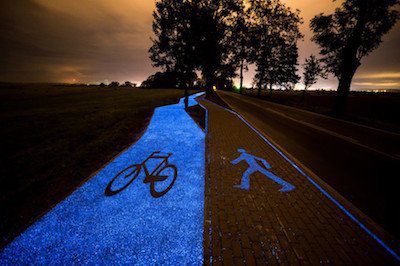
In the rural town of Lidzbark Warminski, something strange and beautiful happens after dark. A stretch of bicycle path begins to glow — deep, luminous blue — powered entirely by sunlight it absorbed during the day.
Key findings
- Glow-in-the-dark bicycle path: The 328-foot test section in Lidzbark Warminski, Poland, emits bright blue light for up to 10 hours each night without any external electricity source.
- Luminophore particles: The path’s surface contains synthetic compounds that absorb solar energy during daylight and release it as visible light after dark — no batteries, no grid connection required.
- Solar-powered infrastructure: Designed by Polish-European engineering firm TPA sp. z o.o., the path represents a practical application of passive solar technology to everyday pedestrian and cyclist safety.
A safety solution with an unexpected beauty
The path was not designed to be a spectacle. TPA’s president, Igor Ruttmar, was thinking about accident prevention — specifically the danger cyclists and pedestrians face on rural roads far from city lighting.
“We hope that the glowing bicycle path will help prevent bicycle and pedestrian accidents at night,” Ruttmar said. “It’s a problem here in Poland, especially in the areas farther from the cities that are darker and more invisible in the night.”
The blue color was a deliberate aesthetic choice, selected to complement the surrounding landscape of dark forest, river, rolling hills, and the nearby Wielochowskie Lake. What emerged from a safety calculation turned out to be genuinely striking — the kind of infrastructure that makes people stop and look.
How luminophores make it work
The science behind the path is relatively straightforward, though the engineering required to make it durable and weather-resistant took real effort. Luminophore particles — synthetic compounds long used in watch faces, emergency signage, and industrial applications — are embedded in the pavement surface.
During daylight hours, these particles absorb photons from sunlight. After dark, they release that stored energy as light, producing the path’s signature blue glow. According to Ruttmar, the material sustains that glow for over 10 hours, meaning it can illuminate through an entire night and begin recharging again the following day.
The path connects to a larger recreation trail leading to Wielochowskie Lake, giving it practical everyday use beyond novelty. TPA planned to monitor how the surface held up through a Polish winter before deciding whether to extend the illuminated section.
Europe’s broader experiment with illuminated paths
Poland was not working in isolation. The idea of light-emitting cycling infrastructure had been circulating in European design and engineering circles for a few years before the Lidzbark Warminski path opened.
In 2014 C.E., Dutch designer Daan Roosegaarde created a “Van Gogh Path” in Eindhoven — a cycling trail embedded with glow-in-the-dark stones inspired by Van Gogh’s Starry Night, paying tribute to the artist who lived in the region. That path used similar luminescent principles but relied on solar-charged LED accents rather than purely passive luminophores.
In 2013 C.E., a U.K.-based company called Pro-Teq Surfacing applied a spray-on glow-in-the-dark coating called “Starpath” to a section of path at Christ’s Pieces Park in Cambridge, England. That system covered 1,614 square feet and demonstrated that the concept could work at a meaningful scale.
What distinguished TPA’s Polish path was its claim to 100% solar energy use, with no supplementary power source — a meaningful step toward infrastructure that costs almost nothing to operate after installation.
Lasting impact
The Lidzbark Warminski path pointed toward something larger than one glowing trail: the possibility that safety infrastructure in rural areas does not have to depend on electrical grids, ongoing energy costs, or complex maintenance systems.
Passive luminescent surfaces could, in principle, be applied to rural roads, hiking trails, canal towpaths, and pedestrian crossings in areas where running electrical lines is prohibitively expensive or environmentally disruptive. Research into photoluminescent road markings has continued to develop in the years since, with interest from road safety engineers across Europe and beyond.
The path also contributed to a broader cultural shift in how cyclists and urban planners think about infrastructure. The OECD’s International Transport Forum has documented the relationship between infrastructure design and cyclist safety outcomes, and illuminated paths in rural settings represent one concrete response to a documented problem. Cycling is also among the most carbon-efficient forms of transportation — making solar-powered cycling infrastructure a small but coherent part of Europe’s climate transport strategy, as the European Environment Agency has noted.
Blindspots and limits
The path’s initial test section covered only 328 feet — a short stretch in one rural town, far from constituting a scalable answer to global cycling infrastructure needs. Luminophore materials also vary significantly in durability, and the long-term performance of embedded particles through freeze-thaw cycles, heavy use, and UV degradation remained an open question at the time of launch. Whether the technology proved cost-effective enough to expand at meaningful scale is something the evidence from this single project could not yet answer.
Read more
For more on this story, see: Understanding Compassion
For more from Good News for Humankind, see:
- ‘Radical’ solar technology breakthrough allows energy to be stored for up to 18 years
- Solar’s 2025 growth is the largest ever recorded for any energy source
- The Good News for Humankind archive on renewable energy
- Clean energy milestones: the breakthroughs powering a fossil-free future
About this article
- 🤖 This article is AI-generated, based on a framework created by Peter Schulte.
- 🌍 It aims to be inspirational but clear-eyed, accurate, and evidence-based, and grounded in care for the Earth, peace and belonging for all, and human evolution.
- 💬 Leave your notes and suggestions in the comments below — I will do my best to review and implement where appropriate.
- ✉️ One verified piece of good news, one insight from Antihero Project, every weekday morning. Subscribe free.


