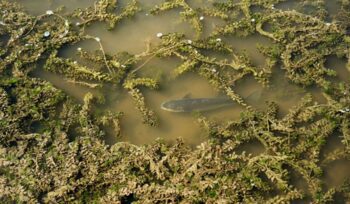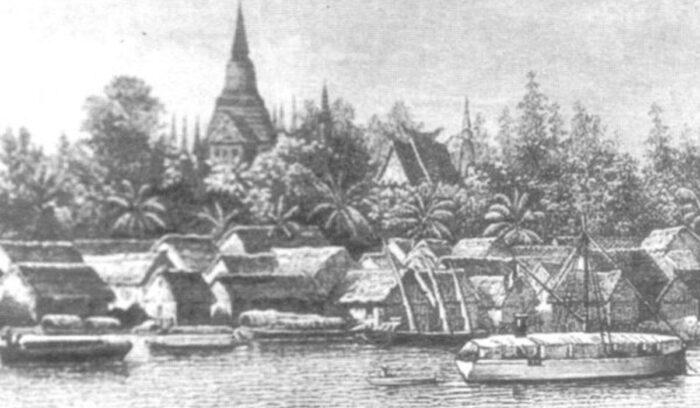
In 1372 C.E., a wealthy widow named Penh pulled a floating koki tree from the Tonlé Sap River during a storm and found inside it four Buddha statues and a figure of Vishnu. She took this as a sign from the divine. On the west bank of the river, she raised a hill and crowned it with a shrine. Around that hill, a city grew. Today, more than two million people call it home.
Key findings
- Phnom Penh founding: According to Khmer legend recorded in the 15th century, Lady Penh established a shrine on a constructed hill in 1372 C.E., giving the city both its name and its origin story — “Phnom” meaning hill in Khmer, “Penh” the name of its founder.
- Lady Penh: Also known as Daun Penh in Khmer, she is remembered not as a queen or a general but as an ordinary woman whose act of reverence — housing sacred objects she found in a river — shaped the geography and identity of a future capital.
- Tonlé Sap confluence: The location Lady Penh chose sits at the meeting point of the Tonlé Sap and Mekong rivers, a position of profound strategic and commercial value that later made Phnom Penh one of mainland Southeast Asia’s most significant trading cities.
A city born from legend and water
The founding story of Phnom Penh is, at its core, a story about a woman acting on faith. Lady Penh did not command armies or hold a throne. She found sacred objects in a river and decided they deserved a proper home. The hill she raised — by hand and community effort — became Wat Phnom, the Buddhist temple that still stands at the north end of central Phnom Penh today.
The legend was first written down roughly a century after the founding is said to have occurred, which means we are working with cultural memory as much as documented history. But that does not diminish its significance. Across the world, founding myths carry real information about values, geography, and identity — and Phnom Penh’s founding myth places a woman, not a king, at the center.
The confluence where Lady Penh built her shrine was already a place of human activity. Archaeological evidence from the nearby Choeung Ek commune suggests settlement and pottery production in the area dating back to the 5th century C.E. The region had long been part of the Funan Kingdom and later the Khmer Empire. Lady Penh was not founding a city in empty land — she was planting a sacred marker in a landscape already alive with civilization.
From shrine to capital
For roughly six decades after its founding, Phnom Penh remained a local settlement rather than a political center. That changed in the 1430s C.E., when King Ponhea Yat moved the Khmer capital south from Angkor Thom after Siamese forces captured and destroyed it. Phnom Penh’s position at the confluence of major rivers made it a natural choice — accessible by water from multiple directions and defensible by geography.
The city served as the royal capital for about 73 years before internal conflicts among the royal court led subsequent kings to relocate the capital multiple times. It did not permanently reclaim that status until the French colonial era in 1865 C.E. But the core — the hill, the shrine, the river — remained.
By the time Cambodia gained independence in the 20th century, Phnom Penh had become known across the region as the “Pearl of Asia,” celebrated for its blend of colonial French architecture, Art Deco buildings, and New Khmer design. The city embodied a remarkable convergence of aesthetic traditions.
Lasting impact
The Phnom Penh founding established a spatial and spiritual logic that has organized Cambodian civic life for more than six centuries. Wat Phnom remains a place of active worship and a symbol of national identity. The riverfront confluence Lady Penh identified as sacred became the commercial and political heart of a nation.
More broadly, the story of Phnom Penh’s founding has preserved the memory of a woman as the originating force behind one of Southeast Asia’s great capitals. In histories that frequently erase or minimize the roles of ordinary women, Lady Penh’s name is literally written into the city’s geography. Every time someone says “Phnom Penh,” they say her name.
The city today is Cambodia’s political, economic, and cultural center, home to the Royal Palace, major universities, and an increasingly dynamic arts scene. Its position within ASEAN has grown steadily, with Phnom Penh hosting multiple ASEAN Summits and the 32nd Southeast Asian Games. The city is also set to host the Asian Youth Games in 2031 C.E. — the first Cambodian city and only the second in Southeast Asia to do so.
The rivers that made the location valuable in 1372 C.E. still define its character. The Mekong and Tonlé Sap remain central to Cambodian food security, fisheries, and cultural life — though both face significant pressure from upstream dam construction and climate-related changes in seasonal flooding patterns.
Blindspots and limits
The founding legend was written down roughly a century after the fact, which means the precise year of 1372 C.E. carries more cultural authority than documentary certainty. Archaeological evidence confirms long human habitation in the area well before that date, suggesting the “founding” may describe a moment of sacred consecration rather than first settlement.
Phnom Penh’s history also includes profound catastrophe. The Khmer Rouge’s forced evacuation of the entire city in 1975 C.E. — one of the largest forced relocations in modern history — emptied a city of millions virtually overnight, and the genocide that followed killed an estimated 1.5 to 2 million Cambodians. Any account of the city that stops in 1372 C.E. leaves out the full arc of what its people have endured and rebuilt.
The story of Cambodia’s reconstruction since 1979 C.E. is still unfolding — economic growth has been significant, but inequality and political freedoms remain areas of ongoing concern.
Read more
For more on this story, see: Wikipedia — Phnom Penh
For more from Good News for Humankind, see:
- Indigenous land rights win recognition for 160 million hectares at COP30
- Ghana establishes marine protected area at Cape Three Points
- The Good News for Humankind archive on Cambodia
About this article
- 🤖 This article is AI-generated, based on a framework created by Peter Schulte.
- 🌍 It aims to be inspirational but clear-eyed, accurate, and evidence-based, and grounded in care for the Earth, peace and belonging for all, and human evolution.
- 💬 Leave your notes and suggestions in the comments below — I will do my best to review and implement where appropriate.
- ✉️ One verified piece of good news, one insight from Antihero Project, every weekday morning. Subscribe free.