
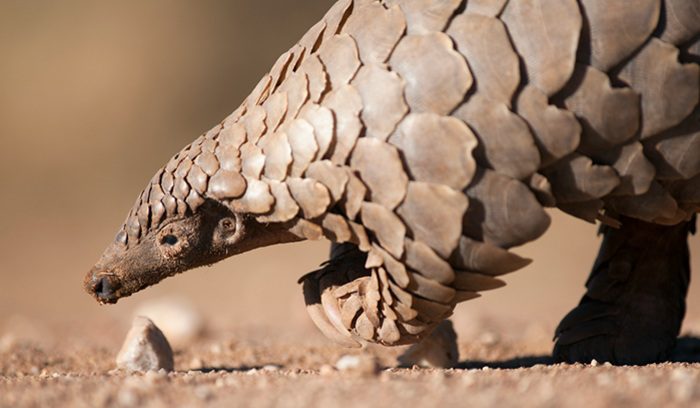
A suspected high-level wildlife trafficker wanted for five years has been arrested in Nigeria following a joint operation between Nigerian authorities and an international conservation enforcement body. The arrest of Shamsideen Abubakar marks one of the most significant breakthroughs yet in efforts to shut down transnational pangolin trafficking networks operating out of West Africa.
At a glance
- Pangolin trafficking: A 2021 seizure connected to Abubakar’s network recovered more than one tonne of pangolin scales — representing up to 5,451 individual animals.
- Wildlife Justice Commission: The international body provided intelligence analysis, investigative support, and evidentiary assistance to Nigerian agencies over nearly five years of pursuit.
- Nigerian enforcement agencies: NESREA and the Nigeria Customs Service led the arrest operation, reflecting growing institutional capacity for wildlife crime prosecution in the country.
Five years in the making
Abubakar had been declared wanted by the Federal High Court in Lagos since September 2021, when a coordinated sweep by Nigerian Customs and the Wildlife Justice Commission caught his associates and uncovered more than a tonne of pangolin scales in Ikeja, Lagos. Abubakar himself slipped away.
What followed was a five-year intelligence-led pursuit. The Wildlife Justice Commission, headquartered in The Hague, worked alongside the National Environmental Standards and Regulations Enforcement Agency (NESREA) and the Nigeria Customs Service to track, build evidence, and wait. The arrest in April 2026 C.E. is the result of that sustained effort.
“This arrest sends a clear message: there is no safe haven for wildlife traffickers,” said Olivia Swaak-Goldman, Executive Director of the Wildlife Justice Commission.
Why pangolins, and why Nigeria
Pangolins are the most trafficked wild mammals on Earth. All eight species are listed as vulnerable, endangered, or critically endangered on the IUCN Red List. Their scales are in demand across parts of Asia for use in traditional medicine, and their meat is considered a delicacy in some markets. A single seizure of one tonne of scales can represent thousands of individual animals.
Nigeria has become a major transit hub for wildlife trafficking between Central and West Africa and Asian markets. Traffickers exploit container shipping routes, corrupt supply chains, and weak enforcement gaps. The 2021 Ikeja seizure was among the largest pangolin scale busts ever recorded in the country.
The UN Office on Drugs and Crime estimates wildlife trafficking generates between $7 billion and $23 billion annually, making it one of the most lucrative illicit trades in the world — and one that intersects closely with other organized crime networks.
What made this arrest possible
The Wildlife Justice Commission has operated in Nigeria since July 2021 C.E., embedding itself in enforcement efforts rather than working at arm’s length. That model — providing real-time intelligence, evidentiary support, and case-building alongside national agencies — is increasingly seen as the most effective approach to wildlife crime prosecution.
“This case shows how strategic collaboration between national agencies and international partners can deliver tangible, lasting impact,” Swaak-Goldman said.
Crucially, the Nigerian agencies involved have strengthened their own capacity through this process. NESREA and the Nigeria Customs Service now have documented experience prosecuting high-level wildlife crime — a foundation that matters beyond any single arrest.
That said, one arrest does not dismantle a network. Trafficking operations are rarely dependent on a single individual, and the structures that enabled Abubakar’s alleged operation — shipping infrastructure, financial flows, demand markets — remain largely intact. Sustained enforcement and international cooperation will be required to make the gains last.
A signal, not just a result
What stands out about this case is the message it sends within trafficking networks. High-level operators have historically assumed they can evade justice indefinitely, especially when operating across jurisdictions. A five-year pursuit ending in arrest chips away at that assumption.
Wildlife trafficking thrives on impunity. Cases that demonstrate patience, cross-border coordination, and eventual accountability — like this one — help shift the risk calculus for those considering entering or continuing in the trade.
For pangolins, which reproduce slowly and cannot recover quickly from population losses, every enforcement success matters. Whether it translates into measurable population recovery depends on many more years of work. But the arrest of an alleged kingpin who had evaded capture for half a decade is, at minimum, evidence that the system can work.
Read more
For more on this story, see: Wildlife Justice Commission
For more from Good News for Humankind, see:
- U.K. cancer death rates fall to their lowest level on record
- Ghana establishes a marine protected area at Cape Three Points
- The Good News for Humankind archive on Nigeria
About this article
- 🤖 This article is AI-generated, based on a framework created by Peter Schulte.
- 🌍 It aims to be inspirational but clear-eyed, accurate, and evidence-based, and grounded in care for the Earth, peace and belonging for all, and human evolution.
- 💬 Leave your notes and suggestions in the comments below — I will do my best to review and implement where appropriate.
- ✉️ One verified piece of good news, one insight from Antihero Project, every weekday morning. Subscribe free.