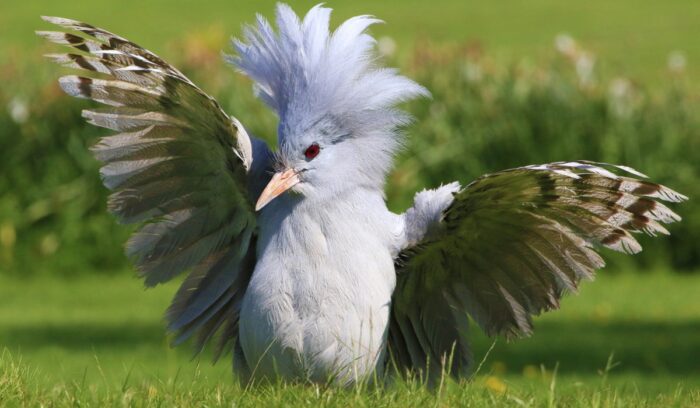
A flightless bird found nowhere else on Earth is staging a remarkable recovery. The cagou — New Caledonia’s grey-plumed, crested icon — has seen its population nearly triple in one protected area after conservationists launched sustained efforts to eliminate predators, track family groups, and breed birds in captivity. From an estimated 60 individuals in Rivière Bleue park in 1984 C.E., managers now count more than 1,000 there. In Farino’s sanctuary, the cagou population is approaching the maximum the habitat can support.
At a glance
- Cagou recovery: Scientist Jörn Theuerkauf estimates the Farino population has roughly tripled since 2017 C.E., when predators killed about three-quarters of the birds in the area.
- Predator management: Hunters patrol Farino’s sanctuary weekly to remove stray dogs, and the park bans all dogs — even leashed ones — following a devastating attack that left at least 30 cagous dead in a single morning.
- Captive breeding: A program that began in the 1980s C.E. at a Nouméa zoo released dozens of cagous into Rivière Bleue park; the zoo still cares for 16 birds today and releases chicks into the wild after weaning them off supplemental feeding.
Why the cagou is so vulnerable
The cagou (Rhynochetos jubatus) is the sole surviving member of its genus and family — a true evolutionary one-of-a-kind. It cannot fly and does not move quickly, which makes it easy prey for introduced mammals that have no place in its ancestral ecosystem.
Stray dogs are the most dangerous threat. In 2017 C.E., a single predator event wiped out roughly 75 percent of the Farino population. A repeat incident in 2020 C.E. pushed numbers down again. Wild pigs compound the problem by trampling ground-level nests before eggs can hatch. Cats take chicks. Because the species evolved in the absence of ground predators, it has no instinct to flee or hide from them.
The bird’s cultural weight makes its decline especially painful for New Caledonians. The cagou appears on postage stamps and banknotes. Its bark-like call — loud enough to carry through dense rainforest before dawn — is one of the territory’s defining sounds. Losing it would mean losing something irreplaceable.
How the recovery happened
Conservation work on the cagou stretches back to 1984 C.E., when the species was listed under the Convention on International Trade in Endangered Species (CITES). Around the same time, Nouméa’s zoo and forest park began a captive breeding program, releasing birds into Rivière Bleue provincial park over nearly two decades.
“Dozens of specimens were released, which made it possible to repopulate the park and it worked well,” says zoo director Marianne Bonzon. The program continues today on a smaller scale. Keepers deliberately skip feeding once a week so chicks learn to forage before release.
In Farino, researcher Jörn Theuerkauf and conservation officer Henri Bloc of the Nature Warden brigade have spent more than a decade monitoring the birds. Since 2015 C.E., transmitters and antennae attached to 15 family groups — each consisting of one female and several males — have mapped territory ranges of up to 15 hectares. Camera traps monitor nests from egg to hatch. The data lets rangers identify where predators are moving before an attack occurs.
After the 2020 C.E. incident, Farino’s park introduced the dog ban and formalized weekly predator hunts. Rivière Bleue takes a similar approach: park manager Jean-Marc Meriot says roughly 60 wild pigs and several stray dogs are removed each year. The IUCN lists the cagou as endangered, with a global estimate of around 2,000 individuals — meaning these two parks now hold a substantial share of the entire species.
What the numbers look like now
In Rivière Bleue, the count has grown from roughly 60 birds in 1984 C.E. to more than 1,000 today. “We now have forest areas with new pairs of cagous,” Meriot says. “The cagou population is doing very well, it is constantly expanding and things couldn’t be better.”
In Farino, Bloc estimates about 1,200 birds now live in the sanctuary. Theuerkauf says the population is approaching its ecological ceiling — the point at which food and territory limit further growth. Cagous are intensely territorial, and conflict between groups increases as density rises. But that is a good problem to have for a species that faced near-collapse just a few years ago.
The zoo in Nouméa handles injured wild birds alongside its breeding program. Animals brought in by local residents receive veterinary care and are released once healthy, closing the loop between captive and wild populations.
An unfinished story
The cagou’s total wild population — estimated at around 2,000 — remains low, and its entire range sits within a single territory, meaning a disease outbreak or a wave of invasive predators could still cause serious harm. The predator management programs require ongoing funding and staffing that cannot be taken for granted. Local conservation organizations continue to push for broader habitat protection and stronger controls on domestic animals near forest edges.
Still, the trajectory is clear. Decades of patient work — captive breeding, predator control, behavioral monitoring, and community engagement — have pulled the cagou back from the edge. It is a model worth studying for island species conservation worldwide. Island biodiversity hotspots face some of the steepest extinction risks on the planet, and the cagou’s recovery shows that coordinated, long-term action can reverse those odds.
The bird that barks like a dog in the dark is still calling from the forests of New Caledonia. And for now, more of them are calling than before. BirdLife International continues to track the species as part of its global seabird and endemic bird monitoring work, and the Pacific Invasives Initiative coordinates regional efforts to address the introduced species threatening island fauna across the Pacific.
Read more
For more on this story, see: The Guardian
For more from Good News for Humankind, see:
- Ghana creates a new marine protected area at Cape Three Points
- Renewables now make up at least 49% of global power capacity
- The Good News for Humankind archive on wildlife conservation
About this article
- 🤖 This article is AI-generated, based on a framework created by Peter Schulte.
- 🌍 It aims to be inspirational but clear-eyed, accurate, and evidence-based, and grounded in care for the Earth, peace and belonging for all, and human evolution.
- 💬 Leave your notes and suggestions in the comments below — I will do my best to review and implement where appropriate.
- ✉️ One verified piece of good news, one insight from Antihero Project, every weekday morning. Subscribe free.