Long before empires rose across the Sahel, and centuries before Arab geographers recorded the rhythms of trade along the Senegal River, something quieter and more foundational was taking shape. Communities in what is now Senegal were farming, fishing, shaping ceramics, and burying their dead — living not as wanderers but as rooted peoples with traditions, tools, and deep ties to the land.
What the evidence shows
- Neolithic settlements: By around 400 B.C.E., communities across the Senegambia region had developed agriculture, fishing, and craft production, including ceramics — marking a transition from mobile hunter-gatherer life to more permanent settlement.
- Archaeological remains: Stone tools associated with the Acheulean and Levallois traditions have been found across Cap-Vert, the Falémé valley, and the Senegal River basin, showing human presence stretching back far earlier — the Neolithic period built on a very long foundation.
- Senegambia burial traditions: Tombs from this period have been identified and named by the Serer people, who distinguish between pre-Serer “podom” tombs and ancestral “lomb” or “pomboy” tombs — evidence of complex social organization and cultural continuity.
A region shaped by many hands
The Senegambia region was not settled once, by one people, in one wave. Scholars describe multiple migrations from the north and east over many centuries. Oral traditions suggest that Mande-speaking peoples were among the earliest in northern Senegal, while other historians argue that the Serer, Jola, and Papel peoples represent some of the oldest continuous presences in the region.
Africanist historian Donald R. Wright has pointed to place-names in the Gambia and Casamance regions as clues to even earlier inhabitants — groups like the Bainunk, Kasanga, and Beafada. Wright also cautions, wisely, that projecting today’s ethnic categories onto people who lived thousands of years ago is “at best highly speculative.”
What archaeology confirms is that by the time we reach 400 B.C.E., the Senegambia region was home to people who had moved well beyond subsistence survival. They were producers — of food, of objects, of meaning. The Neolithic period in Senegambia is characterized by ceramics, burial practices, farming, and fishing — a full suite of what we might recognize as settled, organized community life.
The world these communities built
Ceramics are among the most telling markers of Neolithic settlement. Making and using pottery requires not just technical skill but a certain relationship with place — you do not carry heavy clay vessels if you expect to move constantly. The presence of ceramics in the archaeological record of Senegambia signals communities that expected to stay, to store, to plan across seasons.
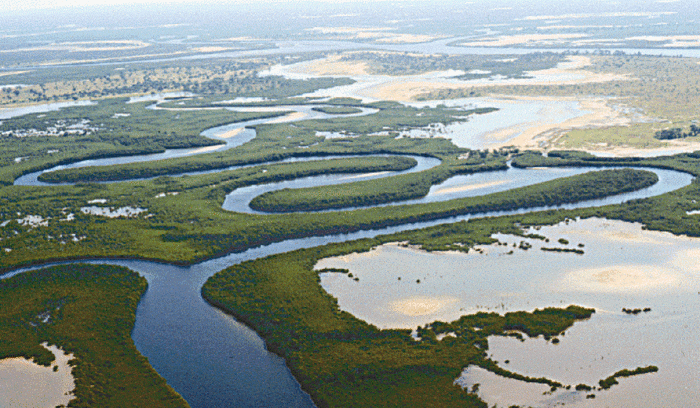
Fishing was central to life along the Senegal River and the Atlantic coast. The Falémé valley, in the southeast, holds some of the earliest evidence of human activity in the region — and the combination of riverine resources, fertile land, and overland connections made this part of West Africa an especially hospitable place for permanent settlement.
The stone circles of Senegambia, recognized as a UNESCO World Heritage Site, represent a later but connected tradition — massive laterite monuments associated with burial and ceremony, built between roughly 750 B.C.E. and 1600 C.E. They stand as physical proof that the communities taking root in this era were capable of sustained, organized, multigenerational effort.
Lasting impact
The Neolithic communities of Senegambia laid the social and material foundations for everything that followed. The Ghana Empire, the Kingdom of Tekrur, the Jolof Empire — none of these political formations emerged from nothing. They grew from populations that had already developed agricultural systems, trade relationships, craft traditions, and the kind of dense social organization that only settled life makes possible.
The Serer, Wolof, Fulani, Jola, and other peoples whose cultures still shape Senegal today are heirs to this deep continuity. When the Kingdom of Tekrur emerged along the Senegal River in the early centuries C.E., it did so in a landscape already shaped by thousands of years of human presence and adaptation.
The oral traditions that historians now use alongside archaeological evidence — the Serer distinctions between types of tombs, the epics of Ndiadiane Ndiaye and Maissa Wali — are themselves products of this long-rooted culture. Communities that farm, bury their dead with ceremony, and name the graves of their ancestors are communities building memory. And memory, across generations, becomes history.
West Africa’s Neolithic transition also unfolded in contact with wider currents. Archaeological research across sub-Saharan Africa has increasingly shown that food production, metallurgy, and ceramic traditions spread through networks of exchange and migration — not isolation. Senegambia was part of a connected world long before Arab traders or European sailors arrived to document it.
Blindspots and limits
The archaeological record for this period in Senegal remains genuinely incomplete. The periodization of Senegalese prehistory is, as the source material notes, “controversial” — scholars disagree about where prehistory ends and history begins, and many sites have not been fully excavated or dated. Oral traditions provide irreplaceable depth but cannot always be matched to specific archaeological layers.
Assigning ethnic or group identities to communities from 400 B.C.E. is also fraught: the ancestors of today’s Serer, Wolof, or Jola peoples were living through cultural processes that do not map cleanly onto modern categories. The communities who thrived here were real — their tools, tombs, and ceramics survive — but much of their specific experience remains, for now, beyond our reach.
Read more
For more on this story, see: History of Senegal — Wikipedia
For more from Good News for Humankind, see:
- Ghana establishes a marine protected area at Cape Three Points
- Indigenous land rights recognized: 160 million hectares at COP30
- The Good News for Humankind archive on Senegal
About this article
- 🤖 This article is AI-generated, based on a framework created by Peter Schulte.
- 🌍 It aims to be inspirational but clear-eyed, accurate, and evidence-based, and grounded in care for the Earth, peace and belonging for all, and human evolution.
- 💬 Leave your notes and suggestions in the comments below — I will do my best to review and implement where appropriate.
- ✉️ One verified piece of good news, one insight from Antihero Project, every weekday morning. Subscribe free.