Long before modern borders divided the eastern Himalayas, a people known as the Monpa had already built something remarkable: a sustained political and cultural order in one of the world’s most rugged landscapes. The kingdom of Monyul — also called Lhomon — took shape in the region centered on what is now Bhutan and the Tawang area of northeastern India, and by around 500 C.E. it had endured for roughly a thousand years.
What the evidence shows
- Monyul kingdom: A state called Lhomon or Monyul is believed to have existed from approximately 500 B.C.E. to 600 C.E., centered in the region of present-day Bhutan.
- Monpa people: The Monpa spoke Tibeto-Burman languages and were distinguished by early Tibetan Buddhist texts from neighboring groups — defined partly by their openness to Buddhist missionaries and their settled, governable communities.
- Himalayan governance: Traditional Monpa society was administered by a council of six ministers called Trukdri, suggesting organized political structures that long predate outside influence.
A kingdom shaped by its terrain
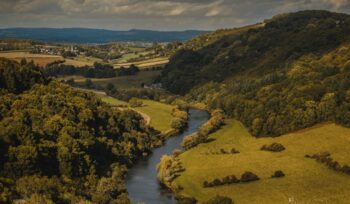
Monyul — the name roughly translates to “low land” — occupied a strategic corridor south of the Himalayan crest line. Its borders were never sharply defined, stretching loosely from eastern Bhutan and western Sikkim eastward toward Tawang. The imprecision wasn’t weakness; it reflected how the Monpa understood their world: as a place defined by rivers, ridgelines, and passes rather than surveyed lines on a map.
The landscape itself was the kingdom’s greatest defense. High passes, dense forests, and extreme seasonal variation made Monyul difficult to reach and harder to hold for outsiders. Generations of Monpa people learned to move through it — herding yak, sheep, and horses across elevation gradients that would exhaust less experienced travelers. Some accounts describe them as the only fully nomadic tribe in northeastern India.
That mobility was not a sign of statelessness. The Trukdri council governed local affairs with considerable authority. Communities organized harvests, managed trade with Tibet, and maintained cultural continuity across a fragmented geography. The kingdom held.
Culture built to last
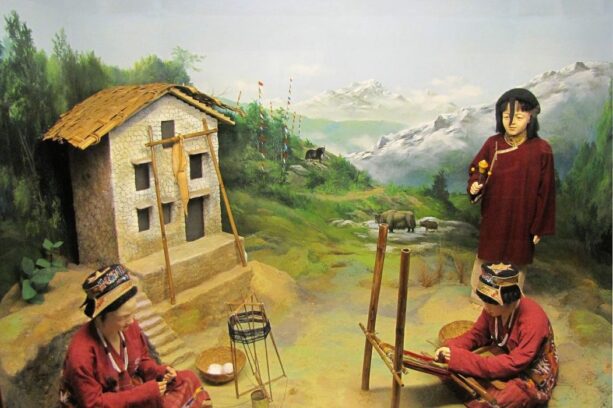
The Monpa were skilled artisans long before Buddhism formalized their intellectual life. They carved wood, wove carpets, made paper from the pulp of the local sukso tree, and crafted bamboo goods traded across the high passes. When Tibetan Buddhism arrived — first through Nyingma and Kagyu missionaries in the 11th century C.E., then through the Gelug school in the 17th century C.E. — it found a people with existing traditions of craft, ceremony, and seasonal festival.
The Tawang Monastery, founded in the 17th century C.E., became the spiritual and political center of Monpa life — but it built on foundations already centuries old. A printing press at Tawang produced religious texts on locally made paper using wooden blocks, a fusion of Monpa craft and Tibetan scholarship.
Principal festivals including Choskar, Losar, and Torgya blended agricultural rhythm with Buddhist observance. During Choskar, Buddhist lamas read scripture in the gompas, and villagers walked around cultivated fields carrying sutras on their backs — a practice that connected spiritual protection directly to the land and its harvest.
A people across borders
Today, around 50,000 to 60,000 Monpa live in Arunachal Pradesh in northeastern India, concentrated in Tawang and West Kameng districts. Another 9,000 or so live in Tibet, and approximately 2,500 live in Bhutan — the heartland of the original Monyul kingdom. They are also recognized as one of 56 official ethnic groups in China, where they are known as Menba.
The Monpa share close cultural affinity with the Sharchops of Bhutan and have historical connections to the Lepcha of Sikkim and the Drukpa of Bhutan — peoples who, over centuries, were known by different names but shared the broad cultural geography of Monyul. The Tawang district, where Monpa people make up about 97% of the population, remains one of the most culturally intact corners of the eastern Himalayas.
The Monpa language belongs to the Tibeto-Burman family but differs significantly from Eastern Tibetan. It is written in the Tibetan script — a practical adaptation made primarily for religious purposes in the 11th century C.E. The Monpa were never regarded as Tibetan, even as they incorporated Tibetan learning into their world.
Lasting impact
The Monyul kingdom matters beyond its borders and its era. It demonstrates that sophisticated, sustained governance was possible in extreme mountain environments long before modern infrastructure. The Monpa’s management of trade routes through the eastern Himalayas connected the Indian subcontinent to the Tibetan plateau for centuries — a corridor that moved goods, ideas, and religious texts across one of the planet’s most formidable natural barriers.
Their paper-making and printing traditions, fused with Tibetan Buddhist scholarship, created a local literary culture that preserved oral and religious knowledge in written form. The Tawang Monastery today holds one of the largest collections of Buddhist manuscripts in the region — a direct legacy of that early synthesis.
The Monpa example also challenges a common assumption: that nomadic or semi-nomadic peoples lack political organization. The Trukdri council, the trade monopolies, the festival calendar, the sustained resistance to absorption by larger powers — these are the marks of a community that governed itself deliberately and with skill.
Blindspots and limits
The historical record for Monyul is thin. The Wikipedia source on which this article draws explicitly flags the claim about the kingdom’s existence as needing better sourcing — peer-reviewed archaeological or historical studies specifically documenting the Lhomon/Monyul state are not easy to find in English-language scholarship. What we know comes largely through Tibetan Buddhist texts written by outsiders, which framed the Monpa partly through the lens of their amenability to conversion.
The 1914 McMahon Line divided Monpa territory between British India and Tibet without Monpa consent, a partition whose political consequences continue today in the disputed status of Arunachal Pradesh between India and China. That border has shaped — and constrained — Monpa life ever since.
Read more
For more on this story, see: Wikipedia — Monpa people: History
For more from Good News for Humankind, see:
- Indigenous land rights win protects 160 million hectares at COP30
- Ghana establishes a major marine protected area at Cape Three Points
- The Good News for Humankind archive on the early middle ages
About this article
- 🤖 This article is AI-generated, based on a framework created by Peter Schulte.
- 🌍 It aims to be inspirational but clear-eyed, accurate, and evidence-based, and grounded in care for the Earth, peace and belonging for all, and human evolution.
- 💬 Leave your notes and suggestions in the comments below — I will do my best to review and implement where appropriate.
- ✉️ One verified piece of good news, one insight from Antihero Project, every weekday morning. Subscribe free.