
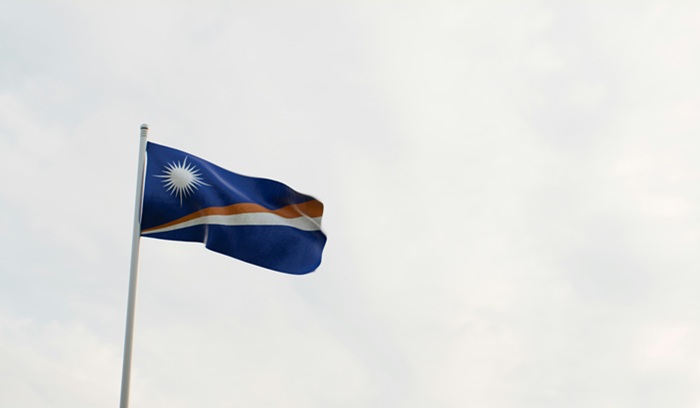
The Marshall Islands has become the first nation to embed a universal basic income directly into its national currency — a move that links the small Pacific island state’s digital money supply to guaranteed cash payments for every citizen. The system uses the country’s sovereign digital currency, known as the SOV, to automatically distribute a share of newly created currency to all residents as a baseline income floor.
At a glance
- Marshall Islands SOV: The SOV is the country’s legal tender digital currency, launched as the world’s first national cryptocurrency under the Declaration and Issuance of the Sovereign Currency Act.
- UBI mechanism: A fixed percentage of all newly minted SOV tokens flows automatically to every citizen, built into the currency’s code rather than administered through a separate government program.
- Global first: No other country has legally embedded a universal basic income into the monetary architecture of a national currency — making this a genuinely novel experiment in economic design.
Why a tiny island nation is leading the way
With a population of roughly 42,000 people spread across 29 low-lying atolls, the Marshall Islands faces a cluster of pressures that most countries can only imagine. Rising seas threaten its very territory, remittances dominate household income, and geographic isolation makes conventional financial infrastructure expensive and unreliable. For Marshallese citizens, distance from banking services isn’t a metaphor — it is a daily reality for people living on outer islands with no physical bank branch within reach.
That context makes the SOV more than a tech experiment. It is an attempt to solve real economic exclusion using the one thing a sovereign government controls: the money supply itself.
How the UBI-in-currency model works
Traditional universal basic income programs require governments to collect tax revenue, run a bureaucracy, and distribute payments through banking systems that often exclude the poorest recipients. The Marshall Islands model flips that logic. Because the UBI is embedded in the SOV’s issuance code, distribution happens at the monetary level — no separate welfare apparatus required.
When new SOV tokens enter circulation, a share goes directly to wallets held by verified citizens. The design draws on central bank digital currency research suggesting that programmable money can carry policy rules — including redistribution — inside the currency itself. Economists have called this approach “monetary UBI” to distinguish it from fiscal UBI programs funded through taxation.
The SOV operates on a blockchain that is designed to comply with international anti-money-laundering standards, a requirement the Marshallese government built in after early criticism from the International Monetary Fund, which had raised concerns about the currency’s potential use for financial crime.
What this means beyond the Marshall Islands
Small island developing states — including neighbors like Kiribati, Tuvalu, and the Federated States of Micronesia — are watching closely. All face similar combinations of geographic isolation, climate vulnerability, and thin tax bases. If the SOV model demonstrates that a UBI can be delivered through currency architecture rather than government spending, it could offer a template that doesn’t depend on large fiscal capacity.
Broader interest comes from UBI researchers and development economists who have long argued that cash transfers are among the most efficient forms of poverty reduction. Embedding the transfer into the money supply removes one of the biggest barriers: building a payment infrastructure that reaches everyone.
Challenges ahead
The SOV project has faced significant skepticism. The IMF urged the Marshall Islands to reconsider adopting a cryptocurrency as legal tender, citing macroeconomic risks and the potential loss of the country’s correspondent banking relationships with U.S. banks — a lifeline for an economy that uses the U.S. dollar alongside the SOV. Volatility in cryptocurrency markets also raises questions about whether a currency whose value can swing sharply is a reliable vehicle for a basic income. Adoption among citizens, many of whom have limited smartphone access, remains an open question that the government has not yet fully resolved.
Read more
For more on this story, see: Good News for Humankind
For more from Good News for Humankind, see:
- Ghana establishes marine protected area at Cape Three Points
- Alzheimer’s risk cut in half by drug in landmark prevention trial
- The Good News for Humankind archive on global health
About this article
- 🤖 This article is AI-generated, based on a framework created by Peter Schulte.
- 🌍 It aims to be inspirational but clear-eyed, accurate, and evidence-based, and grounded in care for the Earth, peace and belonging for all, and human evolution.
- 💬 Leave your notes and suggestions in the comments below — I will do my best to review and implement where appropriate.
- ✉️ One verified piece of good news, one insight from Antihero Project, every weekday morning. Subscribe free.
More Good News
-
Doctors hail first breakthrough in asthma and COPD treatment in 50 years
Benralizumab, a single injection given during an asthma or COPD attack, cut treatment failures fourfold over 90 days compared to the steroid pills doctors have relied on since the 1970s. In a trial of 158 patients arriving at UK emergency departments, the shot eased coughing, wheezing, and breathlessness more effectively than steroids — and could eventually be given at home or in a GP’s office. Because it targets the specific inflammation behind roughly half of asthma attacks, it could spare millions of people from the diabetes and bone-loss risks that come with repeated steroid use. After a 50-year wait for…
-
Mexico launches universal healthcare for all 133 million citizens
Mexico universal healthcare is now officially a reality, with the country launching a system designed to cover all 133 million citizens through the restructured IMSS-Bienestar network. Before this reform, an estimated 50 million Mexicans had no formal health insurance, with rural and Indigenous communities bearing the heaviest burden of untreated illness and medical debt. The new system severs the long-standing tie between employment and healthcare access, providing free consultations, medicines, and hospital services regardless of income. If implemented effectively, Mexico’s move could serve as a powerful model for other middle-income nations still navigating fragmented, inequitable health systems.
-

Ghana declares its first marine protected area to rescue depleted fish stocks
Ghana’s marine protected area — the country’s first ever — marks a historic turning point for a nation gripped by a quiet fisheries crisis. Established near Cape Three Points in the Western Region, the protected zone restricts or bans fishing activity to allow severely depleted fish populations to recover. Ghana’s coastal stocks have fallen by an estimated 80 percent from historic levels, threatening food security and the livelihoods of millions of small-scale fishers. The declaration also carries regional significance, potentially inspiring neighboring Gulf of Guinea nations to establish coordinated protections of their own.
