On Marajó Island, where the Amazon meets the Atlantic, one of the ancient Americas’ most sophisticated societies was quietly shaping the land — and leaving behind some of the most extraordinary ceramic art the Western Hemisphere has ever produced.
Key findings
- Marajoara culture: Archaeological studies place the peak florescence of this complex society between roughly 800 C.E. and 1400 C.E., though human activity on Marajó Island reaches back to at least 1000 B.C.E.
- Earthen mounds: Massive raised platforms called tesos served simultaneously as homes, cemeteries, flood defenses, and possibly military fortifications — built by communities that may have numbered up to 100,000 people.
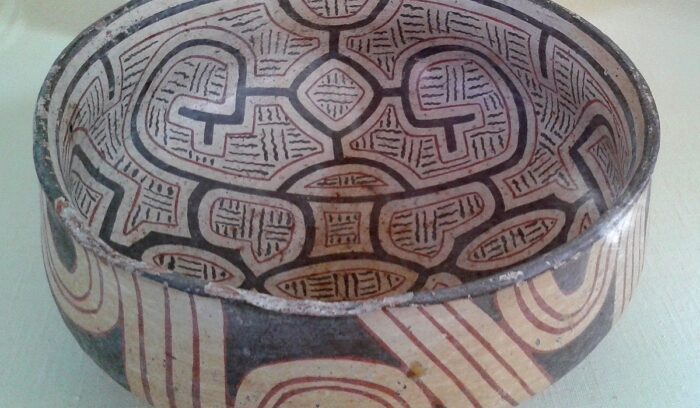
- Amazon ceramics: The Marajoara produced large, elaborately painted and incised pottery — including richly decorated funerary urns — that provided the first material evidence of a complex, stratified society in the Amazon basin.
A civilization built on water and earth
Marajó Island sits at the confluence of the world’s largest river system and the Atlantic Ocean — a vast, flood-prone landscape that would challenge any society trying to build permanence there. The Marajoara did not just survive it. They engineered around it.
Their earthen mounds rose above the seasonal floodwaters, creating stable platforms for multi-family longhouses called malocas. These were arranged in concentric oval patterns, each hearth inside representing one nuclear family. At the largest sites, like Os Camutins, up to 20 successive structures were built atop one another over generations — archaeological layers of continuous habitation stacked like the pages of a living book.
The mounds were not purely human-made from scratch. Geophysical research led by archaeologist Anna Curtenius Roosevelt found that the Marajoara often built upon natural elevated sedimentary surfaces, extending and adapting them rather than constructing entirely from bare ground. This reflects a sophisticated relationship with the landscape — working with the Amazon’s rhythms rather than against them.
What the Amazon fed and what it built
The Marajoara diet was as carefully adapted as their architecture. Evidence from human remains shows they relied heavily on seed crops, tree fruits like açaí and tucuma palm, and small fish — likely harvested using a technique still practiced today: stunning fish with a poisonous liana plant and collecting them as they float to the surface.
Marajó Island has no local source of igneous or metamorphic rock, yet stone artifacts — primarily from a green microcrystalline mafic rock — appear across excavation sites. That means the Marajoara were engaged in trade networks reaching far beyond the island, possibly as far as Mesoamerica. Stone axes introduced during the Marajoara phase represent the primary agricultural technology documented so far.
Underlying much of this agricultural productivity was terra preta — the dark, deliberately enriched soil developed by Amazonian peoples across the basin. By building organic matter, charcoal, and nutrients into otherwise poor tropical soils, Indigenous communities across Amazonia made large-scale cultivation possible in an environment that conventional wisdom once dismissed as incapable of supporting complex civilization.
The art that proved everything
Before the mounds were properly excavated, the ceramics were already speaking. Travelers in the 1800s noticed the beauty of the pottery exposed on mound surfaces and embedded in their sides. European and American museums began collecting the largest and most striking pieces — particularly the funerary urns, which held the processed remains of significant individuals. Flesh was cleared from the bones, which were then placed inside elaborately decorated vessels and sealed with a bowl or platter on top.
The sophistication of these wares — large, symmetrically painted, incised with representations of plants, animals, and geometric forms — was among the first hard evidence that a complex, stratified society had existed in the Amazon. At the time, many Western scholars assumed the Amazon could not have sustained such societies. The Marajoara ceramics helped begin dismantling that assumption.
Ceramic manufacture appears to have become a specialized industry during the height of the Marajoara phase. The increasing complexity of ceremonial wares alongside the uniformity of everyday pottery suggests a division of labor — a hallmark of social stratification. The Marajoara may have developed chiefdom-level governance, with meaningful differences in social rank and access to resources.
Lasting impact
The Marajoara legacy extends in several directions at once. Their ceramic tradition is among the most technically accomplished in pre-Columbian South America — and it was entirely independent of the better-known Andean and Mesoamerican traditions that often dominate discussions of ancient American complexity.
Their land-management practices — the mound construction, the use of terra preta, the fish management techniques — are now part of a much larger rethinking of the Amazon itself. For decades, the scientific consensus held that the Amazon rainforest was essentially a pristine wilderness, too ecologically fragile to have supported large populations. Research into cultures like the Marajoara has helped overturn that view. The Amazon, scholars now understand, was actively shaped by human hands across millennia.
That realization carries practical weight today. Studies of Amazonian dark earth — the terra preta developed by Indigenous peoples — continue to inform contemporary conversations about sustainable agriculture and carbon sequestration in tropical soils. The Marajoara were not just inhabitants of the Amazon. They were its co-authors.
Their persistence is also worth noting. The culture appears to have survived into the colonial era, even as European contact after 1500 C.E. brought catastrophic disruption to Indigenous peoples across the Americas. Some threads of Marajoara knowledge and practice likely continued in communities that endured.
Blindspots and limits
The full picture of Marajoara society remains incomplete. Many smaller mound sites and non-mound settlements have never been excavated, and extensive seasonal sedimentation has likely buried or destroyed significant evidence — including the canals, causeways, and drained agricultural fields that would more fully reveal the scale of their landscape engineering. The question of what ultimately caused the decline of the peak Marajoara phase, and how much continuity existed into the colonial period, remains genuinely open. Many carbonized plant remains from excavations have not yet been identified, leaving gaps in our understanding of the full agricultural system.
Read more
For more on this story, see: Wikipedia — Marajoara culture
For more from Good News for Humankind, see:
- Indigenous land rights get a boost ahead of COP30
- Ghana protects its waters at Cape Three Points
- The Good News for Humankind archive on Brazil
About this article
- 🤖 This article is AI-generated, based on a framework created by Peter Schulte.
- 🌍 It aims to be inspirational but clear-eyed, accurate, and evidence-based, and grounded in care for the Earth, peace and belonging for all, and human evolution.
- 💬 Leave your notes and suggestions in the comments below — I will do my best to review and implement where appropriate.
- ✉️ One verified piece of good news, one insight from Antihero Project, every weekday morning. Subscribe free.