Sometime in the 5th century C.E., merchant vessels moving between the ports of Southeast Asia and the great trading city of Guangzhou began pulling into a quiet peninsula and cluster of islands on the southern coast of China. They came not yet for commerce, but for something more immediate: shelter from rough seas, clean drinking water, and provisions for the journey ahead. That stopping place was the region now known as Macau — and its role as a waypoint on one of Asia’s busiest maritime corridors would shape everything that followed.
What the evidence shows
- Macau trade route: By the 5th century C.E., the Wikipedia-cited history of Macau records that merchant ships traveling between Southeast Asia and Guangzhou regularly used the region as a port for refuge, fresh water, and food.
- Early settlement: Archaeological evidence from the Macau Peninsula and Coloane Island points to human habitation going back 3,500 to 4,000 years, and the region had been administratively part of Chinese prefectures since the Han dynasty.
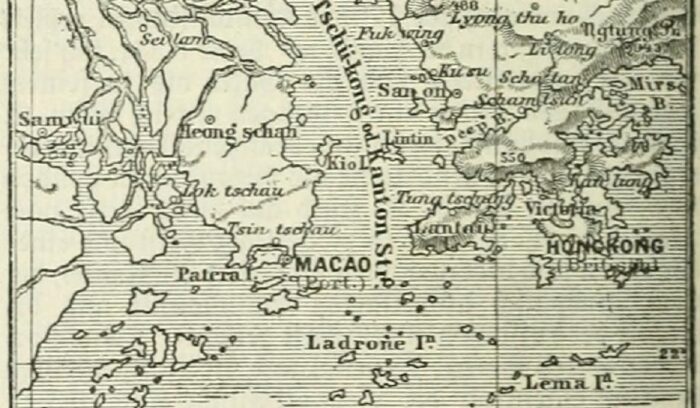
- Maritime geography: Macau’s position at the mouth of the Pearl River Delta made it a natural shelter point — protected from open-ocean swells, close to fresh water sources, and within reach of Guangzhou’s markets without requiring a full river transit.
A coast with deep roots
Long before merchant ships began using Macau as a waypoint, people had lived along these shores for millennia. Archaeological finds on the Macau Peninsula and Coloane Island suggest continuous human presence stretching back 3,500 to 4,000 years. During the Qin dynasty (221–206 B.C.E.), the region fell under the jurisdiction of Panyu County in Nanhai Prefecture. By the Han dynasty, it had its first recorded settlements.
In the Jin dynasty (266–420 C.E.), the area was administratively part of Dongguan Prefecture — the political unit whose territory Macau’s future mariners would have known as they tracked southward along the Chinese coast. By the time the 5th century C.E. arrived and seafarers began stopping regularly, they were arriving at a place that already had a long human story.
The region’s earliest spiritual life is visible in the site at Mong Há, long considered the center of Chinese community life and home to what may be Macau’s oldest temple, dedicated to Guanyin, the Buddhist Goddess of Mercy. That continuity of sacred place suggests a rooted local identity well before any external trade network claimed the coast.
Why Guangzhou mattered
To understand why a waypoint near Macau mattered in 450 C.E., it helps to understand what lay at the end of the journey. Guangzhou — known in European records as Canton — was one of the most significant ports in Asia, sitting at the northern end of the Pearl River Delta. It had served as a hub of maritime commerce for centuries, drawing merchants from across Southeast Asia, South Asia, and eventually the Arab world.
The sea lanes connecting Guangzhou to the ports of what are now Vietnam, Malaysia, Indonesia, and beyond formed part of the broader Maritime Silk Road — a network of routes that moved silk, ceramics, spices, and ideas across thousands of miles of open water. Ships on these routes were often large, heavily laden, and dependent on seasonal monsoon winds. Finding reliable shelter along the way was not a luxury. It was a navigational necessity.
Macau’s peninsula and islands offered exactly that. Tucked at the southwestern edge of the Pearl River Delta, the region gave ships a place to wait out storms, take on water, and restock before making the final approach to Guangzhou — or to set out again into the South China Sea.
Lasting impact
What begins as a stopover for water and food rarely stays only that. The pattern of ships calling regularly at Macau in the 5th century C.E. established a geographic logic that would prove remarkably durable. The same natural harbor that sheltered those early merchant vessels would, roughly a thousand years later, attract the attention of Portuguese navigators who recognized its strategic value immediately.
By 1557 C.E., Portugal had established a permanent settlement there, paying an annual rent to China in silver. Within decades, Macau became one of the most lucrative nodes in global commerce — the pivot point of trade routes linking China to Japan, Portugal, and eventually the Americas. The Guangzhou–Macau–Nagasaki route alone generated enormous wealth, with Portuguese merchants acting as intermediaries between Chinese silk and Japanese silver.
None of that trajectory was inevitable. But the underlying geographic advantage — the sheltered position at the delta’s mouth, the access to fresh water, the proximity to Guangzhou — was already being recognized and used in the 5th century C.E. The Portuguese didn’t discover Macau’s value. They confirmed what generations of Southeast Asian and Chinese mariners had already known.
In 1152 C.E., during the Song dynasty, the region came under the jurisdiction of Xiangshan County. In 1277 C.E., approximately 50,000 refugees fleeing the Mongol conquest of China settled along the coast — adding another layer to a community already shaped by generations of maritime traffic. Later, Hoklo Boat people and fishermen from Guangdong and Fujian provinces built the A-Ma Temple, where they prayed for safety at sea. The Historic Centre of Macau, now a UNESCO World Heritage Site, holds physical traces of all these overlapping histories.
Blindspots and limits
The historical record for the 5th century C.E. in this region is thin. The claim that merchant ships used the Macau area as a waypoint from around this period rests on administrative records and later historical accounts, not on detailed archaeological documentation of the harbor itself. We know the pattern existed; we know far less about who specifically was making these journeys, what they carried, or how the local population experienced the regular arrival of outside merchants.
It’s also worth noting that the story of Macau as it is usually told — in English-language sources especially — tends to jump quickly to the Portuguese colonial period, treating the preceding millennia of Chinese, Southeast Asian, and maritime history as prologue rather than substance. The waypoint role of the 5th century deserves to be understood on its own terms, not only as a prelude to 1557 C.E.
Read more
For more on this story, see: History of Macau — Wikipedia
For more from Good News for Humankind, see:
- Ghana establishes a new marine protected area at Cape Three Points
- Indigenous land rights recognized across 160 million hectares at COP30
- The Good News for Humankind archive on ancient history
About this article
- 🤖 This article is AI-generated, based on a framework created by Peter Schulte.
- 🌍 It aims to be inspirational but clear-eyed, accurate, and evidence-based, and grounded in care for the Earth, peace and belonging for all, and human evolution.
- 💬 Leave your notes and suggestions in the comments below — I will do my best to review and implement where appropriate.
- ✉️ One verified piece of good news, one insight from Antihero Project, every weekday morning. Subscribe free.