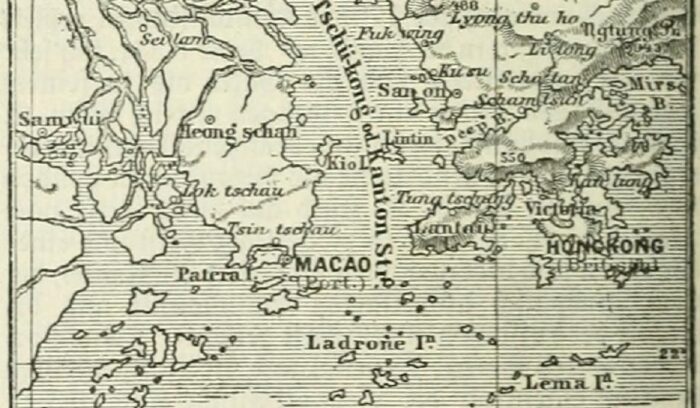
By 1580 C.E., a small peninsula jutting into the South China Sea had become one of the most consequential trading nodes on Earth. Macau’s golden age of trade was just beginning — and the city’s web of commerce would stretch from Chinese silk workshops to Japanese silver mines to the silver-laden galleons of Spanish Manila.
What the evidence shows
- Macau golden age: The period from 1580 to 1640 C.E. coincided exactly with the union of the Spanish and Portuguese crowns under King Philip II, giving Macau privileged access to both Portuguese and Spanish colonial networks simultaneously.
- Silk-silver trade: Portuguese merchants in Macau acted as middlemen on the Guangzhou–Macau–Nagasaki route, shipping Chinese silks to Japan and returning with Japanese silver — a markup so large it became the engine of the city’s prosperity.
- Trade route network: Macau operated across three distinct routes: Macau–Malacca–Goa–Lisbon, Guangzhou–Macau–Nagasaki, and Macau–Manila–Mexico, making it a rare hub where Asian, European, and American economies converged in real time.
How a small port became a global crossroads
Macau’s rise was not inevitable. Portuguese sailors had been probing the Chinese coast for decades before establishing a foothold, suffering serious defeats at the Battle of Tamão in 1521 C.E. and again at Shuangyu in 1548 C.E. The Ming dynasty was not welcoming.
What changed the equation was cooperation, not conquest. After Portuguese traders helped Cantonese authorities suppress coastal pirates, relations warmed enough for a Luso-Chinese agreement in 1554 C.E. By 1557 C.E., a permanent Portuguese settlement had been established at an annual rent of 500 taels of silver — about 20 kilograms — paid to Xiangshan County. China retained sovereignty. Chinese residents remained subject to Chinese law. The arrangement was a pragmatic partnership, not a takeover.
The city’s population in 1583 C.E. numbered around 26,000 people — but only about 900 were Portuguese. The rest were Chinese merchants and laborers, Tanka boat people who had long fished and traded along these waters, Macanese people of mixed heritage, enslaved Africans brought through Portuguese networks, and traders from across Southeast Asia. Macau was a multicultural entrepôt long before that word existed.
The monopoly that made Macau rich
One decision supercharged the city’s fortunes. In 1547 C.E., Chinese officials banned direct trade between China and Japan, citing piracy by Chinese and Japanese nationals. That ban handed Macau’s Portuguese traders a monopoly on one of the most profitable exchange routes in the world.
Japan had silver. China wanted it. China had silk. Japan wanted that. The Portuguese stepped into the gap, buying silk in Guangzhou, sailing to Nagasaki, exchanging it for silver, and returning to buy more silk. The margins were extraordinary. This single circuit funded the construction of churches, fortifications, and institutions that still define Macau’s physical landscape today.
The Macau–Manila–Mexico route added another dimension. Spanish Manila galleons carried New World silver across the Pacific to the Philippines, where it was exchanged for Chinese goods that flowed through Macau. American silver — mined largely by Indigenous and enslaved African labor in places like Potosí — thus entered the Chinese economy through this Macanese corridor, reshaping monetary systems across two hemispheres.
Macau as a city of diplomacy and promotion
King Philip II of Spain, who inherited the Portuguese crown in 1580 C.E. through the Iberian Union, understood Macau’s strategic value. He encouraged the status quo, allowing trade to continue between Portuguese Macau and Spanish Manila — two colonial systems now technically under one crown but operating with distinct identities and interests.
In 1587 C.E., Philip promoted Macau from “Settlement or Port of the Name of God” to “City of the Name of God” — Cidade do Nome de Deus de Macau. It was a formal recognition of what traders already knew: this was no mere outpost. Macau had become a city in every meaningful sense, with its own senate, its own Jesuit college, and its own place in the global order.
Chinese and Portuguese merchants worked alongside each other daily. The Tanka women who had long navigated these waters were among the first to intermarry with Portuguese settlers, and their descendants became the core of the Macanese community — a people who carried the memory of the port’s complex origins in their language, cuisine, and customs.
Lasting impact
Macau’s golden age of trade left marks that outlasted the trade routes themselves. The city’s role as a bridge between Chinese and European knowledge systems made it a conduit for scientific exchange during the late Ming period. Jesuit scholars based in Macau, including Matteo Ricci, used it as a launchpad for one of the most remarkable cross-cultural intellectual exchanges in history, carrying European astronomy and mathematics into China while sending Chinese cartography and philosophy westward.
The silk-silver circuit that ran through Macau helped monetize the Chinese economy at scale, accelerating the shift toward silver-based taxation under the Single Whip Reform. These were not local effects — they were changes in how one of the world’s largest economies functioned.
Macau also demonstrated, imperfectly but demonstrably, that a city could sustain a dual legal and cultural framework for generations. The arrangement — Chinese sovereignty, Portuguese administration, mixed population — prefigured the “one country, two systems” model under which Macau was handed back to China in 1999 C.E., 442 years after the Portuguese first settled there.
The historic centre of Macau was designated a UNESCO World Heritage Site in 2005 C.E., in recognition of its unique fusion of Chinese and Portuguese cultural heritage.
Blindspots and limits
The prosperity of Macau’s golden age rested on systems that extracted enormous human costs elsewhere — from the enslaved Africans trafficked through Portuguese networks to the Indigenous laborers whose silver from the Americas flowed through these same trade routes. The Tanka people, whose knowledge of local waters made early Portuguese settlement possible, were also subject to raids and enslavement by Portuguese settlers. The city’s cosmopolitan vitality and its darker dependencies were not separate stories — they were the same story, told from different vantage points.
Read more
For more on this story, see: History of Macau — Wikipedia
For more from Good News for Humankind, see:
- Ghana creates a new marine protected area at Cape Three Points
- Indigenous land rights: 160 million hectares recognized ahead of COP30
- The Good News for Humankind archive on China
About this article
- 🤖 This article is AI-generated, based on a framework created by Peter Schulte.
- 🌍 It aims to be inspirational but clear-eyed, accurate, and evidence-based, and grounded in care for the Earth, peace and belonging for all, and human evolution.
- 💬 Leave your notes and suggestions in the comments below — I will do my best to review and implement where appropriate.
- ✉️ One verified piece of good news, one insight from Antihero Project, every weekday morning. Subscribe free.