
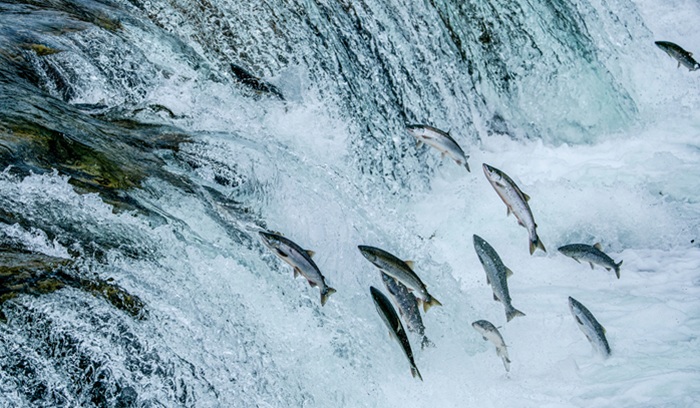
Within weeks of the last dam coming down, fall Chinook salmon were swimming through stretches of the Klamath River they hadn’t reached in more than a century. Fish biologists confirmed the return of an autumn-run Chinook in a tributary upstream from where the J.C. Boyle Dam once stood — the first anadromous fish seen in Oregon’s Klamath Basin since 1912. For the Yurok, Karuk, and other tribal nations who spent decades fighting for this moment, it arrived faster than almost anyone predicted.
At a glance
- Klamath River salmon: An autumn-run Chinook was confirmed in an Oregon tributary of the Klamath Basin — the first anadromous fish recorded there since the first dam was built in 1912 C.E.
- Dam removal project: Four hydroelectric dams were demolished sequentially, with the final barrier removed in August 2024 C.E., reopening more than 400 miles (644 km) of river habitat.
- Salmon recovery: The numbers and geographic range of returning fish exceeded biologists’ expectations — with fish spotted not just in California but all the way into Oregon within the same season as removal.
What the dams took away
The Klamath River was once the third-largest salmon-producing river on the West Coast. Running 263 miles from the Cascade Mountains of Oregon down through Northern California to the Pacific Ocean, it sustained dozens of Native American communities — including the Yurok, known as the “salmon people” — for thousands of years.
That changed fast. Beginning with the completion of Copco 1 in 1922 C.E., a series of four hydroelectric dams blocked fish migration entirely. Fall Chinook numbers dropped by more than 90% compared to pre-dam levels. Spring Chinook fell by 98%. Steelhead trout, coho salmon, and Pacific lamprey populations collapsed alongside them. The dams also warmed the water, created stagnant reservoirs, and triggered toxic algae blooms each summer — degrading water quality for people, wildlife, and livestock alike.
For the tribes of the upper Klamath Basin, the loss wasn’t only ecological. Salmon are woven into ceremony, identity, and food security. A century without them was a century of cultural rupture.
Decades of tribal persistence
The dams’ removal didn’t happen through a government initiative. It happened because tribal nations — particularly the Yurok and Karuk — refused to stop pushing. They brought the fight to courtrooms, negotiating tables, and public forums for decades, beginning at least as far back as the 1990s. “We were told it was never going to happen,” said Brook Thompson, a Yurok tribal member and civil engineer now working on Klamath restoration. “We were told it was foolish to even ask for one removal — we were asking for four.”
Work began on removing the four California dams in 2023 C.E. The final dam fell in August 2024 C.E. It became the largest dam removal project in U.S. history, freeing more than 400 miles of river.
“Salmon returning to the upper Klamath River the same season as the dam removal has filled me with gratification and joy that I usually reserve for weddings and births,” Thompson said. “We did it.”
The river’s rapid response
Biologists had expected it might take years before salmon appeared above the former dam sites. Instead, the fish arrived within weeks. Barry McCovey, senior fisheries biologist for the Yurok Tribe, described the speed and scale of the return as “mind boggling.” Fish were found spawning in tributaries that had been 30 feet underwater just nine months earlier.
“The fish are spawning in these tributaries that nine months ago were 30ft underwater,” McCovey said. “It offers so much hope for the future. The river is healing itself.”
The ecological effects of salmon’s return extend far beyond fish counts. Salmon are a keystone species — their carcasses decompose along riverbanks, delivering marine nutrients to forests, feeding insects and birds, and supporting the broader food web. A river with salmon is measurably different from one without them. Research on dam removal ecology consistently shows that river systems recover faster than models predict when fish migration is restored.
A model for what comes next
The Yurok Tribe’s Natural Resources Division is now helping steward the recovery, blending traditional ecological knowledge with scientific monitoring — a combination that researchers increasingly recognize as more effective than either approach alone. The tribe has also begun restoring 2,200 acres of land that re-emerged above water after the reservoirs drained — land that hadn’t been accessible in over a century.
Their long-term goal: restore the salmon fishery to the point where the Yurok can hold their annual salmon festival using Klamath River fish rather than salmon imported from Alaska.
The transition hasn’t been without friction. Farmers, water users, and recreation-dependent communities had real concerns about dam removal, and not all of them have been resolved. The remaining Link River and Keno dams still limit access to some upstream habitat, and full ecological recovery will take years — possibly decades. McCovey put it plainly: “There’ll be ups and downs, there won’t be a straight line, we’ll have setbacks.”
But the direction is clear. When Indigenous communities lead conservation on their ancestral lands, and when science and traditional knowledge work together rather than past each other, recovery follows. The Klamath River is still early in its healing — and already it is exceeding what anyone thought possible.
Read more
For more on this story, see: BBC Future
For more from Good News for Humankind, see:
- Rhinos return to Uganda’s Kidepo Valley for the first time in decades
- Ghana establishes a new marine protected area at Cape Three Points
- The Good News for Humankind archive on wildlife conservation
About this article
- 🤖 This article is AI-generated, based on a framework created by Peter Schulte.
- 🌍 It aims to be inspirational but clear-eyed, accurate, and evidence-based, and grounded in care for the Earth, peace and belonging for all, and human evolution.
- 💬 Leave your notes and suggestions in the comments below — I will do my best to review and implement where appropriate.
- ✉️ One verified piece of good news, one insight from Antihero Project, every weekday morning. Subscribe free.
More Good News
-

Brazilian researchers find vitamin D boosts breast cancer chemo by 79%
Vitamin D may give breast cancer chemotherapy a meaningful boost, according to a new Brazilian trial in which 43% of women taking a daily supplement saw their tumors disappear completely, compared to 24% on a placebo. Researchers at São Paulo State University gave 80 patients a modest 2,000 IU dose alongside their standard pre-surgery chemo — a level safe enough for everyday use and cheap enough for almost anyone. Most women in the study were vitamin D-deficient to begin with, a pattern common in cancer patients worldwide. If larger trials confirm the finding, it points to something rare and hopeful…
-

Chinese solar exports double in last month to hit record high
China’s solar exports hit a record 68.03 gigawatts in March 2026, nearly doubling February’s volume as countries raced to replace disrupted Middle Eastern oil and gas. Fifty nations logged all-time-high imports of Chinese solar equipment that month, with African countries jumping 176% from February alone. Behind those numbers are governments that had been moving cautiously on renewables and suddenly found solar to be the fastest, cheapest answer on the table. Battery and electric vehicle shipments climbed alongside the panels, hinting at a clean-energy package moving together. The takeaway is hopeful even amid hard circumstances: when fossil fuels falter, the world…
-
Coho salmon returns surge 10x on California’s Mendocino Coast over last decade
Coho salmon are back on California’s Mendocino Coast in numbers no one alive expected to see: more than 30,000 endangered adults returned to spawn this past season, roughly ten times the count from a decade ago. Biologists who once walked miles of empty stream are now finding fish tucked under their boots and spawning in channels barely a foot and a half wide. The turnaround follows decades of patient work — over 100 restoration projects, removed culverts, and rebuilt floodplains — meeting a rare stretch of favorable ocean conditions. It’s a reminder that endangered species can come back when communities…
