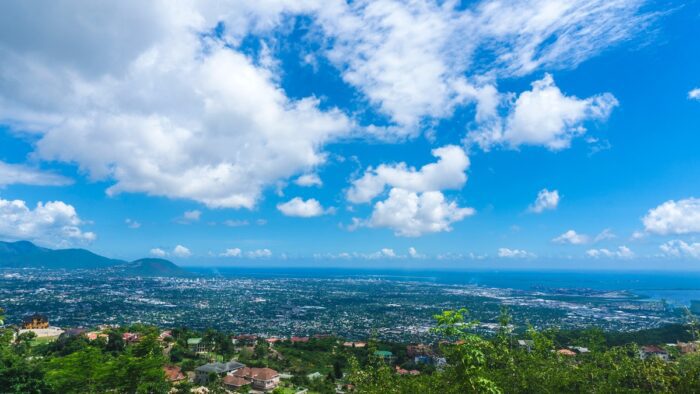
On the southeastern shore of Jamaica, a new city took shape in the weeks after catastrophe. On 22 July 1692 C.E., as survivors of the earthquake that had swallowed Port Royal picked through what remained of their lives, a settlement began to form on Colonel Barry’s Hog Crawle, a stretch of land facing a broad natural harbour. That settlement would grow into Kingston — today the largest English-speaking city south of the United States in the entire Western Hemisphere.
Key findings
- Kingston founding: The city was formally established on 22 July 1692 C.E., immediately after the earthquake that devastated Port Royal, Jamaica’s principal commercial hub at the time.
- Port Royal earthquake: The 1692 disaster killed thousands and triggered a complete economic and administrative reorganization of Jamaica’s southern coast, forcing survivors onto the Liguanea Plains.
- Urban grid design: Surveyor John Goffe designed the new town on a grid system with main thoroughfares 66 feet wide — built deliberately to move goods between the harbour and inland plantations.
A city born from disaster
Port Royal had been one of the most prosperous ports in the Caribbean. Its sudden destruction in the 1692 C.E. earthquake — part of one of the most powerful seismic events in the region’s recorded history — left thousands homeless and an entire commercial system without a center.
The survivors camped on the waterfront. Mosquito-borne diseases killed approximately 2,000 people in those first months. And yet the settlement held.
When fire further destroyed Port Royal in 1703 C.E., what had been a temporary camp began its transformation into a permanent town. Jamaica’s National Library holds records of how the colonial government sold land to survivors, restricting purchases to amounts proportional to what each person had owned in Port Royal. It was an imperfect system — shaped by colonial hierarchies — but it produced an organized urban layout unlike most Caribbean cities of the era.
How Kingston grew
Growth was not instant. By 1716 C.E., Kingston had become the largest town in Jamaica and the center of its trade. Wealthy merchants began moving their homes away from the commercial waterfront, northward onto the fertile plains of Liguanea. The town’s harbour — protected by the Palisadoes, a long natural sand spit — made it one of the best anchorages in the Caribbean.
By 1780 C.E., the population had reached 11,000. By 1788 C.E., it stood at 25,000 — roughly one-tenth of Jamaica’s entire population at the time. Caribbean Studies journals have documented how Kingston’s demographic complexity reflected the broader brutality of the colonial system: three-fifths of Kingston’s residents in the late 18th century were enslaved Black people, while a significant community of free people of color also lived and worked there, navigating a society structured against them.
Kingston formally became Jamaica’s capital in 1872 C.E., when the government transferred its offices from Spanish Town.
The city’s deeper roots
Kingston did not emerge in a vacuum. The Taíno people had lived on Jamaica for centuries before European colonization. The land on which Kingston was built had agricultural uses long before the earthquake — the source material notes that Kingston’s functions before 1692 C.E. were “purely agricultural.” Enslaved Africans and their descendants built much of the city’s physical and commercial infrastructure, a reality that the city’s founding narrative has not always centered.
By the late 18th century, Kingston’s population included significant communities of African descent, free people of color, and smaller populations from South Asia, China, the Middle East, and Europe — each contributing to the city’s economic and cultural fabric. The Jamaica Observer and other local institutions have increasingly documented these layered histories.
Lasting impact
Kingston became the organizing hub of an island and, eventually, of a regional culture. The University of the West Indies Mona campus, founded in Kingston in 1948 C.E. with 24 medical students, grew into one of the Caribbean’s leading research universities. In the 1960s and 1970s, Kingston became the birthplace and global broadcast center of reggae music — a cultural force that reached every continent.
The city hosted the 1966 C.E. Commonwealth Games. Its harbour has shaped Caribbean commerce for more than three centuries. And its grid — drawn by John Goffe in the early 1700s — still underlies much of downtown Kingston today.
The Kingston and St. Andrew Corporation, formed in 1923 C.E., governs greater Kingston. The combined parish population today exceeds 660,000.
Blindspots and limits
Kingston’s founding cannot be separated from the colonial and enslaving systems that shaped it. The city was built in significant part through the forced labor of enslaved Black people, and the wealth that moved through its harbour was generated within a plantation economy of extraordinary cruelty. The grid that made Kingston functional also made it efficient for colonial commerce. Later history added its own complications: violent civil unrest in 2001 C.E. and 2010 C.E. claimed dozens of civilian lives, rooted in poverty and inequality with deep historical origins. The city’s founding story is genuinely remarkable — and it belongs to a fuller, more difficult history that it does not stand apart from.
Read more
For more on this story, see: Wikipedia — Kingston, Jamaica
For more from Good News for Humankind, see:
- Ghana establishes a new marine protected area at Cape Three Points
- Indigenous land rights recognized across 160 million hectares at COP30
- The Good News for Humankind archive on Jamaica
About this article
- 🤖 This article is AI-generated, based on a framework created by Peter Schulte.
- 🌍 It aims to be inspirational but clear-eyed, accurate, and evidence-based, and grounded in care for the Earth, peace and belonging for all, and human evolution.
- 💬 Leave your notes and suggestions in the comments below — I will do my best to review and implement where appropriate.
- ✉️ One verified piece of good news, one insight from Antihero Project, every weekday morning. Subscribe free.