
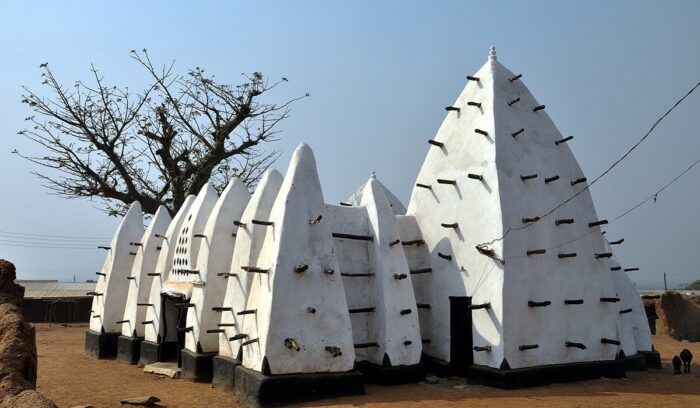
Somewhere in the savanna grasslands of what is now northern Ghana, a political transformation was taking shape. A leader known as Naa Gbewaa — whose ancestors had traveled from the Lake Chad region following the breakup of the Ghana Empire — began unifying decentralized communities into what would become one of the most enduring kingdoms in West African history: the Kingdom of Dagbon.
What the evidence shows
- Kingdom of Dagbon: Founded by Naa Gbewaa, likely between the 12th and 14th centuries C.E., Dagbon unified previously decentralized communities under centralized political authority across roughly 20,000 square kilometers of northern Ghana.
- Dagbani language: The Dagomba people speak Dagbanli, today the most widely spoken language of northern Ghana, belonging to the Gur language family — a vast network of related tongues across West Africa.
- Oral tradition: Dagbon history has been preserved across generations by professional drummer-griots called Lunsi, whose meticulous oral record traces the kingdom’s political origins to a legendary figure called Tohazie, meaning “red hunter.”
A kingdom built on connection
The founding of Dagbon did not happen in isolation. Naa Gbewaa’s descendants went on to establish not just Dagbon but also the Mamprusi and Nanumba peoples, creating a network of related kingdoms across the northern Volta basin. Together, the Mossi-Dagomba states eventually shaped the political landscape of a region that today encompasses all of northern Ghana and much of Burkina Faso.
The Dagomba are traditionally regarded as “senior” among these related kingdoms. And the connections ran deep: Yennenga, a daughter of Naa Gbewaa, is honored as the founding mother of the Mossi kingdoms — a people who today make up nearly half the population of Burkina Faso. One woman’s story threads through the founding narratives of two nations.
Before Gbewaa’s centralization, the land was governed by Tindaamba — local leaders chosen not by royal appointment but by oracle. Remarkably, the Tindaamba still exist today, preserving ancient Dagbon traditions through the centuries. They were never absorbed or erased; they were integrated.
Women, drums, and governance
The Kingdom of Dagbon established governance structures that stood apart from many of its contemporaries. The Dagomba are among the few peoples in Africa to reserve royal titles for women — a tradition that has persisted for centuries. Female chiefs such as the Gundo Naa hold vast regal lands and rule over male subjects. The Zosimli Naa coordinates relationships between cities across Dagbon.
This was not ceremonial inclusion. Dagomba women have shaped political life at the highest levels. The kingdom’s culture eventually produced Ghana’s first female government minister and, by some accounts, Africa’s first female cabinet minister.
Family structure in Dagbon reflects this balance. Close bonds are called Mabihili — a term with no direct English equivalent — and both men and women within such bonds call each other Mabia, meaning “mother’s child.” The mother’s role is foundational. Children fear disappointing her. Brothers protect sisters’ dignity absolutely.
Meanwhile, the Lunsi drummers preserved it all. In a society where written records were not the primary archive, these professional griots carried centuries of political history, genealogy, and cultural memory in rhythm and voice. Dagbon’s history did not disappear — it traveled, generation to generation, through sound.
Islam, scholarship, and a university lost to colonization
Between the 12th and 15th centuries C.E., Soninke traders — known in Ghana as Wangara — brought Islam to the Dagomba. The religion took hold gradually, eventually becoming the state religion during the reign of King Zanjina in the late 1600s C.E. Zanjina’s embrace of Islam opened an era of scholarship: learning centers spread across Dagbon, and in 1700 C.E., the University of Moliyili was established — a hierarchical institution with structures resembling modern universities.
The Dagomba also developed the Dagbani script, a writing system using a modified Arabic alphabet with Dagbani syntax. Archival manuscripts existed. Many were lost during European colonization; others were transferred to Denmark.
The University of Moliyili was later abandoned under colonial pressure — a significant loss for the region’s intellectual tradition.
Lasting impact
The Kingdom of Dagbon’s influence extends far beyond its borders. The Mossi kingdoms of Burkina Faso trace their origin to Dagbon. The Bouna state in modern Ivory Coast and the Dagaaba states of Ghana’s Upper West Region also count Dagomba founders among their origins. Today, more than 3.1 million Dagomba people live across Ghana and Togo.
Dagbon’s festivals — among the oldest in Ghana — are still celebrated. The Bugum (Fire Festival) predates even the kingdom’s formal founding. The Damba Festival, the Guinea Fowl Festival, and Eid celebrations continue to mark the rhythms of Dagomba life.
The Encyclopaedia Britannica’s entry on the Dagomba and A.A. Iliasu’s foundational 1971 paper on the origins of the Mossi-Dagomba states both recognize these kingdoms as among the great medieval empires of West Africa — centralized, durable, and deeply integrated into the broader regional world.
Tamale, the capital of Ghana’s Northern Region, sits at the heart of Dagbon today. It is Ghana’s third most populous city, a living continuation of the kingdom’s reach.
Blindspots and limits
The precise founding date of Dagbon remains uncertain. Oral tradition, Wikipedia’s sourced claims, and scholarly literature point to a range spanning the 12th through 14th centuries C.E. — the ~1100 C.E. date commonly cited is likely earlier than most evidence supports, and the kingdom’s formation was a gradual process, not a single event. Colonial-era destruction of manuscripts and the transfer of archival records to Denmark means significant portions of early Dagomba written history remain inaccessible to Dagomba communities themselves. The Wikipedia source used here relies on several uncited claims and should be read alongside peer-reviewed scholarship such as Iliasu (1971) and sources held by the British Museum and Danish archives for a fuller picture.
Read more
For more on this story, see: Wikipedia — Dagomba people
For more from Good News for Humankind, see:
- Ghana creates a new marine protected area at Cape Three Points
- Indigenous land rights: 160 million hectares recognized ahead of COP30
- The Good News for Humankind archive on Ghana
About this article
- 🤖 This article is AI-generated, based on a framework created by Peter Schulte.
- 🌍 It aims to be inspirational but clear-eyed, accurate, and evidence-based, and grounded in care for the Earth, peace and belonging for all, and human evolution.
- 💬 Leave your notes and suggestions in the comments below — I will do my best to review and implement where appropriate.
- ✉️ One verified piece of good news, one insight from Antihero Project, every weekday morning. Subscribe free.