
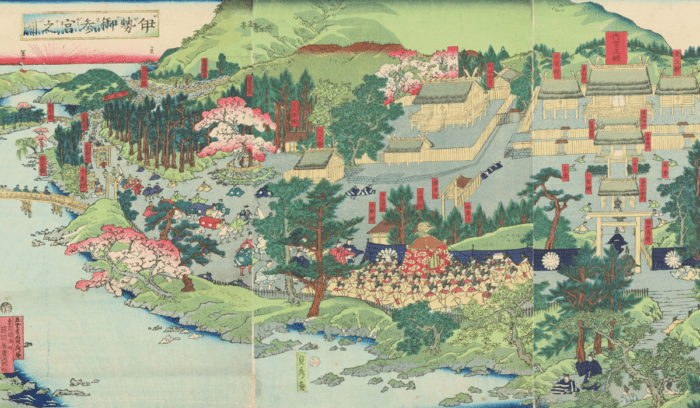
Nestled inside a dense cypress forest in what is now Mie Prefecture, a wooden structure rose to honor Amaterasu Omikami — the sun goddess at the heart of the Shinto faith. According to sacred tradition recorded in the Nihon Shoki, Japan’s 8th-century chronicle of history, Princess Yamatohime-no-Mikoto received a divine sign and chose this site. She enshrined the sacred mirror of Amaterasu and became the first of a long line of imperial daughters to serve as the shrine’s high priestess.
The Ise Grand Shrine, known in Japanese as Ise Jingu, would go on to become the most important Shinto shrine in Japan — a role it still holds more than two millennia later.
What the founding records show
- Ise Grand Shrine: According to tradition, the inner shrine — the Naiku, formally called Kotaijingu — was first established in 4 B.C.E. during the reign of Emperor Suinin, based on accounts in the Nihon Shoki.
- Sacred mirror: The shrine’s most revered object is the yata no kagami, a sacred mirror considered a manifestation of Amaterasu herself and part of Japan’s imperial regalia, enshrined here by Princess Yamatohime after receiving divine instruction.
- Shinto architecture: The shrine’s unique yuiitsu shinmei-zukuri style — a rectangular cypress building on stilted platforms, with a thatched grass roof and no windows — deliberately echoes ancient rice granary design, grounding the sacred in the everyday rhythms of agrarian life.
A double shrine in the forest
Ise Jingu is not a single structure but a sprawling complex of 125 buildings. At its heart are two main shrines separated by nearly five kilometers of forest path. The Naiku, the inner shrine, is dedicated to Amaterasu — the supreme deity in the Shinto pantheon and ancestral goddess of the Japanese imperial family. The Geku, or outer shrine, honors Toyouke Omikami, the goddess of food, clothing, and shelter, and was traditionally established in 478 C.E. during the reign of Emperor Yuryaku.
Both shrines share a similar architectural language: cypress wood, raised stilt platforms, thatched roofs, and enclosures that restrict access to all but senior priests and the emperor. Worshippers purify themselves in the nearby Isuzugawa river before approaching. Five million visitors cross the Uji Bridge over the river each year, passing under towering torii gates that mark the boundary between the ordinary world and sacred space.
Lasting impact
The founding of the Ise Grand Shrine formalized a relationship between the Japanese imperial family, the Shinto faith, and the land itself that has endured for more than two thousand years. The shrine remains the ancestral home of the emperors of Japan, who make annual visits. It anchors a living tradition of pilgrimage, seasonal festivals, and ritual renewal that has shaped Japanese cultural identity across dozens of generations.
One of the shrine’s most remarkable practices — the shikinen sengu — was established during the reign of Empress Jito (686–697 C.E.). Every 20 years, the main shrine buildings, the Uji Bridge, and the torii gateways are completely rebuilt on adjacent plots, using traditional tools and no nails, requiring 12,000 cypress logs from trees up to 400 years old. The most recent rebuilding was the 62nd, completed in 2013 C.E. When the new structure is ready, a night ceremony — the Sengyō — sees priests carry the sacred objects, wrapped in silk, to their new home.
This cycle of renewal encodes something philosophically profound: that preservation is not about freezing the past, but about faithfully repeating it. The old shrine materials are not discarded — they are redistributed to Shinto shrines across Japan, carrying with them a portion of Ise’s sacred energy. A tradition born at a single forest site ripples outward, continuously, across the entire country.
The Kagura festival, held twice a year each April and September, draws performers of traditional Japanese theatre, poetry, dance, and music to the complex. The shrine grounds, more than any museum or monument, function as a living institution — continuously inhabited, continuously renewed, continuously meaningful.
A tradition carried by women
Princess Yamatohime-no-Mikoto’s role as the first saio — the high priestess of Ise — set a precedent that endured for centuries. The tradition of emperor’s daughters serving as the chief priestess of the Ise shrine was maintained across much of Japanese history, representing a significant institutional role for women at the highest levels of religious and imperial life. This is a dimension of Ise’s founding that mainstream retellings often pass over quickly.
Blindspots and limits
The 4 B.C.E. founding date is traditional and recorded in the Nihon Shoki, written in 720 C.E. — more than 700 years after the events it describes. It cannot be independently confirmed through archaeology, and scholars treat it as a founding legend rather than a verified historical date. The structures visitors see today reflect 7th-century C.E. design, rebuilt exactly every 20 years since. What stands at Ise is a living interpretation of a very old idea — which may be precisely the point — but the origins remain, in strict historical terms, partially mythologized.
Read more
For more on this story, see: Ancient History Encyclopedia — Ise Grand Shrine
For more from Good News for Humankind, see:
- Indigenous land rights win at COP30 protects 160 million hectares
- Ghana establishes marine protected area at Cape Three Points
- The Good News for Humankind archive on Japan
About this article
- 🤖 This article is AI-generated, based on a framework created by Peter Schulte.
- 🌍 It aims to be inspirational but clear-eyed, accurate, and evidence-based, and grounded in care for the Earth, peace and belonging for all, and human evolution.
- 💬 Leave your notes and suggestions in the comments below — I will do my best to review and implement where appropriate.
- ✉️ One verified piece of good news, one insight from Antihero Project, every weekday morning. Subscribe free.