
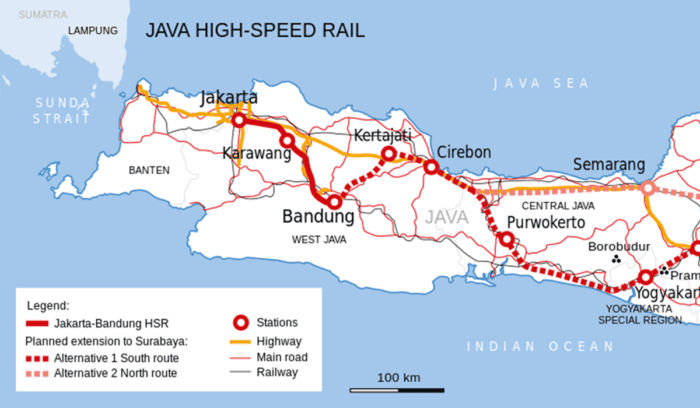
On October 2nd, 2023 C.E., Indonesia launched commercial service on the Southern Hemisphere’s first high-speed rail line, connecting Jakarta and Bandung in just 46 minutes — down from a journey of roughly three hours by conventional train. President Joko Widodo presided over the ceremonial opening, capping months of technical testing and limited trial runs in September.
At a glance
- High-speed rail: The Jakarta–Bandung line spans 142 km (88 miles) on international standard gauge track, with trains tested at up to 385 km/h (239 mph) and operating commercially at around 350 km/h (217 mph).
- Journey time: The scheduled 46-minute trip could eventually fall to 36 minutes, according to operator KCIC, with introductory fares starting at roughly US$10.
- Indonesian–Chinese joint venture: The line is owned 60% by PT Pilar Sinergi BUMN Indonesia and 40% by Beijing Yawan HSR Co. Ltd, using rolling stock from China’s proven CR400AF fleet.
Why this matters for Southeast Asia
Java is one of the most densely populated islands on Earth, and the corridor between Jakarta — with 11.25 million residents — and Bandung — with 2.67 million — is among Indonesia’s busiest travel routes. Cutting that trip from three hours to under an hour changes the calculus for millions of commuters, business travelers, and families.
High-speed rail also reshapes the competition with domestic aviation. Research on mature networks consistently shows that rail journeys of up to four hours displace most flights on the same route, because door-to-door travel time, reliability, and comfort favor the train. All high-speed rail runs on electricity, making it the least carbon-intensive form of long-distance transport per passenger kilometer — an advantage that grows as power grids get cleaner.
The bigger picture: a line still growing
Jakarta–Bandung is only phase one. Plans call for extending the corridor east through Bandung all the way to Surabaya, Indonesia’s second-largest city, roughly 800 km from Jakarta. If that extension opens as projected, the current eight-plus-hour conventional rail journey between Indonesia’s two largest cities could shrink to two or three hours.
The technology behind the line is well established. China operated more than 42,000 km of high-speed rail by the end of 2022 C.E. — over two-thirds of the global total — and the CR400AF variant used on this line has accumulated extensive service hours across that network. Indonesian rail staff are currently being trained alongside Chinese technicians, with a handover of full operational responsibility planned over the next few years.
A milestone with room to grow
The opening is genuinely historic: no country in Latin America, Africa, Oceania, or the rest of Southeast Asia had put a high-speed line into commercial service before this one. For Indonesia, a nation of more than 270 million people spread across thousands of islands, the line signals an ambition to build world-class surface transport infrastructure on the most populous of those islands.
That said, the project has not been without complications. Construction costs and timelines ran over initial projections, and the extension to Surabaya — which would unlock the line’s full transformative potential — has no firm opening date. Early promotional fares are also expected to roughly double once the introductory period ends, which will test how price-sensitive the ridership is in the long run.
Still, 46 minutes where three hours once stood is hard to argue with.
Read more
For more on this story, see: CleanTechnica — First high-speed train arrives in Southern Hemisphere
For more from Good News for Humankind, see:
- Canada declares high-speed internet a basic service for all citizens
- The second-largest U.S. electric company by market value plans to exit all coal by 2035
- The Good News for Humankind archive on Indonesia
- The electric vehicle revolution: the milestones driving the shift to clean transportation
About this article
- 🤖 This article is AI-generated, based on a framework created by Peter Schulte.
- 🌍 It aims to be inspirational but clear-eyed, accurate, and evidence-based, and grounded in care for the Earth, peace and belonging for all, and human evolution.
- 💬 Leave your notes and suggestions in the comments below — I will do my best to review and implement where appropriate.
- ✉️ One verified piece of good news, one insight from Antihero Project, every weekday morning. Subscribe free.


