
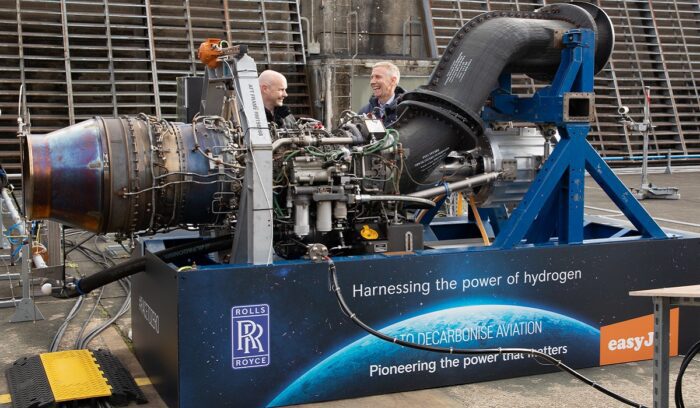
A converted jet engine roared to life on a test stand in the U.K., burning not conventional aviation fuel but hydrogen — and producing water vapor instead of carbon dioxide. The ground test, carried out by Rolls-Royce and European budget airline easyJet, marked what Rolls-Royce called “the world’s first run of a modern aero engine on hydrogen,” a milestone the two companies hope points toward a cleaner future for commercial flight.
At a glance
- Hydrogen jet engine: Rolls-Royce and easyJet used a converted AE 2100-A regional aircraft engine for the ground test, conducted at a facility in the U.K.
- Green hydrogen fuel: The European Marine Energy Centre produced the hydrogen at a facility on Eday in Scotland’s Orkney Islands, powered entirely by wind and tidal energy.
- Aviation decarbonization: Both companies have made formal commitments to cut greenhouse gas emissions, and see hydrogen as a potential path to meeting those climate goals.
Why aviation is so hard to clean up
Of all the industries facing pressure to cut carbon, aviation is among the most stubborn. Batteries that power electric cars are far too heavy and bulky to lift a passenger jet on a long flight. That physical reality has pushed airlines and engine makers toward alternative fuels — and hydrogen sits near the top of the list.
When hydrogen burns, it produces water vapor rather than carbon dioxide. If the hydrogen itself is made using renewable energy — as the fuel for this test was — the entire chain from production to combustion can be close to emissions-free. That version, called green hydrogen, is what Rolls-Royce and easyJet used: wind and tidal power from the Orkney Islands drove the production process at the European Marine Energy Centre’s facility on Eday.
What the test actually showed
The engine at the center of the test was a Rolls-Royce AE 2100-A, a regional aircraft engine that was adapted to run on hydrogen rather than conventional jet fuel. The test was a ground run — the engine was not airborne — but it demonstrated that a modern aero engine can combust hydrogen and operate as intended.
That proof of concept matters. Aviation engineers have long understood hydrogen’s theoretical promise, but real-world engine behavior under hydrogen combustion is different from computer modeling. A successful ground test gives engineers data they could not get any other way.
Rolls-Royce and easyJet have said they plan additional ground tests before pursuing what they describe as a “longer-term ambition” of full flight tests. The runway to a hydrogen-powered commercial flight is still a long one.
The hurdles still ahead
Green hydrogen faces two immediate problems: it is scarce, and it is expensive. Most hydrogen produced today still relies on natural gas, which releases carbon dioxide in the process. That makes the fuel’s climate credentials entirely dependent on the energy source behind its production. Governments including the Biden administration at the time invested heavily in scaling up green hydrogen output, but supply remains far short of what commercial aviation would need.
Aircraft design presents another challenge. Hydrogen has far lower energy density by volume than jet fuel, meaning planes need much larger tanks to carry equivalent amounts. According to the International Air Transport Association, new aircraft designs would need to be certified from scratch to accommodate hydrogen storage — a process that takes years and significant capital.
A 2020 European Union report estimated that hydrogen-powered passenger planes serving routes up to about 1,860 miles could be commercially available by 2035 C.E. That timeline benefits easyJet specifically: the airline operates almost entirely short-haul routes across Europe, where hydrogen’s range limitations are less of a constraint.
Rolls-Royce, which supplies engines to more than 400 airlines, counts Boeing and Airbus among its customers — and both manufacturers are also researching hydrogen propulsion independently. That breadth of industry interest suggests the Orkney Islands test is one node in a much wider network of parallel effort.
A first step, not a final answer
The Rolls-Royce and easyJet test does not mean hydrogen planes are arriving soon. It means a foundational question — can a modern jet engine run on hydrogen at all — now has a confirmed answer. Everything that follows, from fuel supply chains to aircraft certification to airport infrastructure, remains unbuilt.
Still, the significance of an early proof of concept should not be dismissed. Rolls-Royce’s own press release framed the test as a stepping stone in a multi-phase program, with the companies committed to continuing toward an eventual flight demonstration. In an industry where the physics are genuinely difficult and the timelines measured in decades, a first ground test is where every breakthrough has to begin.
Read more
For more on this story, see: The Verge
For more from Good News for Humankind, see:
- Bangladesh to begin producing lithium batteries and electric vehicles to cut emissions
- Airbus flies first helicopter with both engines burning 100% green fuel for the first time ever
- The Good News for Humankind archive on clean energy
- The electric vehicle revolution: the milestones driving the shift to clean transportation
About this article
- 🤖 This article is AI-generated, based on a framework created by Peter Schulte.
- 🌍 It aims to be inspirational but clear-eyed, accurate, and evidence-based, and grounded in care for the Earth, peace and belonging for all, and human evolution.
- 💬 Leave your notes and suggestions in the comments below — I will do my best to review and implement where appropriate.
- ✉️ One verified piece of good news, one insight from Antihero Project, every weekday morning. Subscribe free.


