In 1550 C.E., the Swedish king Gustav I issued a royal charter establishing a new town on the southern coast of Finland, at the mouth of the Vantaa River. The settlement — named Helsinge fors, meaning “Helsinge rapids” — was a modest trading post by any measure. No one at the time could have guessed that this small, cold-water outpost would one day become one of the world’s most liveable cities.
Key facts
- Helsinki founding: King Gustav I of Sweden ordered the town established in the village area of Forsby, now known as Koskela, choosing the site for its position on the Baltic Sea trade routes to Reval (present-day Tallinn).
- Vantaa River rapids: The town’s Swedish name — Helsinge fors — referred directly to the Vanhankaupunginkoski rapids at the river’s mouth, a geographical feature that shaped the site’s identity for centuries.
- Baltic trade rivalry: Gustav I’s motivation was commercial: he wanted a Finnish rival to the prosperous Hanseatic city of Reval, and hoped to redirect Baltic Sea trade through Swedish-controlled territory.
A strategic gamble on the Baltic
By the mid-16th century C.E., the Baltic Sea was one of the most commercially active bodies of water in the world. Cities like Reval and Riga dominated trade between northern Europe and the Russian interior. Sweden, under the ambitious and consolidating rule of Gustav I — the same king who had broken with the Catholic Church and established the Lutheran Swedish state — wanted a piece of that prosperity.
Helsinki was Gustav’s answer. He forced burghers from several existing Finnish towns, including Porvoo, Rauma, Tammisaari, and Ulvila, to relocate to the new settlement. The idea was to concentrate merchant activity and challenge Reval’s dominance. It didn’t work, at least not immediately. The site was poorly positioned relative to the main shipping lanes, the harbor was shallow, and the population remained small for generations.
For roughly its first two centuries of existence, Helsinki was, frankly, an underperformer — a town that existed more by royal decree than by organic vitality.
Who was already there
The land where Helsinki was founded was far from empty. Archaeological evidence shows human presence in the region dating back to roughly 5000 B.C.E., when the first settlers arrived after the retreat of the last great ice sheet. By the Iron Age — the beginning of the first millennium C.E. — Tavastian peoples had established communities in the area, using the rivers and forests for fishing and hunting.
Pollen analysis has confirmed agricultural settlements in the region as far back as the 10th century C.E. Swedish-speaking coastal communities had been present since at least the late 13th century C.E., following Swedish expansion into Finland. When Gustav I “founded” Helsinki, he was in many ways reorganizing and renaming a landscape that had been shaped by multiple peoples across thousands of years.
The Tavastian and Finnish-speaking communities who had long inhabited the region had little say in the decision to relocate merchants to their shores. This is part of the fuller story.
Lasting impact
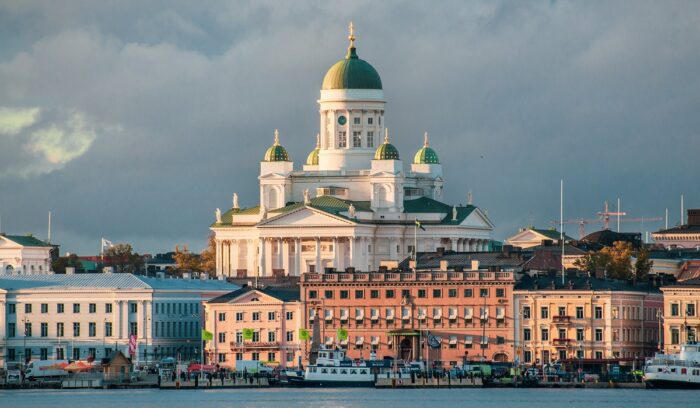
The real transformation came much later. In 1809 C.E., Finland passed from Swedish to Russian rule, becoming an autonomous Grand Duchy under the Russian Empire. Tsar Alexander I chose Helsinki — then still a modest coastal town — as the new capital, replacing Turku. A massive urban planning project followed, led by German-born architect Carl Ludwig Engel, who redesigned the city center in a neoclassical style modeled partly on Saint Petersburg.
That decision, combined with Helsinki’s deepwater harbor and growing rail connections, turned the modest 16th-century trading post into a proper capital city. By the time Finland declared independence in 1917 C.E., Helsinki had become the country’s undisputed political, economic, and cultural center.
Today, the city of roughly 694,000 people — and a metropolitan area of 1.6 million — regularly ranks among the world’s most liveable urban environments. It has hosted the 1952 Summer Olympics, the first CSCE/OSCE Summit in 1975 C.E., and the first World Athletics Championships in 1983 C.E. UNESCO recognized it as a Creative Cities Design City in 2014 C.E. In 2017 C.E., it was rated the world’s busiest passenger port by sea traffic volume.
The city is bilingual, with Finnish and Swedish as official languages — a living echo of its Swedish colonial origins. About 73% of residents speak Finnish as their first language, 5% Swedish, and 21% other languages, reflecting a city that has become genuinely cosmopolitan.
Blindspots and limits
The founding of Helsinki was an act of royal will imposed on existing communities — both the Finnish-speaking inhabitants who had long lived in the region and the merchants from other towns who were forced to relocate. The early town struggled for generations, and the “founding” of 1550 C.E. only makes sense as a milestone in retrospect, when later decisions — Russian imperial investment, 19th-century urban planning, and Finnish independence — gave it genuine weight.
The historical record also centers Swedish and later Russian actors almost entirely, largely because they left the documents. The Indigenous Tavastian and Finnish-speaking peoples who shaped this landscape for millennia before Gustav I’s charter appear mainly in pollen records and archaeological fragments — their voices absent from the official founding story.
Read more
For more on this story, see: Wikipedia — Helsinki: Early history
For more from Good News for Humankind, see:
- Renewables now make up at least 49% of global power capacity
- Ghana protects key marine habitat at Cape Three Points
- The Good News for Humankind archive on the early modern era
About this article
- 🤖 This article is AI-generated, based on a framework created by Peter Schulte.
- 🌍 It aims to be inspirational but clear-eyed, accurate, and evidence-based, and grounded in care for the Earth, peace and belonging for all, and human evolution.
- 💬 Leave your notes and suggestions in the comments below — I will do my best to review and implement where appropriate.
- ✉️ One verified piece of good news, one insight from Antihero Project, every weekday morning. Subscribe free.