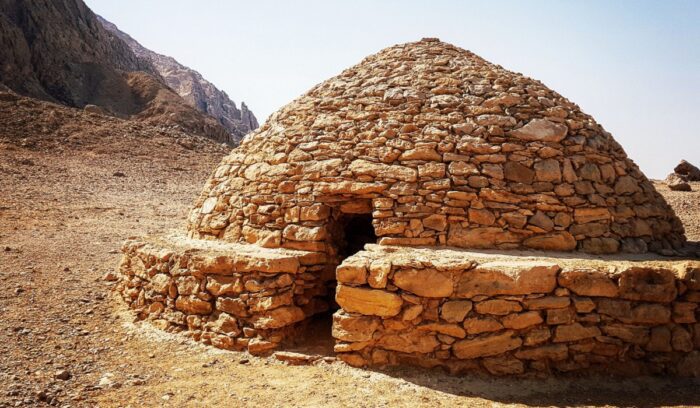
Around 3200 C.E.… wait — let me reframe. Around 3200 B.C.E., in the rocky terrain at the foot of the Hajar Mountains, people began burying their dead in a distinctive way: beehive-shaped stone tombs, built by hand, clustered on hilltops across what is now Oman and the United Arab Emirates. These graves would one day give their name to an entire era of human civilization in southeastern Arabia — the Hafit period.
Key findings
- Hafit period tombs: More than 317 circular stone tombs have been identified at Jebel Hafit alone, a rocky mountain near Al Ain, giving the period its name and providing the clearest archaeological window into early Bronze Age life in the region.
- Bronze Age settlement: The Hafit period, spanning roughly 3200 to 2600 B.C.E., marks the repopulation of land west of the Hajar Mountains after a prolonged dry spell known as the Dark Millennium had forced earlier inhabitants to abandon the area entirely.
- Falaj irrigation systems: Excavations reveal evidence of wells and partially underground falaj irrigation channels — a water management technology that helped sustain agriculture in this arid landscape for five millennia, continuing in the Al Ain Oasis to the present day.
A people returning to the land
The Hafit period did not emerge in a vacuum. It followed the Dark Millennium, a stretch of intense aridity that had made life in the region untenable. When conditions shifted and people returned, they brought with them the knowledge and skills to not just survive but build — stone tombs, settlements, and water systems that still echo in the landscape today.
The beehive tombs themselves are striking. Constructed from local stone without mortar, they sit on ridgelines and hilltops across the UAE and Oman, in sites including Bidaa bint Saud, Jebel Buhais, and Buraimi. Their elevated placement suggests these communities understood something important: that the dead deserved a view, or perhaps a presence that could be seen from a distance.
What the tombs tell us about daily life is limited, but the broader archaeological record fills in some gaps. Mud brick constructions served defensive, domestic, and economic purposes. The Al Ain Oasis shows evidence of sophisticated water management enabling early agriculture. These were not nomads passing through — they were settlers, planners, builders.
Mesopotamia was closer than you’d think
Among the most remarkable finds from Hafit period sites is pottery that shows clear trading links to Mesopotamia — specifically, styles associated with the Jemdat Nasr period (3100–2900 B.C.E.). Southeastern Arabia in 3200 B.C.E. was not an isolated backwater. It was part of a wider network of exchange connecting communities across thousands of miles of desert, sea, and river valley.
This matters. The story of early civilization is too often told as a story of a handful of great centers — Mesopotamia, Egypt, the Indus Valley — with everyone else as a footnote. The Hafit people complicate that picture in the best possible way. They were participants in long-distance trade, contributors to and beneficiaries of a connected ancient world.
Locally manufactured pottery began to emerge during the transitional period between the Hafit and the subsequent Umm Al Nar cultures, roughly 2800 to 2700 B.C.E. — suggesting that as these communities matured, they moved from importing styles to developing their own. Cultural confidence expressed in clay.
How the period was discovered
The tombs were first identified by Danish archaeologist P.V. Glob of the University of Aarhus in 1959, during a visit to Al Ain accompanied by Geoffrey Bibby and, notably, Zayed bin Sultan Al Nahyan — the man who would later become the founding president of the UAE. Glob and Bibby recognized the significance of what they were seeing: a vast field of ancient burial mounds unlike anything previously recorded in the region.
But the insight that the Hafit graves represented a culturally distinct and earlier period came not from Glob himself, but from a member of his team, archaeologist Karen Frifelt. Working on a tribute volume for Glob’s 60th birthday in 1970, Frifelt made the analytical leap that defined the field. It is worth naming her clearly: a woman scholar’s careful reading of the evidence gave the Hafit period its identity.
Today, the Jebel Hafeet Desert Park preserves the original necropolis and surrounding landscape, and the site is recognized as part of the broader Al Ain heritage zone, a UNESCO World Heritage Site since 2011 C.E.
Lasting impact
The Hafit period is the foundation layer of recorded human civilization in the UAE and Oman. Everything that followed — the Umm Al Nar period, the Wadi Suq culture, the long continuity of falaj irrigation, the trading relationships that would eventually stretch from Arabia to South Asia — grew from this beginning.
The falaj systems developed during and after the Hafit period are especially significant. These partially underground channels, designed to move water from mountain aquifers to agricultural land, represent one of the earliest known examples of large-scale water engineering in the Arabian Peninsula. They are still in use. The Al Ain Oasis, irrigated by falaj systems for five thousand years, remains a living agricultural site today — one of the most direct links anywhere on Earth between ancient engineering and modern daily life.
The Hafit period also helps reframe our understanding of the ancient world’s geography of innovation. Civilization was not a single fire that spread outward from one or two centers. It was kindled in many places at once, by many peoples adapting to their specific landscapes. Southeastern Arabia’s Bronze Age communities were among those kindlers.
Blindspots and limits
The archaeological record from the Hafit period is largely funerary — we know more about how these people buried their dead than how they actually lived. Settlement sites are rarer and less well-preserved than the tombs, leaving significant gaps in our understanding of daily life, social organization, and the full range of cultural practices from this era. The precise nature of the Hafit people’s relationship to contemporaneous societies in Mesopotamia and the Indus Valley also remains an open area of scholarly inquiry, with much still to be excavated and interpreted.
Read more
For more on this story, see: Wikipedia — Hafit period
For more from Good News for Humankind, see:
- Indigenous land rights and the long arc of recognition
- Ghana protects its coastal waters at Cape Three Points
- The Good News for Humankind archive on prehistory
About this article
- 🤖 This article is AI-generated, based on a framework created by Peter Schulte.
- 🌍 It aims to be inspirational but clear-eyed, accurate, and evidence-based, and grounded in care for the Earth, peace and belonging for all, and human evolution.
- 💬 Leave your notes and suggestions in the comments below — I will do my best to review and implement where appropriate.
- ✉️ One verified piece of good news, one insight from Antihero Project, every weekday morning. Subscribe free.